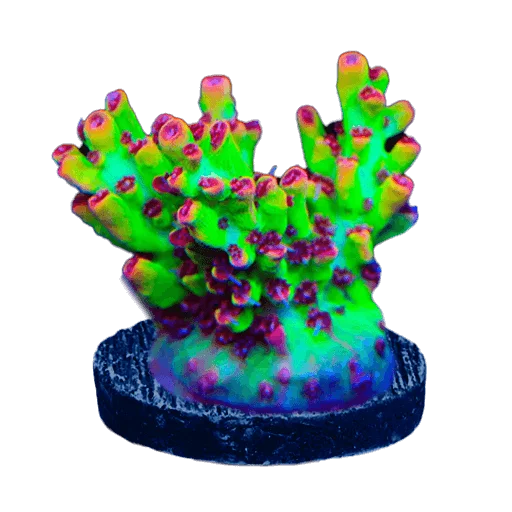
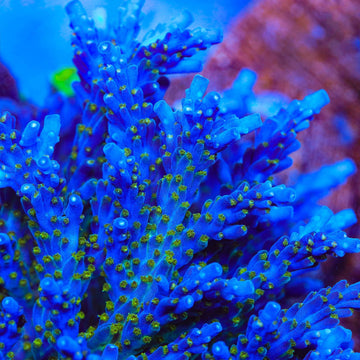
TSA Explosive Ember Acropora Coral
Overview
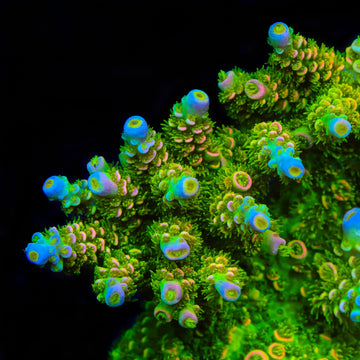
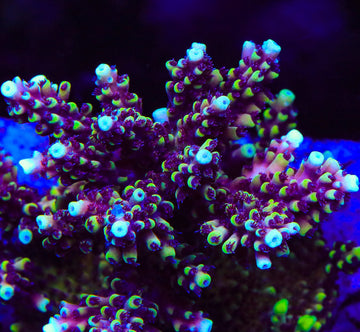
Explosive Ember Acropora Coral shows bright orange to red branch tips with compact, bushy branches. Acropora tenuis is a small-polyp stony branching coral that thrives under strong light and high, turbulent water flow. It is photosynthetic via symbiotic algae, but occasional small-particle foods can support growth and may improve coloration. Place high on stable rockwork with room for outward growth, and keep distance from aggressive stinging corals.
Quick Facts
Care
Difficult
Lighting
High
Flow
High, turbulent
Placement
High
Temperament
Peaceful (2–3 inches spacing)
Recommended Parameters
Temp
76–80°F
pH
8.1–8.4
Salinity
1.025–1.026
Calcium
420–450 ppm
AlkAlkalinity
8–9 dKH
Magnesium
1280–1350 ppm
Feeding
photosynthetic (primary), microplankton, phytoplankton, zooplankton, rotifers, copepod nauplii, coral foods powder, amino acids
Care & Placement
FAQ
Frequently Asked Questions
About the TSA Explosive Ember Acropora Coral
-
Why does my Explosive Ember Acropora (Acropora tenuis) lose its ember hues under strong lighting?
Color washout often comes from high PAR with imbalanced nutrients. Keep PAR ~300–400 but maintain nitrate 2–10 ppm and phosphate 0.02–0.08 ppm to avoid pastel bleaching. Emphasize violet/royal-blue (400–470 nm) and dial back cool whites/green. Stable alkalinity (7.5–8.5 dKH) and adequate potassium (380–420 ppm) support blues; slight iron/iodine availability helps greens/reds. Acclimate lighting slowly. -
My tenuis shows great growth but poor daytime polyp extension—what’s the hidden culprit?
In A. tenuis, muted daytime PE often signals pests or chemical stress rather than just flow. Inspect for AEFW bite marks near axial tips and check for red bugs; perform a turkey baster blast to reveal flatworms. Run fresh carbon if soft corals are nearby. Add more cross-flow for random turbulence, not a direct jet, and confirm stable temp and alkalinity. -
How can I prevent “burnt tips” on this coral when pushing growth?
Burnt tips arise from high alkalinity combined with intense light and ultra-low nutrients. Keep dKH steady (target 8 ±0.3), avoid sudden dosing spikes, and ensure measurable nitrate/phosphate. If tips pale or necrose, slightly lower PAR or raise nutrients instead of cutting light drastically. Amino dosing can help, but reduce if film algae or cyano increases. -
What mounting strategy gives Explosive Ember its fullest, bushy form?
Mount frags horizontally or at a slight angle on a wide plug/rock ledge to encourage fast encrustment before vertical branching. Tenuis thickens its base first; once a strong plate forms, branches multiply. Provide side lighting to reduce self-shadowing and use alternating gyres for chaotic flow that reaches between branches. Avoid direct, laminar blasts at axial tips.