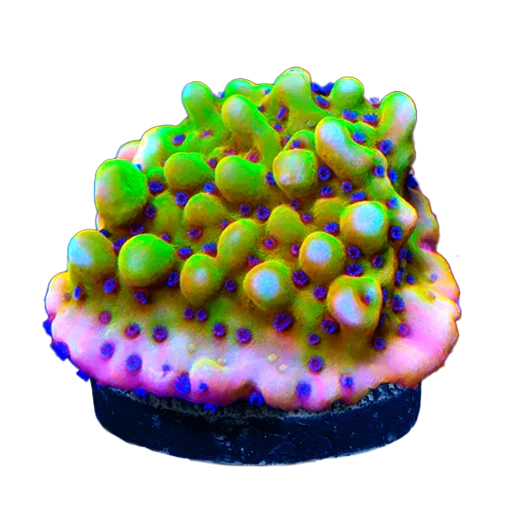
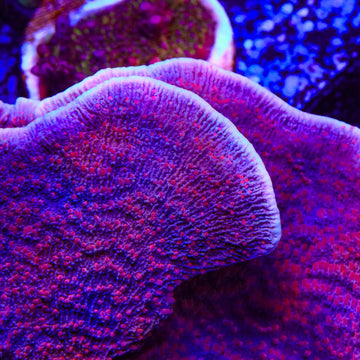
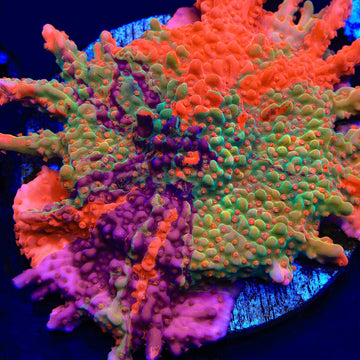
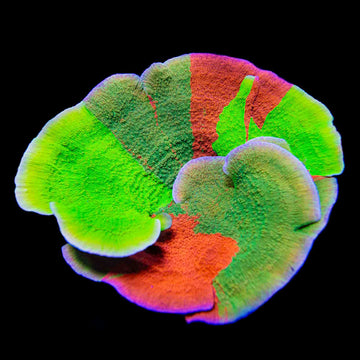
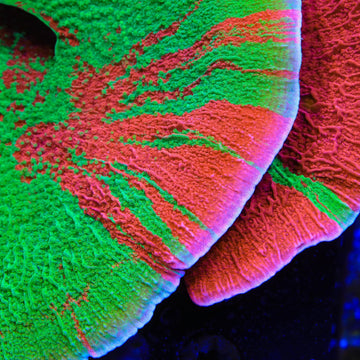
TSA Emerald City Montipora Coral
Overview
Emerald City Montipora Coral shows bright green encrusting plates with fine, textured polyps. Montipora sp. is a small polyp stony coral that forms plating or encrusting growth; it prefers moderate to strong lighting and moderate to strong, indirect water flow. It is primarily photosynthetic via symbiotic algae, but occasional small particle foods can support growth and maintain color. Place on stable rock with space for spreading, and keep away from aggressive neighbors to prevent tissue damage.
Quick Facts
Care
Moderate
Lighting
Moderate–High
Flow
Moderate–High
Placement
Mid–High
Temperament
Peaceful (2–3 inches spacing)
Recommended Parameters
Temp
76–80°F
pH
8.1–8.4
Salinity
1.025–1.026
Calcium
420–450 ppm
AlkAlkalinity
7.5–9 dKH
Magnesium
1280–1350 ppm
Feeding
photosynthetic, microplankton, phytoplankton, zooplankton, rotifers, copepod nauplii, powdered coral foods (e.g., Reef-Roids), amino acid supplements
Care & Placement
FAQ
Frequently Asked Questions
About the TSA Emerald City Montipora Coral
-
Why is my Emerald City Montipora (Montipora sp.) fading from vivid emerald to pale or brown?
This coral often pales when nutrients and trace elements run too low or lighting is ramped too fast. Aim for stable nitrate 5–15 ppm and phosphate 0.03–0.1 ppm; avoid aggressive GFO. Keep alkalinity steady (8–9 dKH). Target 200–300 PAR with a slow acclimation. Greens respond well to balanced iron/iodine via quality salt or trace dosing. If washed out under heavy UV, reduce UV channels and add more broad-spectrum white. -
Why does my colony switch between plating, encrusting, or nodular growth?
Montipora sp. adjusts growth to flow, light, and mounting angle. Strong laminar flow plus high PAR pushes plating; lower flow or oblique light encourages encrusting with nodules. Mount frags horizontally on flat plugs to promote plates, vertically for shelves with ruffles. Provide cross-flow under the colony to prevent detritus buildup and self-shading. Trim the leading edge periodically so the underside doesn’t starve and algae can’t colonize shaded skeleton. -
How can I confirm and control Montipora-eating nudibranchs on this coral?
Look for scalloped bite marks on new growth, white patches, and tiny white nudibranchs active at night; egg spirals appear along edges. Remove affected pieces, dip in an effective coral dip (repeat every 4–7 days to break the life cycle), and manually siphon adults/eggs. Quarantine new frags. A vigilant wrasse (e.g., Halichoeres melanurus) may help, but manual removal and repeated dips are the backbone of control. -
My Montipora is receding from the base despite good parameters—what’s the hidden cause?
Base STN often follows chronic shading, detritus accumulation, or micro-alk swings that don’t show on weekly tests. Increase alternating flow beneath the colony, turkey-baste weekly, and verify diurnal alkalinity stability with closer testing. Check for pest nips at night. If recession line advances, cut a healthy margin ahead of the die-off and remount. Review trace dosing and carbon use; excessive carbon can increase light stress in high PAR.