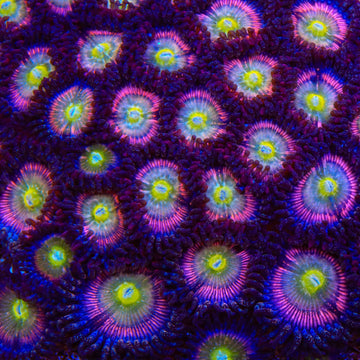
Gatorade Zoanthids Coral
Overview
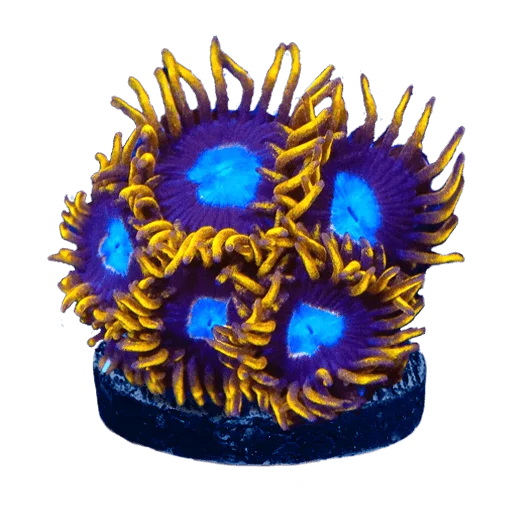
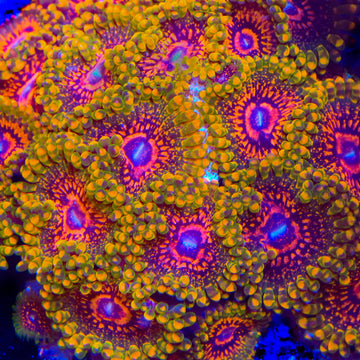
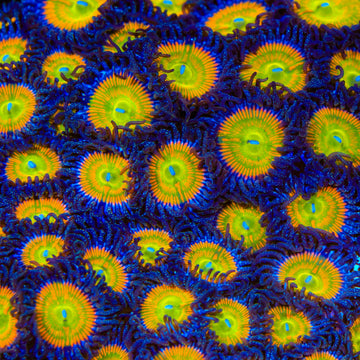
Gatorade Zoanthids Coral shows bright green centers with contrasting skirts. Zoanthus sp. Coral is a soft, mat-forming colonial polyp that does well under moderate light and moderate, indirect flow. Primarily photosynthetic via symbiotic algae, it also accepts small meaty or planktonic foods, which can improve growth and color. Place on isolated rock to control spread, and handle with gloves due to potential toxins.
Quick Facts
Care
Easy
Lighting
Low–Moderate
Flow
Moderate, indirect
Placement
Low–Mid
Temperament
Peaceful to semi-aggressive (may overgrow; provide moderate spacing)
Recommended Parameters
Temp
76–80°F
pH
8.1–8.4
Salinity
1.025–1.026
Calcium
400–450 ppm
AlkAlkalinity
8–10 dKH
Magnesium
1250–1350 ppm
Feeding
photosynthetic (primary), phytoplankton, microplankton, rotifers, cyclops, marine snow, powdered coral foods (e.g., Reef-Roids), amino acid supplements
Care & Placement
FAQ
Frequently Asked Questions
About the Gatorade Zoanthids Coral
-
Why do my Gatorade Zoanthids lose their neon ring or shift toward dull green under certain lights?
This morph’s fluorescence depends on blue/violet spectrum and moderate PAR. Under very high white-heavy light, pigments wash out; under too little light, polyps stretch and mute. Aim for 80–150 PAR with strong blue channels (420–470 nm). Maintain stable nutrients (NO3 5–15 ppm, PO4 0.03–0.1 ppm). A brief acclimation ramp after changes helps retain the signature ring. -
My colony is growing a thick mat but won’t extend polyps fully—what’s causing this “helmet” look?
Excess flow or low phosphate often cause tight, short stalks. If PO4 trends near zero, supplement feeding (fine zooplankton, reef roids) and reduce mechanical filtration intensity. Shift flow to a varied, indirect pattern. Check for irritants: detritus trapped at the base, micro-spiders, or sundial snails. A gentle turkey baster blast daily can clear debris and improve extension. -
What pests or infections target this morph, and how do I distinguish them from normal closing?
Persistent nighttime closing with bite marks suggests zoa-eating nudibranchs; look for matching-colored egg spirals. Perfectly circular missing centers hint at sundial snails. Pale speckling and pitting can be zoa pox; treat with Furan-2 baths. If colonies close after light changes only, that’s acclimation—reopen within 24–48 hours. Use red flashlight at night to spot predators. -
How can I propagate Gatorade Zoanthids safely without color loss or colony “melt”?
Cut between polyps, not through them, and include a bit of mat. Dip frags in iodine-based coral dip, then secure on rough plugs for quick encrustment. Provide moderate light/flow and slightly “dirty” water (non-zero NO3/PO4) for two weeks. Avoid handling mucus near eyes/skin; wear protection. Sudden ultra-clean water or large alkalinity swings post-frag often trigger receding.