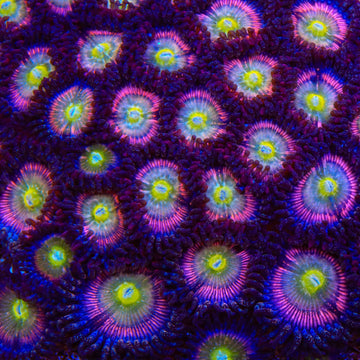
Fruit Loops Zoanthids Coral
Overview
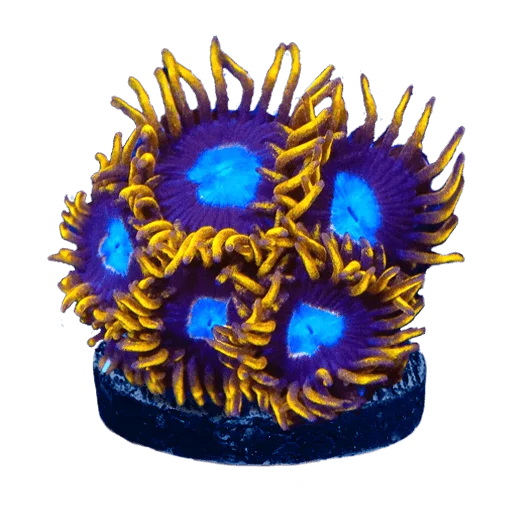
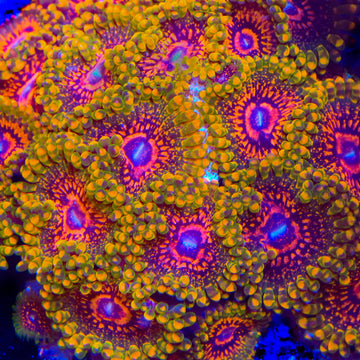
Fruit Loops Zoanthids Coral displays small button polyps with bright orange centers and contrasting ringed skirts. Zoanthus sp., a soft colonial polyp coral, thrives under moderate light and low to moderate water flow. It is photosynthetic via symbiotic algae but will accept occasional fine particulate or meaty foods, which can support growth and bring out color. Place on a separate rock to manage rapid spreading and give space from neighbors; handle with care and avoid contact with eyes or cuts.
Quick Facts
Care
Easy
Lighting
Low–Moderate
Flow
Moderate
Placement
Low–Mid
Temperament
Semi-aggressive (may overgrow nearby corals)
Recommended Parameters
Temp
77–80°F
pH
8.1–8.4
Salinity
1.025–1.026
Calcium
380–450 ppm
AlkAlkalinity
8–10 dKH
Magnesium
1280–1350 ppm
Feeding
photosynthetic (primary), microplankton, phytoplankton, rotifers, fine zooplankton, powdered coral foods (e.g., reef roids), marine snow
Care & Placement
FAQ
Frequently Asked Questions
About the Fruit Loops Zoanthids Coral
-
My Fruit Loops closed up after I moved them—how can I tell if it’s light shock, flow, or pests?
Start by reducing PAR to ~80–120 and bias spectrum toward 420–460 nm; too much white can wash colors and cause prolonged closing. Provide indirect, moderate flow so skirts flutter but polyps aren’t blasted. Inspect at night for zoa-eating nudibranchs, sundial snails, or spiders; use a quality dip if found. Stabilize alk, salinity, and temp—zoanthus resent rapid swings more than low nutrients. -
How do I keep the vivid ring colors on Fruit Loops from dulling or turning brown?
Maintain balanced nutrients: nitrate 5–15 ppm, phosphate 0.03–0.10 ppm. Underfed, ultra-low nutrients fade colors; excessive nutrients brown them. Keep PAR 80–150 with strong blue/UV. Avoid large white spikes at photo start; ramp whites slowly. Feed occasional fine zooplankton or amino blends 1–2x weekly. Trace stability (iodide, iron) via regular water changes often helps more than dosing. -
How do I handle sudden “melting” or zoa pox in Fruit Loops?
First rule out pests and parameter swings. Increase flow slightly and reduce light intensity for a week. For pox (tan pustules), Furan‑2 dips per label are effective; alternate with iodine dips for general bacterial issues. Remove detritus, improve mechanical filtration, and perform small, frequent water changes. If recession continues, frag healthy heads away from affected tissue to save the line. -
Do Fruit Loops tolerate mixed gardens with leathers, palythoas, and LPS?
They can, but plan for chemical and physical aggression. Run fresh carbon and perform regular water changes when mixing with leathers. Give distance from palythoas, which can overgrow or shade Zoanthus mats. Keep at least 3–4 inches from LPS with long sweepers (e.g., euphyllia). Avoid fish known to nip zoas (certain angels, butterflies) and keep emerald crabs well-fed to reduce picking.