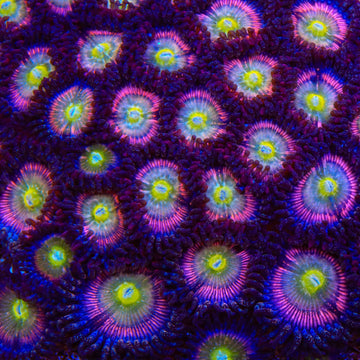
Candy Apple Red Zoanthids Coral
Overview
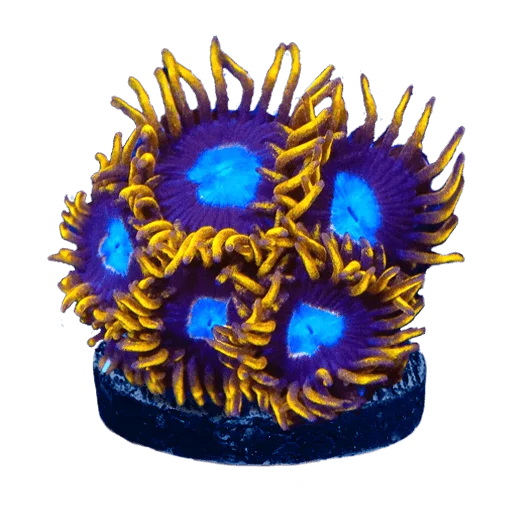
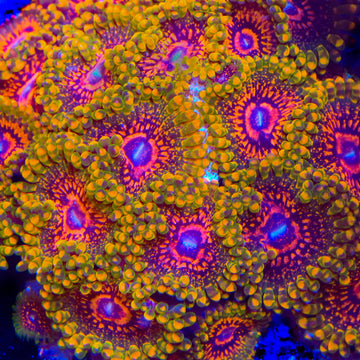
Candy Apple Red Zoanthids Coral shows red skirts with green centers on a spreading polyp mat. Zoanthus sp. is a soft, colonial polyp coral that does well under moderate light and low to moderate, indirect flow. Primarily photosynthetic with symbiotic algae, it will accept small meaty or planktonic foods that support faster growth and stable color. Place on an isolated rock to control spreading and keep space from delicate neighbors.
Quick Facts
Care
Easy
Lighting
Low–Moderate
Flow
Moderate, indirect
Placement
Low–Mid
Temperament
Semi-aggressive (fast-growing; allow 2–3 inches spacing)
Recommended Parameters
Temp
76–82°F
pH
8.1–8.4
Salinity
1.025–1.026
Calcium
380–450 ppm
AlkAlkalinity
8–10 dKH
Magnesium
1250–1350 ppm
Feeding
photosynthetic, microplankton, phytoplankton, zooplankton, rotifers, copepod nauplii, finely minced mysis shrimp, enriched brine shrimp nauplii, powdered coral foods, marine snow
Care & Placement
FAQ
Frequently Asked Questions
About the Candy Apple Red Zoanthids Coral
-
Why do my Candy Apple Red Zoanthids lose their deep red and look dull over time?
Reds fade from excess light intensity or overly blue-heavy spectrum, and from ultra-low nutrients. Aim for moderate PAR (80–150), keep some balanced white spectrum, and maintain low but detectable nutrients (NO3 2–10 ppm, PO4 0.03–0.08 ppm). Stabilize alkalinity and trace iron. If they’ve lightened, lower intensity 15–20% and allow 2–3 weeks. Target feeding fine meaty foods weekly can restore body and color. -
My colony grows but polyps “stretch” and lean—what’s causing the odd shape?
Stretching usually signals low light or directional flow. Increase diffuse light slightly and create random, cross-current flow so skirts move but polyps don’t fold. Thin the mat by trimming overcrowded edges; dense mats self-shade and push polyps upward. Place on a slightly sloped rock to reduce detritus accumulation, and turkey-baste weekly. Correcting these factors typically returns polyps to a compact, upright posture. -
What’s the safest, most effective way to frag Candy Apple Reds without losing the morph?
Use a sharp scalpel to cut between polyps, lifting the mat with a thin layer of substrate. Avoid cutting through polyp mouths. Place frags on clean plugs with a dab of gel cyanoacrylate. Dip in iodine solution, then cure in low–moderate flow and moderate light for 5–7 days. Maintain stable nutrients; swings cause “melt.” Propagate only from consistently colored, mature polyps to preserve the morph’s red ring and green skirt. -
How can I prevent and treat rare issues like zoa pox or sudden “melt” in this morph?
Prevention: stable salinity/alkalinity, good flow, and regular turkey-basting to remove biofilms. At first signs of pox (white pustules), move to quarantine and use Furan-2 dips per label for 2–3 days, plus iodine between treatments. For unexplained melt, reduce light 15%, increase flow, add fresh carbon, and perform a 20–30% water change. Inspect nightly for nudibranchs and eggs; manual removal plus a wrasse helps.