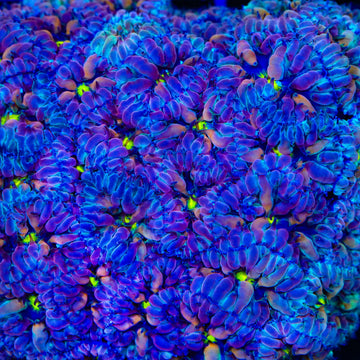
Blue Raven Merletti Blastomussa Coral
Overview
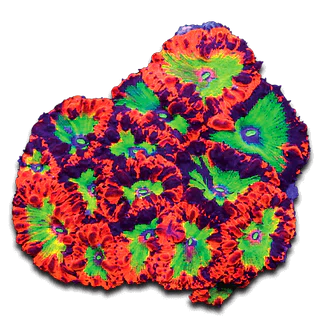
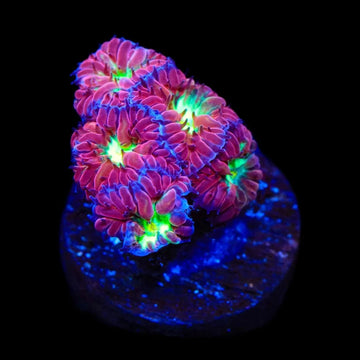
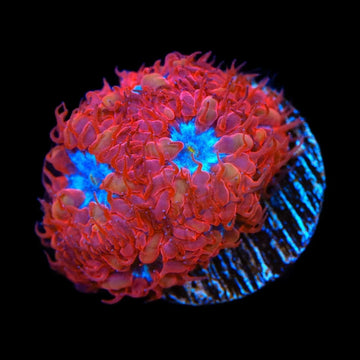
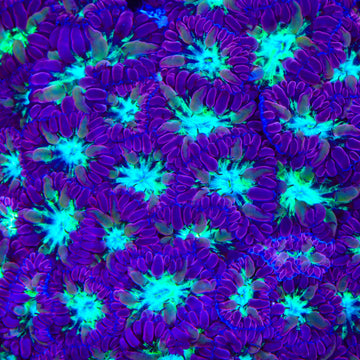
Blue Raven Merletti Blastomussa Coral shows small, tightly packed polyps forming round heads with contrasting centers. Blastomussa merleti is a fleshy, colonial large-polyp stony coral that does well under moderate light and gentle to moderate water flow. It is photosynthetic via symbiotic algae but accepts small meaty foods; occasional target feeding can support faster growth and deeper coloration. Place on stable rock with space around the colony, as sweeper tentacles can sting nearby corals.
Quick Facts
Care
Easy
Lighting
Low–Moderate
Flow
Low–Moderate
Placement
Low–Mid
Temperament
Semi-aggressive (3–4 inches spacing)
Recommended Parameters
Temp
76–80°F
pH
8.1–8.4
Salinity
1.025–1.026
Calcium
400–450 ppm
AlkAlkalinity
8–10 dKH
Magnesium
1250–1350 ppm
Feeding
photosynthetic, mysis shrimp, enriched brine shrimp, rotifers, copepods, cyclops, microplankton, coral-specific powdered foods, finely minced seafood, small LPS pellets
Care & Placement
FAQ
Frequently Asked Questions
About the Blue Raven Merletti Blastomussa Coral
-
Why does my Blue Raven Merletti Blastomussa Coral recede when I increase lighting?
B. merleti has small polyps that bleach and retract under high PAR. Aim for 50–120 PAR with blue-dominant spectrum and gentle, random flow. Sudden jumps in intensity can shock tissue; ramp up over 2–3 weeks. If edges thin or mouths gape, lower light or add shade. Moderate nutrients (NO3 5–15 ppm, PO4 0.03–0.1 ppm) help maintain color and tissue. -
What feeding approach suits B. merleti’s smaller mouths?
Offer fine to small meaty foods 1–2 times weekly: enriched brine, small mysis, cyclops, or powdered reef foods. Target feed with pumps off for 10–15 minutes. Oversized prey is wasted and can foul water. Watch for feeder tentacle extension after lights dim; that’s a good window. Consistent micro-feeding supports polyp density and growth without nutrient spikes. -
My colony stopped expanding after a neighbor LPS thrived—what’s happening?
B. merleti has short sweepers and loses turf wars against aggressive LPS and some soft corals. It’s sensitive to allelopathy and stings. Increase spacing, run fresh carbon, and adjust flow so no direct tentacle contact occurs at night. If tissue recession is localized toward the competitor, move the Blastomussa to a calmer zone with a buffer of at least 7–10 cm. -
Why are inner polyps pale while outer branches look vibrant?
This species forms dense clusters on branching skeletons, and self-shading can starve inner heads of light and flow. Rotate the frag or adjust angle so interior polyps receive gentle light and indirect flow. Periodic target feeding of inner polyps helps. If the base is bare, consider trimming outer branches and remounting to open light paths and improve circulation.