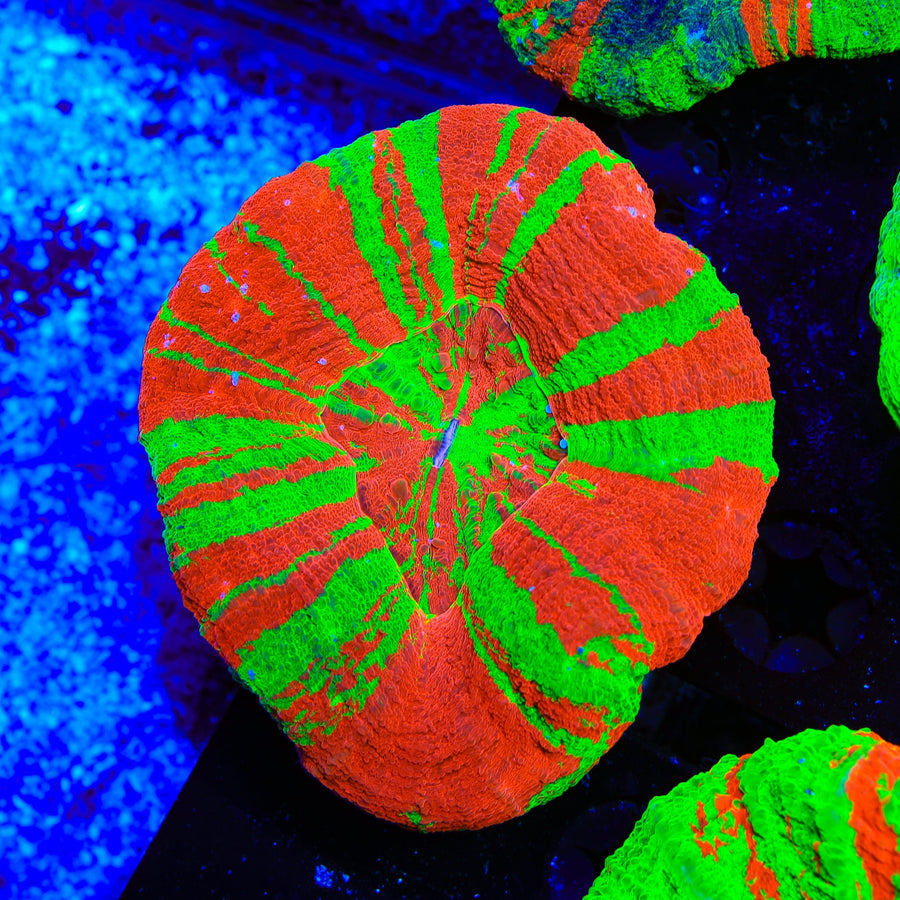
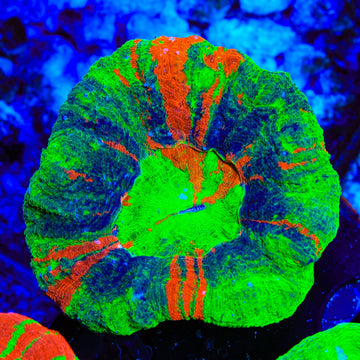
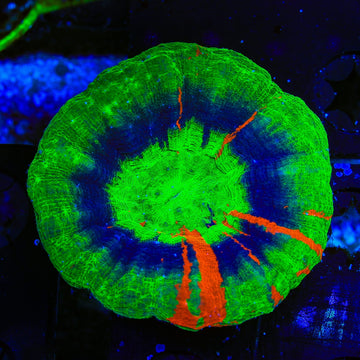
Bleeding Apple Scoly Coral
Overview
Bleeding Apple Scoly Coral shows bold red and green banding around a fleshy, round single polyp with a central mouth. Homophyllia australis is a large-polyp stony coral that prefers low to moderate light and gentle to moderate water flow. It is photosynthetic via symbiotic algae but benefits from occasional small meaty feedings, which can improve growth and coloration. Place on the sandbed or a smooth, stable surface and allow space from other corals due to a strong sting.
Quick Facts
Care
Moderate
Lighting
Low–Moderate
Flow
Low–Moderate
Placement
Low
Temperament
Aggressive (6–8 inches spacing)
Recommended Parameters
Temp
76–80°F
pH
8.1–8.4
Salinity
1.025–1.026
Calcium
400–450 ppm
AlkAlkalinity
8–9 dKH
Magnesium
1280–1350 ppm
Feeding
photosynthetic, mysis shrimp, enriched brine shrimp, chopped krill, finely chopped shrimp or fish, clam meat, LPS pellets, zooplankton, microplankton, coral-specific microfoods
Care & Placement
FAQ
Frequently Asked Questions
About the Bleeding Apple Scoly Coral
-
My Bleeding Apple Scoly Coral is losing the sharp red/green contrast. What fine-tuning helps restore color?
Start by reducing PAR to the 70–120 range and increase spectrum around 10–14K with some white to avoid over-blue washout. Maintain stable alkalinity (8–9 dKH), calcium (420–450), and magnesium (1300–1400). Slightly richer nutrients (NO3 5–15 ppm, PO4 0.03–0.08) and weekly target feeds aid pigment density. Potassium and iodine within natural seawater ranges support reds; avoid rapid changes. -
The mouth looks puffy and tissue is receding in a ring. Is this infection or irritation?
Check for sand abrasion, vermetid snail filaments, or nipping fish first. Increase gentle, laminar flow to keep detritus off the oral disc. Pause feeding 48 hours, then offer small, soft meaty foods. If recession progresses, do an iodine or broad-spectrum coral dip, trim vermetid tubes nearby, and stabilize parameters. Avoid high PAR during recovery. -
Is it safe to frag Homophyllia australis to propagate color morphs?
It’s a single-polyp LPS with thick septa; cutting carries high mortality. If attempted, only use a diamond saw, cut cleanly through the skeleton, and ensure pristine water, strong but gentle flow, and amino/iodine support post-cut. Expect long healing times. Natural budding is rare but safer; most keepers acquire additional specimens instead of fragmenting. -
Mine inflates dramatically by day, then deflates with exposed ridges at night. Normal or stress?
Daily expansion/deflation is typical for feeding and light regulation. Concern starts if the mouth gapes for days, tissue pulls from septa, or slime appears. Lower PAR, verify temperature stability, and rule out alkalinity swings. Moderate, indirect flow prevents stagnation. If signs persist, perform an antiseptic dip and reduce handling until polyp tone returns.