

Aquacultured corals are grown from start to finish in land-based tank systems. Maricultured corals are fragged and grown on farms in the ocean before being collected. Wild-caught corals are harvested directly from the reef. All three end up in the same online listings, often without the label being made clear — and the difference shows up in your tank within the first month.
Here's what actually separates them, and how to decide which belongs in your system.
The Comparison at a Glance
| Factor | Aquacultured | Maricultured | Wild-Caught |
|---|---|---|---|
| Where it's grown | Land-based tank systems | Ocean farms, on racks or tables | Collected from the natural reef |
| Adapted to aquarium conditions | Closest — already living under artificial light and pump flow | Partially — grown outdoors under natural light and flow, so both still need transition | No — full transition required |
| Typical price | Higher per frag | Moderate | Often lowest per unit of size |
| Coloration on arrival | Predictable — closest to what you'll keep, though color still shifts somewhat with your spectrum and PAR | Variable | Often stunning, frequently fades or shifts in-tank |
| Acclimation difficulty | Lowest | Moderate | Highest |
| Pest & disease risk | Lower, but never zero — still dip | Moderate to high — arrives from open ocean water | Highest |
| Available as a colony | Less often — usually frags | Yes | Yes — large colonies common |
| Reef impact | No ongoing collection from the reef | Reduced collection; can benefit local economies | Direct removal from the reef |
| Regulatory exposure | Minimal for domestic sales; CITES still applies if shipped internationally | CITES permitting applies | CITES permitting; subject to collection bans |
What "Aquacultured" Actually Means
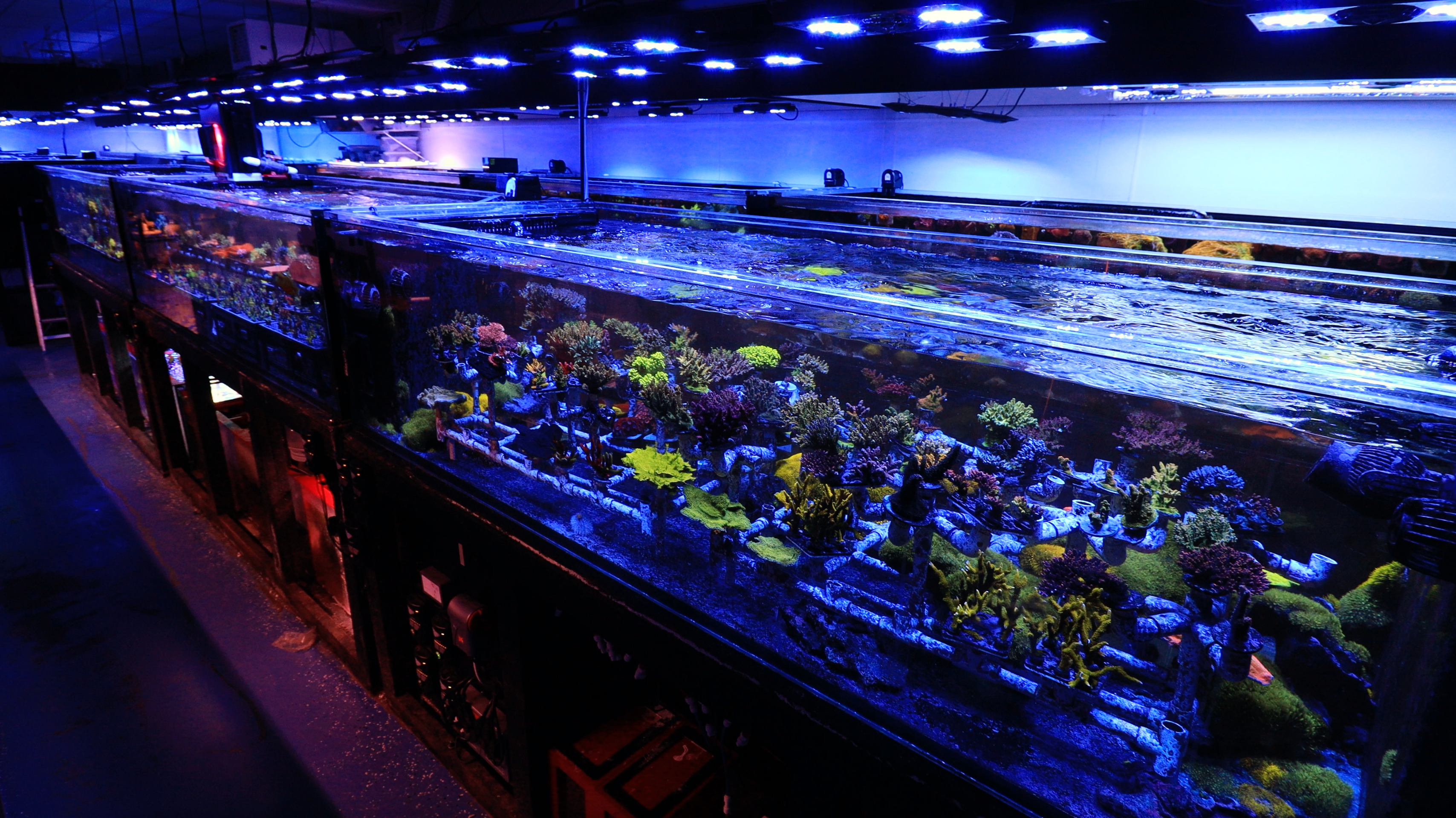
An aquacultured coral is one that was propagated and grown in a land-based system — a facility with artificial lighting, engineered flow, managed chemistry, and controlled temperature, whether the water recirculates in a closed loop or flows through from a natural seawater source. A parent colony is fragged, the frag is mounted, and it grows to sale size having never lived anywhere but a tank.
The key consequence is that an aquacultured coral has spent its entire life under the same category of conditions it will find in your display. It already knows LED spectrum. It already knows powerhead flow. Its zooxanthellae are already tuned to artificial light rather than to tropical sun at 15 feet of depth.
The label is worth scrutinizing, though. "Aquacultured" is not a certified term, and some vendors apply it to a wild colony that was fragged after arriving in their holding system. That's a wild coral with a short tank history, not a farm-raised one. The honest question to ask any vendor is simple: did you grow this, or did you cut it? A facility that grows its own can answer immediately and usually has photos of the mother colony.
What "Maricultured" Means — and Why It's Not the Same Thing
Mariculture is the category most buyers have never had explained to them, and it accounts for a large share of what's sold as "farm raised."
A maricultured coral is fragged from a parent colony and then grown in the ocean, typically cemented to a plug or disc and set out on racks or concrete tables in shallow lagoon water. It grows under natural sunlight, natural flow, and natural nutrient loads until it reaches size, then it's collected and exported.
In most cases the seed fragment or parent colony was originally collected from a nearby reef, so mariculture reduces ongoing wild collection rather than eliminating it — and the amount of grow-out time before export varies a lot between farms.
The advantages are real: mariculture can substantially reduce pressure on wild reefs relative to straight collection, supports coastal economies in collection regions, and produces corals with excellent growth form and often spectacular color.
The catch is the transition. A maricultured coral has been living under natural sunlight — usually a higher daily light dose than a home fixture delivers, with full-spectrum and UV components no LED reproduces exactly — and in water with a nutrient profile unlike a skimmed reef tank. Moving it into your display is a genuine adjustment, and it commonly shows up as browning out or paling in the first month while the coral re-acclimates. It also arrives from open ocean water, which means the pest risk sits closer to wild than to aquacultured.
A note on terminology: in scientific and FAO usage, "aquaculture" is the umbrella term and mariculture is a form of it. In the coral trade the two words are used the way we use them here — aquacultured meaning tank-raised on land, maricultured meaning ocean-grown. If you see "farm raised" or "cultured" on a listing without further detail, mariculture is a likely answer. It's a legitimate category — just not interchangeable with tank-raised.
What "Wild-Caught" Means
Wild-caught corals are collected directly from a natural reef and exported. The trade is regulated — all stony corals (order Scleractinia) are listed on CITES Appendix II, as are fire corals, lace corals, organ pipe coral, blue coral and black corals, and major exporting countries set national annual export quotas — but the coral is still coming off the reef.
Where wild collection still makes sense: genetic diversity. Essentially every prized morph in the hobby traces back to a wild colony at some point, and responsibly managed collection is how new genetics enter the captive gene pool. Wild colonies also arrive at sizes that would take years to grow out, which matters for anyone stocking a large display quickly.
The trade-offs are significant. A wild colony has to survive collection, holding, export, transshipment, and import before it reaches you — a chain that can span days to weeks. It then has to make the full jump from reef conditions to aquarium conditions. Wild corals typically arrive with the highest pest and pathogen load in the hobby, they carry the most acclimation risk, and the extraordinary color you saw in the vendor photo frequently shifts once the coral adjusts to your lighting.
They also come with real supply uncertainty. Collection bans and export policy changes have repeatedly cut off entire regions with little notice, which is precisely why the hobby's long-term stability depends on captive propagation.
Why Farm-Raised Corals Do Better in Your Tank
The conservation argument for aquacultured coral is well known. The practical argument is the one that actually changes outcomes for reef keepers, and it comes down to a single idea: you're asking the coral to make a much smaller adjustment.
Lighting is most of the way there. A tank-grown coral has photoacclimated to LED or T5 spectrum and to a specific PAR range. It doesn't need to rebuild its pigment response the way a coral coming off natural sunlight does. That's why farm-raised frags so often hold their color from day one, while a stunning wild or maricultured piece browns out for six weeks before deciding what it wants to look like. It may still shift somewhat if your fixture or PAR differs from the farm's — which is exactly why matching the farm's numbers during acclimation matters.
Flow is most of the way there. Pump flow is fundamentally different from ocean surge — more consistent, more directional, less variable. A coral that grew up in it has already built its skeleton and tissue accordingly.
Chemistry is most of the way there. Aquacultured corals are grown in water held in the same general ranges most reefers run for alkalinity, calcium, magnesium, and nutrients. Farms don't all run identical numbers — which is why it's worth asking — but there's no jump to a fundamentally different chemistry regime.
Pest exposure is lower. A closed system with quarantine protocols carries much less risk of reef hitchhikers — crabs, worms, boring organisms, unknown pathogens — than coral coming out of open ocean water. The exception worth knowing: a few of the hobby's worst pests, including red bugs and Acropora-eating flatworms, circulate mainly through the captive frag trade rather than through wild imports. Lower risk is not no risk, and you should dip everything regardless.
And the growth form is already proven in captivity. When you buy a tank-grown frag, you're buying a genetic line that has demonstrably done well in a tank, because it grew to salable size in one. That is not a guarantee a wild colony can offer.
The honest counterpoint: aquacultured corals generally cost more per frag and are less often available as large colonies. If you want a 12-inch LPS showpiece tomorrow, farm-raised may not have it. If you want a coral that survives, colors up, and grows — it's the better bet nearly every time.
Inside the Top Shelf Aquatics Coral Farm
Most of the pages you'll find on this topic make the aquaculture argument in the abstract. We'd rather show it.
Top Shelf Aquatics operates more than 30,000 gallons of dedicated farm tank water volume. That's not holding capacity for corals passing through on their way to customers — it's grow-out capacity, built for corals to live in for months and years.
The system is organized around long grow-out raceways where frags are mounted and monitored through their full growth cycle. Mother colonies are maintained as dedicated broodstock, fragged repeatedly, and never sold. Lighting, flow, and nutrient levels are managed to the same targets we publish in our care guides, so the numbers we tell you to run are the numbers the coral has actually been living in.
Our specialization is Acropora — among the least tolerant of instability and the least forgiving of being moved. Acropora demands precise, steady conditions to color up and encrust, and a system built to grow it reliably clears the bar for most of what the hobby keeps. That capability is the foundation under everything else we grow.
What that means for a buyer is specific rather than abstract: a frag grown here spent its life in the conditions described in this article, under lighting and flow comparable to your display, with a documented history in a tank rather than an unknown history on a reef.
The Conservation Case
The practical argument stands on its own, but the conservation argument is real and worth stating plainly.
Coral reefs are among the most biologically diverse ecosystems on Earth, and they're in decline. Rising sea temperatures drive bleaching events, in which corals lose or expel the symbiotic algae living in their tissues and — without recovery — die. Elevated atmospheric CO₂ lowers carbonate saturation in seawater, impairing the ability of corals to build and repair skeleton. Coastal pollution, destructive fishing practices, and disease outbreaks compound the pressure. The consequences aren't only environmental: millions of people depend on reefs for food, tourism income, and storm protection.
Aquaculture doesn't reverse any of that. What it does is remove the aquarium hobby from the list of pressures. Every coral grown in a tank is one that didn't need to be taken from a reef, and at the scale the hobby now operates that's a meaningful substitution rather than a symbolic one.
It also does something quieter. Aquaculture facilities maintain large living stocks of coral in conditions that stay stable regardless of what's happening on the reef, and they build the practical husbandry knowledge that reef restoration work depends on. Commercial farms aren't a substitute for formal genetic banking — most farm stock is clonal, propagated from a limited number of parent colonies — but keeping species and color morphs alive and growing in captivity has real value as reef conditions decline. The fragmentation and grow-out techniques that take a frag to a colony in a raceway are closely related to what in-water coral nurseries use, though restoration work increasingly relies on larval rearing and sexual propagation to build genetic diversity that fragging alone can't provide.
A hobby supplied by farms instead of reefs is a hobby that can continue indefinitely. That's the actual goal.
How to Buy Aquacultured Corals with Confidence
Ask where it was grown. A vendor that propagates its own stock will tell you directly and usually has photos of the mother colony. Vagueness on this question is informative.
Prefer WYSIWYG. "What you see is what you get" means you're buying the exact coral photographed, not a representative example. For anything above entry-level pricing, this matters — coral of the same named morph can vary substantially.
Check for encrusting. A frag whose tissue has grown down onto and across the plug has been settled and growing there for a while rather than mounted last week. It does not by itself prove tank-raised origin — maricultured corals encrust their plugs on ocean tables too — so pair it with a direct question about where the coral was grown.
Ask what parameters it was grown in. A real farm can tell you its alkalinity, calcium, magnesium, and nutrient targets without hesitating, which lets you match your acclimation to what the coral is used to.
Frag or colony? Frags cost less, ship better, and adapt faster. Colonies fill a tank immediately but carry more transition risk. For a newer system, frags are the lower-risk path.
Dip everything anyway. Every coral entering your display should be dipped and, ideally, quarantined — regardless of source.
Frequently Asked Questions
Are aquacultured corals more expensive?
Usually, per frag. Growing a coral to size in a controlled system carries real costs in energy, salt, labor, and time. The relevant comparison isn't sticker price though — it's cost per coral that survives and colors up, and by that measure aquacultured frags typically come out ahead.
Do aquacultured corals color up the same as wild ones?
They color up more predictably. A tank-grown coral is already photoacclimated to artificial lighting, so what you see in the listing is close to what you'll keep — though it can still shift somewhat if your spectrum and PAR differ from the farm's. Wild and maricultured corals frequently arrive more vivid and then shift or brown out as they adjust to aquarium light.
Is maricultured the same as aquacultured?
Not in trade usage. Maricultured corals are grown on farms in the ocean under natural light and flow; aquacultured corals are grown in land-based tank systems. (In scientific usage aquaculture is the umbrella term and mariculture is a subset of it, but the coral trade treats them as distinct.) Both reduce pressure on wild reefs — only aquacultured corals arrive already adapted to aquarium conditions.
Do aquacultured corals carry pests?
The risk of reef hitchhikers is substantially lower than with wild-collected coral, but it is not zero — and a few of the hobby's worst pests, including red bugs, Acropora-eating flatworms, and Montipora-eating nudibranchs, actually circulate mainly through the captive frag trade. Dip every coral before it enters your display, regardless of source.
Are wild-caught corals illegal?
No. All stony corals are listed on CITES Appendix II — not Appendix I — which means trade is legal with the required export and import permits rather than prohibited. Major exporting countries set their own annual export quotas, and specific countries have imposed collection and export bans at various times. In the US there's a second layer: a number of Indo-Pacific reef-building corals are listed as threatened under the Endangered Species Act. NOAA has not yet issued trade-restricting regulations for those species, but the status is under active rulemaking and worth watching. Buy from vendors who import through proper channels.
Are aquacultured corals better for beginners?
Yes. They're more forgiving during acclimation, more predictable in appearance, and carry lower pest risk. For a first coral or a young system, farm-raised is the right starting point.
Can you tell if a coral is aquacultured just by looking at it?
Not with certainty. There are partial signals — tissue encrusting across the plug (which shows time on the plug, not necessarily a land-based farm), a uniform frag plug or disc, and growth form consistent with tank conditions rather than wild reef structure. The most reliable method is still asking the vendor directly.
Shop Aquacultured Corals at Top Shelf Aquatics
Corals grown in our own farm system come out of more than 30,000 gallons of dedicated grow-out water, raised under the conditions we publish in our care guides. No transition from wild reef to your display — just a coral moving from one tank to another.
New to coral selection? Start with our beginner's guide to coral types, then browse LPS corals, SPS corals, and our signature corals.