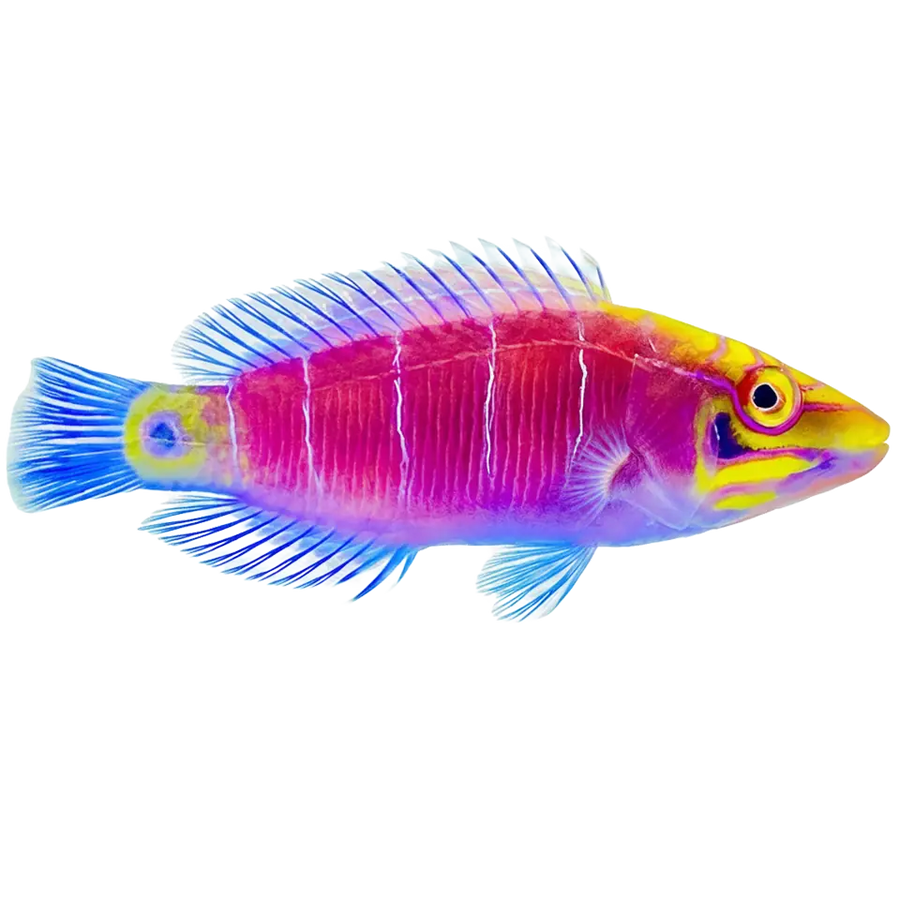
Splendid Pintail Fairy Wrasse - Male

Cirrhilabrus isosceles is a slender Western Pacific fairy wrasse recorded from Izu-Oshima and the Ryukyu Islands south through Taiwan to the Philippines, typically between 24 and 60 meters over flat or gently sloping bottoms punctuated by low rock and scattered coral outcrops. Terminal-phase males are the showpiece: orange-yellow across the back, grading into lavender along the belly, with a vivid blue-to-purple lateral stripe and a dark mid-dorsal blotch. The elongated, broadly lanceolate tail carries the triangular color pattern that gave the species its name. Initial-phase individuals are more uniformly orange with muted striping. Adults reach roughly 4 inches.

Plan on an established marine system of at least 70 gallons, with the footprint weighted toward horizontal open water rather than height, since this is a fish that patrols the middle of the tank throughout the day. Secure the live rock so it forms stable caves and crevices for daytime retreat and nighttime shelter. A tightly fitted, gap-free lid is not optional; fairy wrasses jump, and this one is no exception. Medium flow and consistently stable water chemistry suit it well. Because it originates from deeper reef slopes, shaded overhangs and a gradual introduction to intense reef lighting help it settle. Reports on substrate preference disagree, with some accounts describing sand-burying behavior and others noting that fairy wrasses sleep in rockwork instead; well-structured rock with reliable hiding places is the requirement that holds up across the evidence.

In the wild, this wrasse works the water column for tiny crustaceans, particularly copepods, which places it firmly among the small-prey carnivores. In the aquarium, build the diet around small meaty items: enriched mysis and brine shrimp, copepods, finely chopped marine seafood, and quality mixed frozen preparations. Appropriately sized marine pellets and flakes are readily accepted once the fish is settled and round out the rotation.

Feed several small portions across the day rather than one large meal, which better matches the constant activity level and quick metabolism of the species. Newly arrived fish deserve a quiet, low-competition environment; shipping and the first days in a new system are sensitive periods, and the fish should be feeding confidently before larger or pushier tankmates are introduced. Establishing it early in the stocking order pays off in long-term condition and color.

Enriched Mysis Shrimp Enriched Brine Shrimp Copepods Finely Chopped Marine Seafood Mixed Frozen Carnivore Preparations Small Marine Pellets Marine Flakes
Peaceful and highly visible, the Pintail Fairy Wrasse spends most of its time cruising open water above the rockwork, dropping into cover when startled. It can be timid around boisterous or fast-feeding fishes, so it fares best where it is not forced to compete for every mouthful. Males may show territorial intent toward other fairy wrasses or similarly shaped fishes, especially in confined quarters. The standard approach is one male, optionally with positively identified females; additional fairy or flasher wrasses can work in a larger system when introductions are staged thoughtfully.

Choose companions from the calmer end of the reef community and avoid species that will bully it or monopolize food. In the reef itself, this wrasse is dependable: corals and sessile invertebrates are left alone, and its habit of picking copepods and other minute crustaceans from the water should not be mistaken for coral predation. General invertebrate compatibility is well reported, though very small ornamental shrimp fall within the size range it naturally eats, so keep that in mind in tanks stocked with delicate micro-crustaceans. No specific risk to snails, clams, or small fishes appears in the record.

FAQ

Frequently Asked Questions

About the Pintail Fairy Wrasse

  • How large an aquarium does a Pintail Fairy Wrasse need?
    A 70-gallon aquarium is the recommended adult minimum, with length prioritized over height. Ample horizontal open water is more important to this active swimmer than total volume alone.
  • Does this wrasse require a sand bed?
    The evidence is inconsistent, with some accounts describing sand-burying and others reporting that fairy wrasses sleep in rock crevices instead. Securely stacked live rock with caves and crevices is the requirement that is consistently supported.
  • Is it safe with corals and ornamental invertebrates?
    Yes, it is reef safe and leaves corals and sessile invertebrates alone. General invertebrate compatibility is well reported, though very small ornamental crustaceans overlap with its natural prey size.