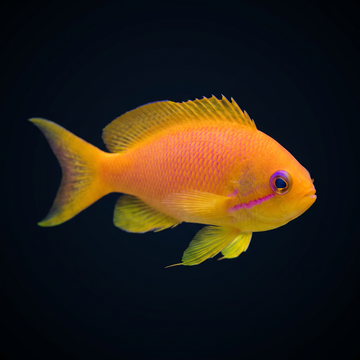
Bimaculatus Anthias (Male) saltwater fish care guide

Overview:
The Bimaculatus Anthias (Male), known for its vibrant coloration and dynamic presence, thrives in a well-maintained marine aquarium. Ideally, these fish require a tank of at least 125 gallons, providing ample swimming space and a stable environment. They prefer a habitat with plenty of live rock for hiding and exploring, mimicking their natural reef environment. Water conditions should be pristine, with temperatures maintained between 72-78°F, a pH of 8.1-8.4, and specific gravity of 1.020-1.025. Strong water movement and efficient filtration are essential to replicate ocean currents and maintain water quality.

Compatibility:
When considering tankmates for the Bimaculatus Anthias, select peaceful species that share similar environmental needs. They do well in groups, ideally with one male and several females, to mimic their natural social structure. Avoid housing them with aggressive or overly territorial fish, as this can cause stress and disrupt their social dynamics. Suitable companions include other anthias species, peaceful wrasses, gobies, and tangs. Ensure ample hiding spots to reduce stress and provide refuge.

Health and Quarantine:
Maintaining the health of Bimaculatus Anthias involves regular monitoring and preventive care. Quarantine new arrivals for 2-4 weeks to observe for signs of disease and prevent the introduction of pathogens into the main tank. Common health issues include marine ich and bacterial infections, often resulting from stress or poor water quality. Regular water changes, a balanced diet, and maintaining stable water parameters are crucial for preventing illness. If signs of disease appear, such as changes in behavior or appetite, address them promptly with appropriate treatments. Regularly inspect fish for physical changes and ensure a stress-free environment to promote overall well-being.

Mysis Pellets Finely Chopped Seafood
Bimaculatus Anthias males are active swimmers, often seen darting around reef structures. They exhibit a strong social hierarchy, forming harems with one dominant male and multiple females. Males are territorial, defending their space against rivals. They are generally peaceful with other non-aggressive species but may display aggression toward other males. They thrive in groups and prefer ample swimming space with plenty of hiding spots. Compatibility is high with similarly sized, peaceful fish, but they should be monitored in mixed-species tanks to prevent territorial disputes.

FAQ

Frequently Asked Questions

About the Bimaculatus Anthias (Male)

  • How can I maintain the intense pink and yellow coloration of a male Bimaculatus Anthias in captivity, and why do some males fade to a duller orange over time?
    Color intensity in male Bimaculatus Anthias is strongly linked to diet, hierarchy, and environment. Provide a varied, high-quality diet rich in carotenoids and marine proteins: multiple daily feedings of small portions of frozen mysis, enriched brine, finely chopped krill, calanus, and quality pellets formulated for marine carnivores, plus occasional live foods. Make sure the fish is the dominant male or at least not being bullied by more assertive tankmates; chronic stress and subdominant status often lead to washed-out colors. Maintain stable parameters (salinity ~1.025–1.026, temp 24–26°C, low nutrients but not ultra-sterile water) and moderate, indirect lighting with some shaded zones, as excessively bright, open lighting can cause them to “hide” and show paler colors. Good water quality, strong but not chaotic flow, and a peaceful social setting are key to preserving the vibrant male coloration.
  • My male Bimaculatus Anthias constantly patrols and chases other anthias in the tank. How do I structure the social group to reduce aggression while still keeping a proper harem?
    Bimaculatus Anthias are haremic, with one dominant male keeping multiple females. For a male, aim for a group ratio of at least 1 male to 4–6 females of the same species, introduced simultaneously or females first and the male last. Avoid mixing multiple established males in tanks under about 6 feet; in medium systems, only one male should be present, or males should be separated by rockwork with clear visual breaks and large distances. Provide complex aquascaping with caves, arches, and overhangs so females and subordinate fish can retreat out of sight lines. Keep other active mid-water swimmers (e.g., fairy or flasher wrasses) to diffuse attention but avoid highly aggressive or fin-nipping species. Consistent, frequent feeding (3–5 times per day) reduces chasing triggered by food competition. If aggression stays severe, rehome excess males or remove the most aggressive individual.
  • Why does my male Bimaculatus Anthias spend much of the day hovering in the water column instead of exploring the rockwork like my wrasses and tangs, and is this normal behavior?
    This is normal for the species. Bimaculatus Anthias are mid-water planktivores that naturally hover in the water column, facing into the current and darting out to grab passing zooplankton. They are not rock pickers like many wrasses, nor benthic grazers like tangs. To support this behavior, design your flow so there is a moderate, laminar or gently turbulent current across the front half of the tank, where they can hover comfortably without being blasted. Provide open swimming space along with overhead cover and ledges behind or above them so they feel secure while mid-water. If your male is hovering but alert, eating well, and showing normal respiration, it is healthy. If it hangs listlessly near the surface, gasps, or hides in corners, then reassess oxygenation, tankmates, and water parameters.
  • Can a male Bimaculatus Anthias be kept in an SPS-dominated reef with very low nutrients, and how do I prevent it from starving without raising nitrates and phosphates too high?
    Yes, but it requires careful feeding and export. Anthias are high-metabolism planktivores and need frequent small meals, which challenges low-nutrient SPS systems. Use an automatic feeder for tiny pellet portions 2–3 times daily, supplemented by 1–2 frozen feedings. Choose lower-filler, high-protein pellets that produce less waste, and rinse frozen foods before feeding to reduce dissolved nutrients. Counterbalance the heavier feeding with aggressive export: strong protein skimming, refugium with macroalgae, occasional use of GFO or other phosphate control media as needed, and regular water changes. Aim for low but measurable nitrate (e.g., 2–10 ppm) and phosphate in the 0.02–0.08 ppm range rather than trying to hit absolute zero; that range is generally compatible with SPS while still allowing anthias to be fed enough to maintain weight and color.
  • My male Bimaculatus Anthias ignores large chunk foods and only picks at tiny particles. What feeding strategy works best for this species in a mixed reef where I don’t want food blown all over corals?
    Male Bimaculatus Anthias prefer small, suspended particles that drift in the water column. Instead of large chunks, offer finely minced foods or micro-sized pellets (0.5–1 mm). Turn down or pulse your return/gyre flow briefly to keep food suspended but not immediately swept into overflow boxes. Use a turkey baster or pipette to slowly broadcast-feed into the current upstream of where the anthias hover, giving them time to grab many small bites. Feed smaller amounts 3–5 times daily rather than one or two heavy feedings. If you keep LPS or target-feeding corals, feed the anthias first with broadcast micro-foods, then turn flow down further and spot-feed corals with larger pieces; this sequence reduces wasted food and helps corals and fish both get what they need without overloading the system.