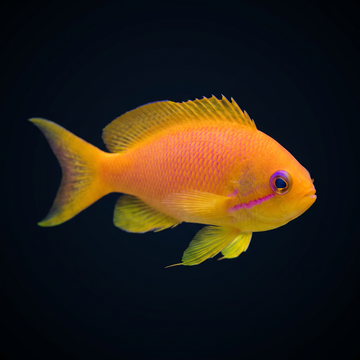
Lyretail Anthias saltwater fish care guide

The Lyretail Anthias (Pseudanthias squamipinnis), also sold as the Scalefin Anthias or Sea Goldie, is a small, vividly colored member of the grouper family Serranidae. The species is strongly sexually dimorphic: females wear a uniform orange to golden-orange coat, sometimes with an iridescent bluish-purple streak below the eye, while dominant males shift to magenta, fuchsia, or reddish-pink and develop an elongated dorsal spine along with the forked, lyre-shaped tail that gives the fish its common name. Males reach roughly 5 inches, with females staying closer to 3 to 4 inches. Populations range across the Indo-Pacific, from the Red Sea and East Africa through the Maldives, Indonesia, and the Philippines to Fiji and the Great Barrier Reef, where enormous shoals hover above outer reef slopes, drop-offs, and channel walls picking plankton from the current.

Successful adult housing begins with a mature, stable reef-quality system. Plan on at least a 125-gallon aquarium for a harem, with larger species-focused or reef displays being better still, since subordinate fish need room to escape the pecking order. Strong, high-turnover flow on the order of 15 to 20 times display volume per hour reproduces the current-swept slopes these fish evolved on. Combine wide-open swimming lanes through the middle and upper water column with dense live rock that offers caves, overhangs, and crevices; branching stony corals such as Acropora and Pocillopora serve as tactical refuge on the reef and function the same way in an aquarium. Water chemistry should be held to the same standard applied to SPS husbandry, and somewhat subdued or filtered lighting suits fish that naturally live beneath the glare. A secure lid is essential, as this species is a known jumper.

Wild Lyretail Anthias are obligate planktivores, hunting zooplankton in the open water above the reef as often as six to eight times per day. That grazing pattern translates directly into captive care: this is a high-metabolism fish that requires frequent small meals rather than one large offering. Frozen mysis shrimp, enriched frozen brine shrimp, and calanus form an excellent rotation, and established specimens will generally accept high-quality flake and pellet foods once settled. A refugium seeded for live copepods and amphipods provides valuable between-meal foraging.

Feed a minimum of two to three times daily, and more often if the schedule allows, watching subordinate females closely since they are the first to fall behind at the buffet. Newly imported specimens are prone to stress-related feeding refusal and can starve slowly while still looking outwardly healthy, so the introduction period deserves attention. Use a slow drip acclimation, dim the lights, and keep disturbance to a minimum during the first 48 hours to ease the transition into the display.

Frozen Mysis Shrimp Enriched Frozen Brine Shrimp Calanus Live Copepods Amphipods Marine Flake Food High-Quality Marine Pellets
These are restless, fast-moving fish that swim almost continuously through the middle and upper water column, and they look and behave best in groups. Lyretail Anthias are protogynous hermaphrodites organized into harems of one dominant male with multiple females; if the male is lost, the largest female will convert to male over roughly two to four weeks. Aim for eight or more individuals, or a ratio near one male to four to six females, so that aggression is spread thin. In cramped or undersized systems, fish low in the hierarchy are bullied, stressed, and out-competed at feeding time.

Squabbling occurs within the group and toward other food competitors, but toward unrelated tankmates this species is well mannered. Tangs, wrasses, blennies, and gobies make sensible companions. Avoid intimidating or predatory neighbors such as large angelfish and triggers, which suppress natural schooling and feeding behavior and can push a group into hiding. Lyretail Anthias are reef safe, leaving corals and sessile invertebrates alone entirely and coexisting with large motile invertebrates, which makes them one of the most useful mid-water additions to a stocked reef display.

FAQ

Frequently Asked Questions

About the Lyretail Anthias

  • How often should Lyretail Anthias be fed?
    Feed small meals at least two to three times daily, and more frequently when possible, since wild fish graze on plankton six to eight times a day. Underfeeding leads to slow starvation even when the fish still looks healthy.
  • What size aquarium does a harem require?
    Plan on a 125-gallon aquarium or larger for a properly managed harem. Extra volume gives subordinate females space to avoid the dominant male and reach food.
  • Are Lyretail Anthias safe with corals and invertebrates?
    Yes. They do not nip corals or sessile invertebrates and coexist with large motile invertebrates, making them a dependable mid-water fish for a fully stocked reef.