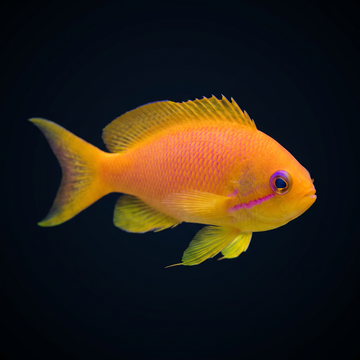
Hutchi Anthias (Female) saltwater fish care guide

Overview:
The Hutchi Anthias (Female) thrives in a well-maintained marine aquarium that mimics its natural reef environment. Ideal conditions include a tank size of at least 70 gallons, with plenty of live rock for hiding and swimming. Water parameters should be stable, with a temperature range of 72-78°F, pH between 8.1-8.4, and specific gravity of 1.020-1.025. A moderate to strong water flow and efficient filtration system are essential to maintain water quality. Lighting should be moderate to high, replicating natural sunlight to support their active nature.

Compatibility:
Hutchi Anthias (Female) are generally peaceful and can coexist with other non-aggressive fish species. They do well in groups, ideally with one male and several females, as they exhibit a social hierarchy. Avoid housing them with overly aggressive or territorial species that may intimidate or outcompete them for food. Suitable tankmates include other anthias species, clownfish, gobies, and wrasses. Ensure ample space and hiding spots to reduce stress and aggression within the group.

Health and Quarantine:
Maintaining the health of Hutchi Anthias (Female) involves regular monitoring of water quality and prompt attention to any signs of illness. Common health issues include ich, bacterial infections, and stress-related ailments. Quarantine new arrivals for at least two weeks to prevent the introduction of diseases into the main tank. During quarantine, observe for any signs of illness and treat accordingly. Regularly check for changes in behavior, appetite, or appearance, as these can indicate health problems. Providing a stress-free environment with stable conditions and a balanced diet is key to preventing health issues.

Pellets Mysis Finely Chopped Seafood
Female Hutchi Anthias are active swimmers, often found in groups within coral reefs. They exhibit schooling behavior for protection and social interaction. These fish are generally non-territorial but may show mild aggression during feeding. They coexist well with other peaceful species and thrive in environments with ample hiding spots. Compatibility is high with similarly sized, non-aggressive fish, making them suitable for community tanks. Their swimming patterns are dynamic, often darting between coral branches, and they prefer well-oxygenated water with moderate currents.

FAQ

Frequently Asked Questions

About the Hutchi Anthias (Female)

  • How can I maintain the bright orange and lavender coloration of a female Hutchi Anthias long term in captivity?
    Color holds best with strong but not harsh lighting, high water quality, and frequent small, protein-rich feedings. Use a mix of small marine foods like enriched Mysis, calanus, finely chopped krill, fish roe, and quality pellets designed for planktivores. Feed at least 2–3 times daily. Keep nitrate under ~15 ppm and phosphate low but detectable; starving the tank of nutrients can wash out color. Hutchi Anthias also show better coloration when kept in a calm, low-stress harem with hiding spots and dimmer overhang areas so they can move in and out of brighter light.
  • What tank layout and flow pattern work best for female Hutchi Anthias, given their natural midwater behavior?
    They prefer a scape with tall rockwork, arches, and ledges that create shaded midwater “lanes” in front of the rock, not just open sand. Aim for strong, broad, alternating flow across the front third of the tank where they can hover and dart for food, with lower flow and caves behind and under the rock for retreat. Avoid single, blasting jets that pin them to the glass. A gyre or multiple wavemakers set to random or pulse modes works well. They feel more secure if they can retreat quickly into rockwork from midwater perches.
  • How do I manage social dynamics in a group of Hutchi Anthias so my females do not get bullied to death by the dominant fish?
    Start with one clear male and at least 4–6 females (more is better in larger systems) to spread aggression. Introduce them all at once, or if adding later, introduce new females in a social acclimation box so the male can see them but not attack. Provide multiple caves and overhangs so subdominant females have separate territories. Watch for one female being chased constantly and losing weight; if that occurs, rearrange some rockwork to break sight lines and consider temporarily removing the aggressor or using an acclimation box reset. Keep other semi-aggressive planktivores (like more assertive Anthias species) out of the same tank, or introduce Hutchi Anthias first so they establish themselves.
  • My female Hutchi Anthias sometimes disappears into the rock at lights-on and during the day; how do I tell normal shy behavior from early health problems?
    New or lower-ranking females often hide more, particularly at lights-on or if tankmates are boisterous. Normal shy behavior: she emerges to feed when food is present, shows normal body shape (not pinched), normal breathing, no scratching or clamped fins. Concerning signs: rapid gilling while hiding, stringy white feces, refusal to eat for more than a day or two, frayed fins, or visible spots/velvet “dust.” If she hides all day and skips multiple feedings, isolate her in a hospital tank for observation and possible treatment (e.g., for parasites or bacterial issues), and review aggression in the display.
  • How can I keep a female Hutchi Anthias eating well in a mixed reef without overfeeding and causing nutrient spikes?
    Use small, frequent feedings and high-quality, nutrient-dense foods. Auto-feed tiny pellets (0.5–1 mm) 2–3 times per day, then supplement with one or two small frozen feedings targeted to the area they hover in. Train them to come to a specific flow pattern when pumps slow or pause; briefly reduce flow, feed into that area, then return normal flow after most food is consumed. Support export with a strong skimmer, refugium or algae reactor, and regular filter sock or roller maintenance. Adjust feeding amounts by watching their bellies: slightly rounded after meals is ideal; sunken bellies or concave sides mean they need more, rising nitrate and algae blooms mean you are overshooting.