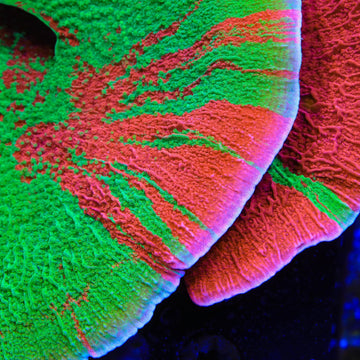
TSA Danger Zone Montipora Coral
Overview
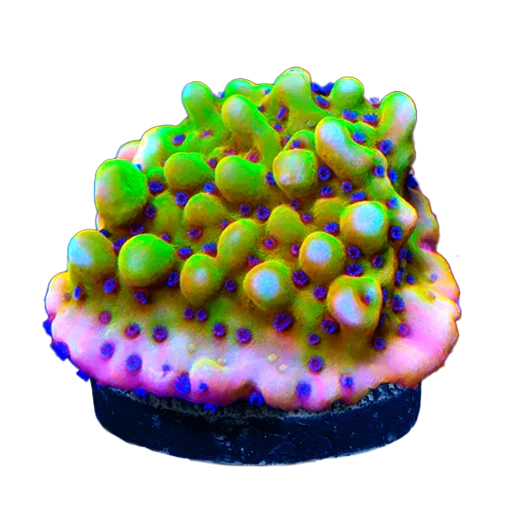
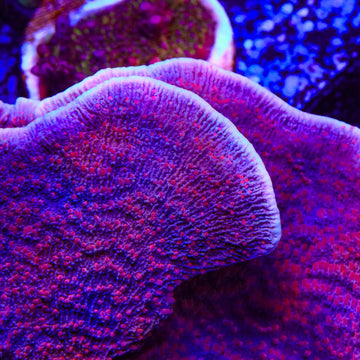
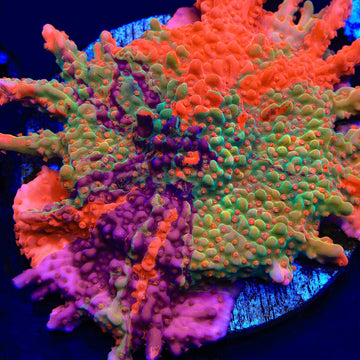
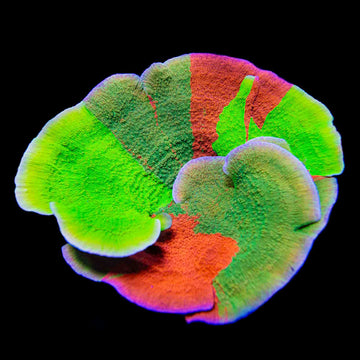
Danger Zone Montipora Coral forms thin plating sheets with scalloped edges and contrasting polyps across the surface. Montipora sp. is a small-polyp stony coral that grows in plating or encrusting forms and prefers moderate to high light with moderate to strong, turbulent flow. It is mainly photosynthetic with symbiotic algae, but occasional fine particulate feeding can support growth and color. Place on stable rockwork with room to expand and keep distance from aggressive stinging corals to prevent tissue damage.
Quick Facts
Care
Moderate
Lighting
Moderate–High
Flow
Moderate–High
Placement
Mid–High
Temperament
Peaceful (2–3 inches spacing)
Recommended Parameters
Temp
76–80°F
pH
8.1–8.4
Salinity
1.025–1.026
Calcium
400–450 ppm
AlkAlkalinity
8–9.5 dKH
Magnesium
1250–1350 ppm
Feeding
photosynthetic (primary), microplankton, phytoplankton, zooplankton (rotifers), copepod nauplii, powdered coral foods (e.g., Reef-Roids), amino acids
Care & Placement
FAQ
Frequently Asked Questions
About the TSA Danger Zone Montipora Coral
-
Why does my Danger Zone Montipora switch between encrusting and plating growth?
Morphology shifts with light and flow. Strong, chaotic flow and higher PAR (250–350) push tighter, encrusting growth; slightly lower PAR or more laminar flow encourages plating to capture light. Placement near rock faces often starts encrusting, then shelves as the colony seeks light. Plan spacing to prevent self-shading, and ensure flow reaches the underside to keep detritus from building up. -
How can I keep the intense color of this morph from washing out or browning?
Color is sensitive to spectrum and nutrients. Keep NO3 around 2–10 ppm and PO4 0.03–0.08; ultra-low levels pale the tissue, excess nutrients brown it. Favor strong blue/violet (420–460 nm), acclimate any light increases over 2–3 weeks, and keep alk stable (8–9 dKH). If fading, slightly raise nutrients or reduce intensity 10–15%. Consistent trace replenishment helps maintain fluorescence. -
What’s a reliable way to detect and manage Montipora-eating nudibranchs?
Inspect after lights-out with a flashlight; look for tiny white nudibranchs and crescent egg spirals along damaged edges. Dip frags (e.g., iodine or coral-safe insecticide dips) every 4–7 days for 3–4 weeks to break egg cycles, and quarantine new pieces. A Melanurus or Yellow Coris wrasse can help control, but won’t eradicate. Manually trim necrotic edges and remount healthy tips away from the main colony. -
My colony is receding from the base while the tips look fine—what’s the cause?
Base recession usually stems from shading, detritus buildup, or instability. Increase crossflow under plates, turkey-baste weekly, and correct alk swings. Check for low-level pests and verify stable salinity and temperature. If tissue is peeling, cut a margin into healthy tissue to stop spread and remount fragments in brighter, well-ventilated areas. Carbon and regular water changes help if chemical warfare is involved.