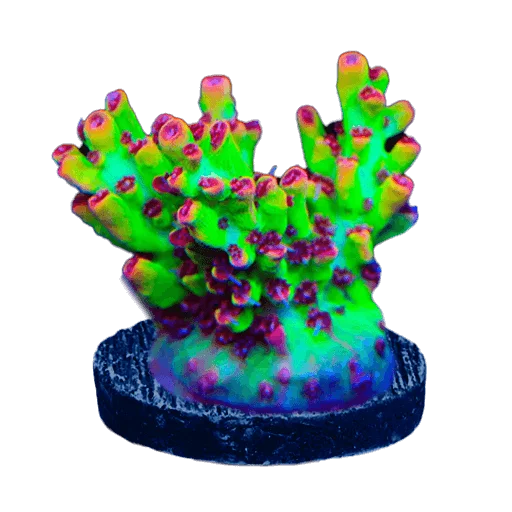
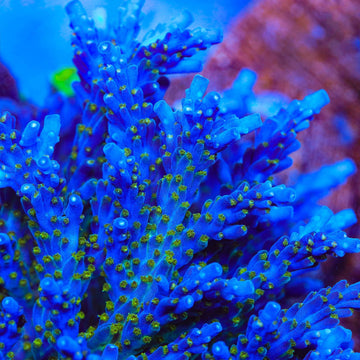
TSA Circus Freak Tenuis Acropora Coral
Overview
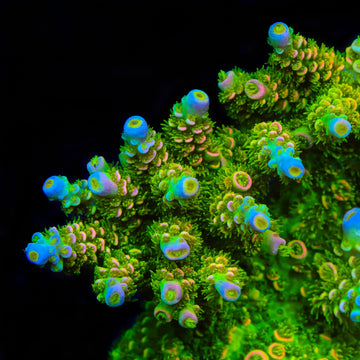
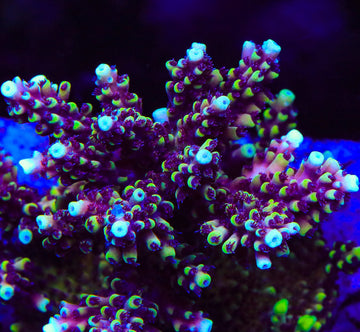
Circus Freak Tenuis Acropora Coral shows tightly spaced, branching axial tips with vivid contrasting polyps. Acropora tenuis is a small-polyp stony branching coral that prefers strong lighting and high, turbulent water flow. It relies on symbiotic algae for most nutrition but benefits from occasional fine particulate foods, which can support growth and color. Place high on stable rockwork with space from aggressive neighbors, and keep parameters stable to prevent tissue recession.
Quick Facts
Care
Difficult
Lighting
High
Flow
High, turbulent
Placement
High
Temperament
Semi-aggressive (2–3 inches spacing)
Recommended Parameters
Temp
77–80°F
pH
8.1–8.4
Salinity
1.025–1.026
Calcium
420–450 ppm
AlkAlkalinity
7.5–9 dKH
Magnesium
1280–1350 ppm
Feeding
photosynthetic (primary), microplankton, phytoplankton, zooplankton, rotifers, copepod nauplii, coral-specific microfoods (e.g., Reef-Roids)
Care & Placement
FAQ
Frequently Asked Questions
About the TSA Circus Freak Tenuis Acropora Coral
-
Why does my Circus Freak Tenuis (Acropora tenuis) look muted under high PAR but pop under blues?
This morph often shows strongest fluorescence under 420–470 nm, while excessive white/UV or very high PAR can wash pigments and cause tip burn. Aim for 250–350 PAR with a blue-heavy spectrum, ramping slowly. Keep nutrients non-zero (NO3 5–15 ppm, PO4 0.03–0.08 ppm) to avoid pastel fade. Stable alkalinity (7.5–8.5 dKH) prevents oxidative stress that dulls colors. -
It encrusts fast but stalls on vertical branching—how can I jump-start upward growth?
Mount the frag at a slight angle so light hits one side of the axial corallite, promoting an apical branch. Maintain turbulent, cross-directional flow over the tip; avoid laminar blasts. Keep the base clear of shadowing to prevent basal recession. Minor weekly micro-trims of competing branches can redirect energy to a desired leader. -
I’m seeing tiny bite marks and reduced polyp extension—could this be pests specific to tenuis?
Tenuis is a favorite target of Acropora-eating flatworms and red bugs. Look for crescent bites, pale patches, and egg clusters along branch undersides. Do a nighttime inspection with a flashlight. Perform matched-temperature dips (e.g., Bayer/iodine per vetted protocols), turkey-baste to dislodge pests, and repeat on a 6–7 day cycle. Quarantine new acros; use a wrasse helper only as secondary control. -
My colony browns at the base while tips stay colored—what’s the advanced fix?
This often reflects detritus accumulation and localized low flow causing microbial stress. Increase chaotic flow at the base, raise the colony sli