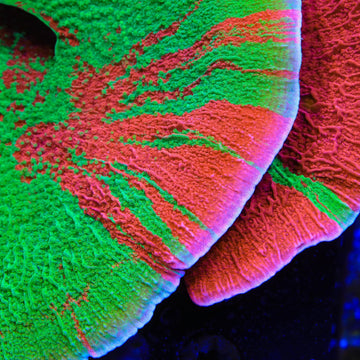
TSA Chili Pepper Montipora Coral
Overview
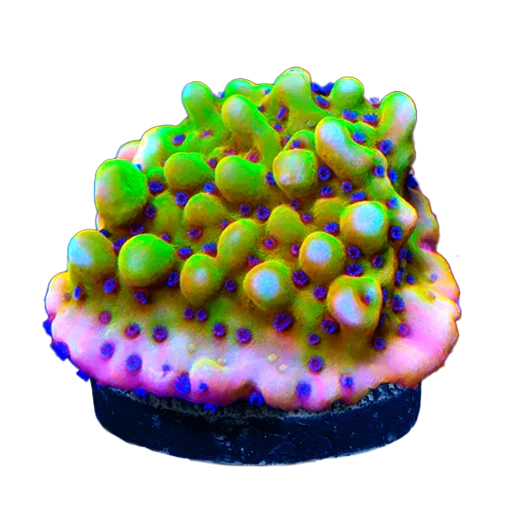
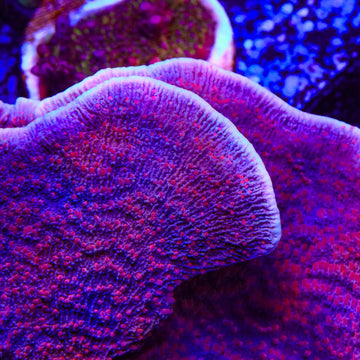
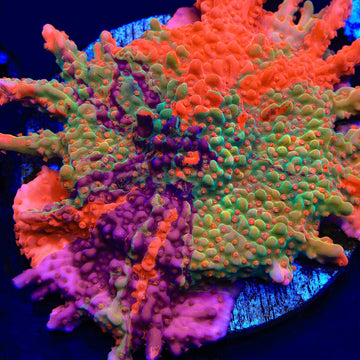
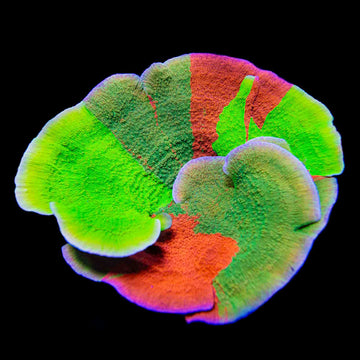
Chilli Pepper Montipora Coral shows a bright green base with red to orange polyps on a flattened, encrusting surface. Montipora danae is a small polyp stony coral that grows as encrusting to plating sheets; it prefers moderate to strong light and moderate to high, varied water flow. It is photosynthetic via symbiotic algae, but occasional feeding of fine plankton can support growth and color stability. Place on stable rock with space around the colony, and avoid contact with aggressive neighbors to prevent tissue damage.
Quick Facts
Care
Moderate
Lighting
Moderate–High
Flow
High, indirect
Placement
Mid–High
Temperament
Peaceful (2–3 inches spacing)
Recommended Parameters
Temp
76–80°F
pH
8.1–8.4
Salinity
1.025–1.026
Calcium
400–450 ppm
AlkAlkalinity
8–9 dKH
Magnesium
1280–1350 ppm
Feeding
photosynthetic, microplankton, rotifers, copepod nauplii, bacterioplankton, coral-specific powdered foods, amino acid supplements
Care & Placement
FAQ
Frequently Asked Questions
About the TSA Chili Pepper Montipora Coral
-
How do I keep the neon green base and orange-red polyps from fading on Chilli Pepper Montipora?
Target a PAR of ~200–300 with strong blue/violet (420–460 nm) and stable nutrients: nitrate 2–10 ppm, phosphate 0.03–0.08 ppm. Maintain alk 8–9 dKH, Ca 420–450, Mg 1300–1400, and avoid rapid swings. Potassium 380–420 mg/L supports reds in Montipora. Excess warm white or ultra-low nutrients wash out color; too high nutrients darken the base. -
Mine is encrusting instead of plating—normal for Montipora danae?
Yes. This morph typically encrusts first, then forms low ridges or shallow plates as it gains momentum. Strong, chaotic flow and stable parameters encourage upward growth. If you want plating, give it space on an isolated rock “island” with room at the edges; avoid shaded overhangs that stall margin growth and cause dieback. -
How can I quickly identify and manage Montipora-eating nudibranchs on this coral?
Look at night for tiny white, frilly nudibranchs and crescent egg spirals along margins and shaded seams. Manually remove adults, scrape eggs, then perform repeated dips (every 3–4 days for 2–3 weeks). Quarantine affected pieces. A wrasse such as Halichoeres melanurus can help with control, but won’t eliminate eggs—consistency is key. -
Why does the edge recede after a dusting of sand or detritus?
The thin, expanding rim is sensitive to abrasion and smothering. Provide strong, random flow to keep surfaces clean and avoid direct, laminar jets that peel tissue. Raise the coral off sand, reduce detritus by increasing mechanical filtration, and run fresh carbon if soft corals are present; allelopathic compounds amplify margin stress.