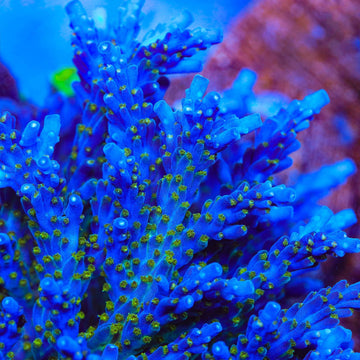
TSA Bubbleyum Tenuis Acropora Coral
Overview
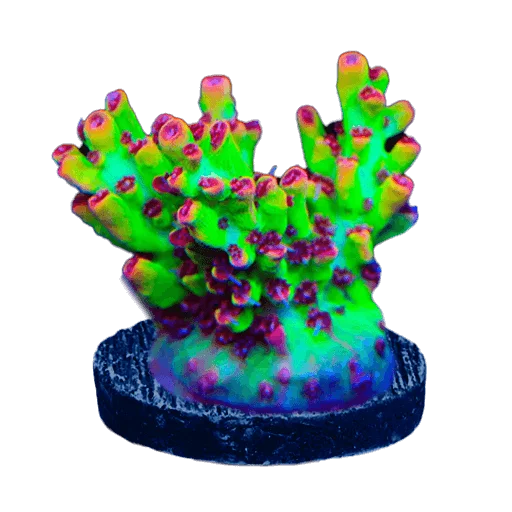
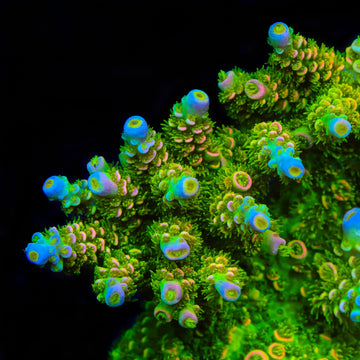
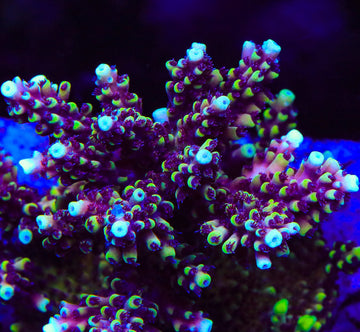
Bubbleyum Tenuis Acropora Coral has a compact branching form with thick branchlets and rounded, nubby tips. Acropora tenuis is a hard, branching stony coral that prefers strong light and high, random water flow. It is photosynthetic through symbiotic algae but may also take very fine planktonic foods; occasional feeding can support growth and coloration. Place it high on stable rockwork with ample space from aggressive corals to prevent tissue damage.
Quick Facts
Care
Difficult
Lighting
High
Flow
High
Placement
High
Temperament
Semi-aggressive (3–6 inches spacing)
Recommended Parameters
Temp
76–80°F
pH
8.1–8.4
Salinity
1.025–1.026
Calcium
420–450 ppm
AlkAlkalinity
8–9 dKH
Magnesium
1280–1350 ppm
Feeding
photosynthetic (primary), microplankton, rotifers, copepod nauplii, oyster eggs, cyclops, reef-specific powdered coral foods, amino acids
Care & Placement
FAQ
Frequently Asked Questions
About the TSA Bubbleyum Tenuis Acropora Coral
-
Why does Bubbleyum Tenuis lose its hot pink/blue tones under strong white lighting?
Acropora tenuis fluoresces best under heavy blue/violet spectrum (420–470 nm). High white intensity can wash pigments and shift it toward brown/green if nutrients are elevated. Aim for 250–350 PAR with a blue-biased schedule, maintain NO3 ~5–15 ppm and PO4 0.03–0.08 ppm, and avoid sudden drops in nutrients or alkalinity. Select side lighting or cross-lighting to limit self-shadowing inside bushy branches. -
My Tenuis shows great polyp extension at night but retracts by day—normal or a stress sign?
It’s often normal. Tenuis extends more after lights out to capture plankton. Daytime retraction increases with excessive laminar flow, fish nipping, or micro-irritants. Switch to randomized, high but non-blasting flow (alternating gyres), check for red bugs/AEFW, and verify alk stability. A brief evening amino/particulate feed can condition consistent extension without triggering nuisance algae. -
How do I prevent basal die-off when the colony thickens and shades its base?
Plan for light penetration from multiple angles. Use two fixtures or an LED/T5 hybrid to fill shadows, and maintain vigorous, cross-tank flow to keep corallites clean. Periodically trim inner branches to open the colony, and elevate the coral so lower tiers receive light. Keep alk steady (7.5–8.5 dKH) and avoid detritus buildup at the base to reduce tissue recession. -
Tenuis started STN after a mild alk spike—any recovery tips specific to this species?
Tenuis can be alk-sensitive. Immediately stabilize parameters (small daily water changes, consistent dosing), raise flow across the affected margin, and frag 5–10 mm into healthy tissue if recession localizes. Run fresh carbon to remove irritants and check for pest damage that can mimic STN. Temporarily reduce PAR by ~15–20% and restore gradually over a week while monitoring polyp behavior.