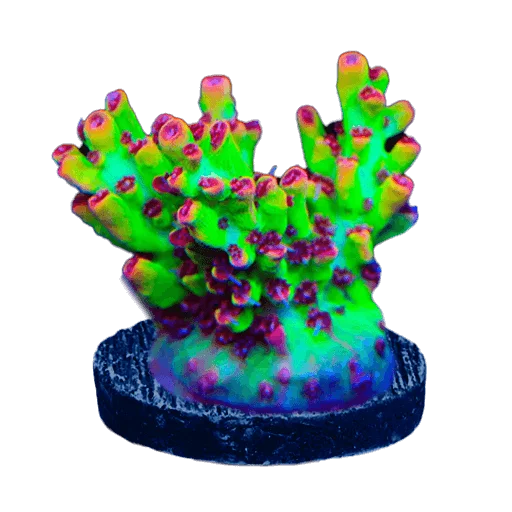
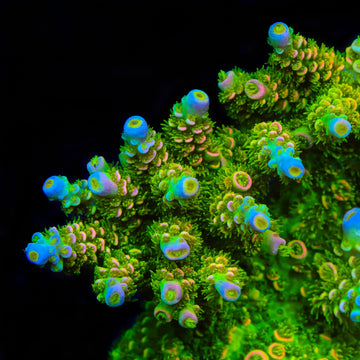
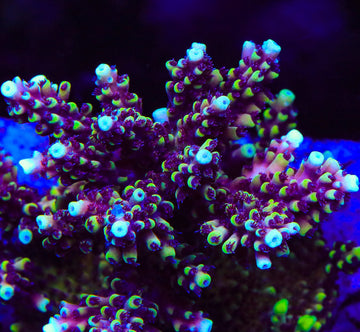
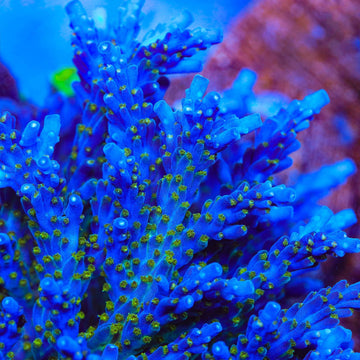
TSA Bollywood Acropora Coral
Overview
Bollywood Acropora Coral forms dense branching colonies with pointed tips and small axial corallites. Classified as Acropora sp., it is a small-polyp stony branching coral that prefers strong light and high, turbulent water flow. It is primarily photosynthetic through symbiotic algae but can take occasional micro-plankton or amino-rich foods to support growth and color. Place high on stable rockwork with space around the colony, and avoid contact with aggressive or sweeper-tentacled neighbors.
Quick Facts
Care
Difficult
Lighting
High
Flow
High, turbulent
Placement
High
Temperament
Peaceful (3–4 inches spacing)
Recommended Parameters
Temp
76–80°F
pH
8.1–8.4
Salinity
1.025–1.026
Calcium
420–450 ppm
AlkAlkalinity
8–9 dKH
Magnesium
1280–1350 ppm
Feeding
photosynthetic (primary), microplankton, rotifers, copepod nauplii, powdered coral foods (e.g., Reef Roids), marine snow, amino acid supplements
Care & Placement
FAQ
Frequently Asked Questions
About the TSA Bollywood Acropora Coral
-
My Bollywood Acropora lost its neon hues after a move—how can I restore color?
Stabilize alk 8–9 dKH, Ca 420–450, Mg 1300–1400 with minimal daily swing. Target PAR 300–400 under strong blue spectrum (400–470 nm). Keep measurable but low nutrients (NO3 5–15 ppm, PO4 0.03–0.08 ppm). Boost flow and reduce organics with fresh carbon. Replenish key traces (K, Fe, I) via modest dosing or regular water changes. Color recovery often lags 2–6 weeks after stability returns. -
What growth pattern should I expect, and how should I place it?
It typically encrusts for weeks before pushing vertical branches. Strong, turbulent flow thickens branches; laminar flow can produce uneven, shadowed growth. Place high with clear space in all directions; avoid shade from faster growers. Mount on a solid base slightly angled into flow to keep tissue clean. Keep stinging LPS at least 6–8 inches away to prevent chemical and sweeper damage to new tips. -
How do I detect and handle Acropora pests on this coral?
Inspect weekly with a flashlight: look for bite marks, sand-like eggs on the underside (AEFW), or tiny orange specks (red bugs). Blast the colony with a baster; flatworms dislodge as tan ovals. Quarantine new frags; use sequential dips (e.g., iodine, then a broad-spectrum coral dip) and brush the base. Add a wrasse helper (melanurus or yellow “coris”) for predation. For infestations, run a structured dip schedule and remove egg-laden bases. -
Any advanced tips to push polyp extension and steady growth?
Provide oscillating, high-energy flow that cycles debris off the tissue. Feed small-particle foods or amino acids sparingly at lights-down when polyps extend. Keep pH 8.1–8.4 via aeration or kalkwasser; higher pH often improves calcification. Replace old bulbs or recalibrate LED channels to maintain strong blues. Use carbon in small, frequent changes to limit allelopathy. An ICP test every few months helps catch low potassium or elevated metals that mute extension.