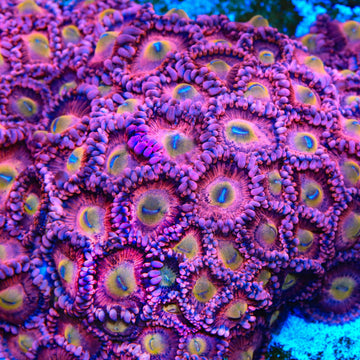
TSA Blueberry Stylophora Coral
Overview
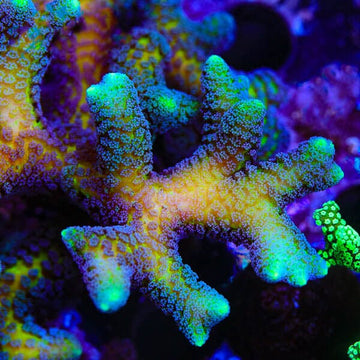
Blueberry Stylophora Coral forms dense, thick-branching clusters with small, closely spaced polyps and blue to purple hues. Stylophora pistillata is a small-polyp stony branching coral; it prefers moderate to high light and strong, turbulent water flow. It is primarily photosynthetic via symbiotic algae, but occasional small particle or coral food feedings can support growth and deepen coloration. Place high on stable rockwork with space from aggressive neighbors, as its short sweeper tentacles can still sting on contact.
Quick Facts
Care
Moderate
Lighting
Moderate–High
Flow
Moderate–High
Placement
Mid–High
Temperament
Semi-aggressive (3–4 inches spacing)
Recommended Parameters
Temp
76–80°F
pH
8.1–8.4
Salinity
1.025–1.026
Calcium
400–450 ppm
AlkAlkalinity
8–9 dKH
Magnesium
1250–1350 ppm
Feeding
photosynthetic, microplankton, rotifers, copepod nauplii, cyclops, reef-specific powdered coral foods (e.g., Reef Roids), very fine zooplankton suspensions, amino acid supplements
Care & Placement
FAQ
Frequently Asked Questions
About the TSA Blueberry Stylophora Coral
-
Why does my Blueberry Stylophora lose its blue tips and turn purple or brown?
Color shifts often track spectrum, PAR, and minor elements. Aim for 200–350 PAR with strong 420–470 nm. Keep nutrients measurable (NO3 5–15 ppm, PO4 0.03–0.08 ppm); near-zero PO4 can pastel and thin tissue, excess browns it. Stable alkalinity 8–9 dKH is key. Low potassium trims blues/purples—test and maintain ~380–420 ppm. Avoid abrupt light changes; acclimate over 1–2 weeks. -
My colony is receding on the side facing the pump—what’s causing this pattern?
Stylophora dislikes constant, laminar flow blasting one face. This can cause tissue wear, detritus scouring, and localized STN. Provide high, turbulent, alternating flow with wide gyres or random pulses, not a narrow jet. Re-aim powerheads so branches sway from multiple directions. Check for alk swings and detritus accumulation in branch bases, and gently baste debris during maintenance. -
Can clownfish or crabs irritate Stylophora pistillata?
Yes. Some clowns adopt bushy SPS, rubbing off tissue over time. If hosting occurs, add an alternative (e.g., large Euphyllia or a faux nem) or use a mesh cage until clowns lose interest. Emeralds are usually safe; decorator and some hermits may pick at polyps. Nighttime sweeper stings are short but can mark close neighbors; keep a few centimeters of space. -
How do I troubleshoot sudden tip burn or rapid tissue loss on Stylophora?
Tip burn often follows alkalinity spikes or rapid PAR increases. Verify alk stability (daily swing <0.2 dKH) and reduce light 20–30% temporarily. For RTN/STN, frag healthy branches ahead of the recession, dip in an SPS-safe antiseptic (e.g., povidone-iodine at appropriate dilution), and add fresh carbon to mitigate chemical warfare from soft corals. Ensure temperatures stay 24–26°C with good gas exchange.