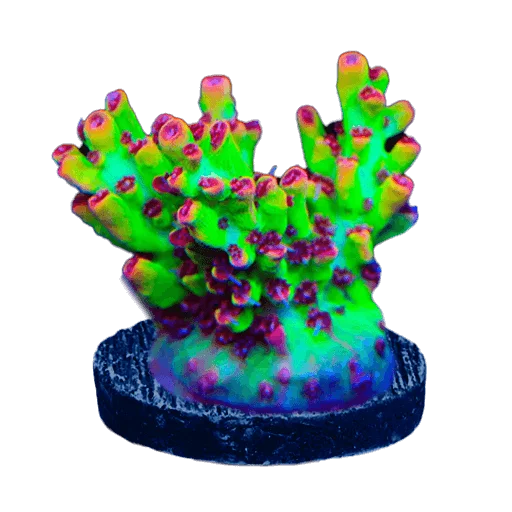
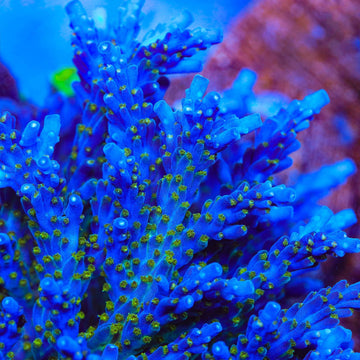
TSA Blueberry Shortcake Acropora Coral
Overview
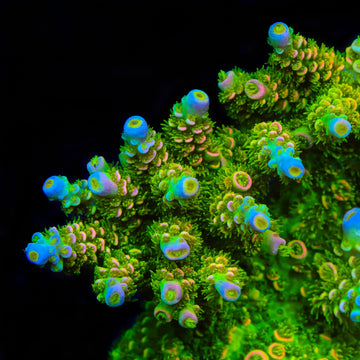
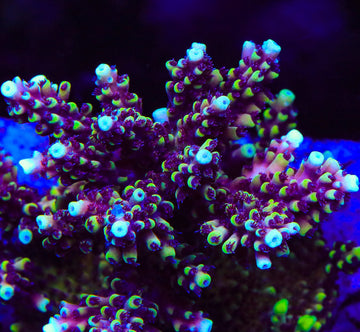
Blueberry Shortcake Acropora Coral features tightly branched stalks with contrasting colored tips. Acropora microclados is a small-polyp stony branching coral that prefers strong light and brisk, variable water flow. It relies mainly on symbiotic algae for energy but benefits from occasional small planktonic foods to support growth and color. Place high on stable rockwork with space from aggressive corals, and keep parameters steady to prevent tissue loss.
Quick Facts
Care
Difficult
Lighting
High
Flow
High
Placement
High
Temperament
Peaceful (3–4 inches spacing)
Recommended Parameters
Temp
77–79°F
pH
8.1–8.4
Salinity
1.025–1.026
Calcium
420–450 ppm
AlkAlkalinity
7.5–9 dKH
Magnesium
1300–1400 ppm
Feeding
photosynthetic (primary), microplankton, rotifers, copepod nauplii, zooplankton suspensions, coral-specific powdered foods (e.g., Reef-Roids), amino acid supplements, phytoplankton (sparingly), bacterioplankton-rich reef snow
Care & Placement
FAQ
Frequently Asked Questions
About the TSA Blueberry Shortcake Acropora Coral
-
Why does my Blueberry Shortcake lose its blue and pink highlights and turn mostly green?
Color shifts usually track light spectrum, nutrients, and potassium. Aim for 250–400 PAR with strong 420–450 nm. Keep NO3 around 5–15 ppm and PO4 0.03–0.08 ppm; too lean washes colors, too rich browns it. Maintain potassium 380–420 mg/L and stable alkalinity 7.5–8.5 dKH. Increase random flow to reduce shading and detritus that dulls tips. -
How can I encourage dense, corymbose branching rather than leggy growth?
Provide high, turbulent flow that changes direction to mimic surge; avoid laminar streams. Keep strong blue-heavy light and prevent self-shading by pruning horizontal plates. Allow the base to fully encrust before raising PAR to push vertical branches. Maintain stable alkalinity and calcium to avoid tip burn, and avoid sudden nutrient dips that cause thin, spaced branching. -
I’m seeing tip necrosis without base recession—what should I check first?
Tip die-off often follows alkalinity spikes, sudden PAR increases, or trace imbalances. Verify dKH stability (daily swing <0.3), reduce PAR 15–20% temporarily, and increase crossflow to cool hot spots. Check potassium and iodine levels; deficits blunt pigments and healing. Inspect for sting marks from nearby LPS sweepers and relocate if any contact is possible at night. -
Are there tankmates or coral neighbors that commonly stress this coral?
Avoid close placement to aggressive LPS with long sweepers and soft corals that shed terpenes; run carbon and keep distance. Some angels and butterflyfish nip at new axial tips. Maintain space from fast-growing Montipora that can shadow or overgrow the base. Introduce new Acropora with a dip and quarantine to prevent AEFW or red bug transfer.