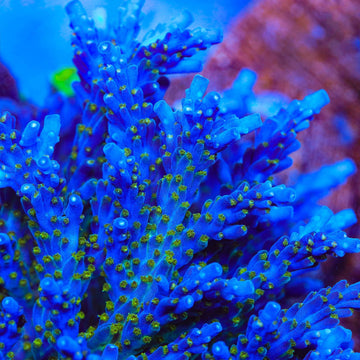
TSA Blue Flame Acropora Coral
Overview
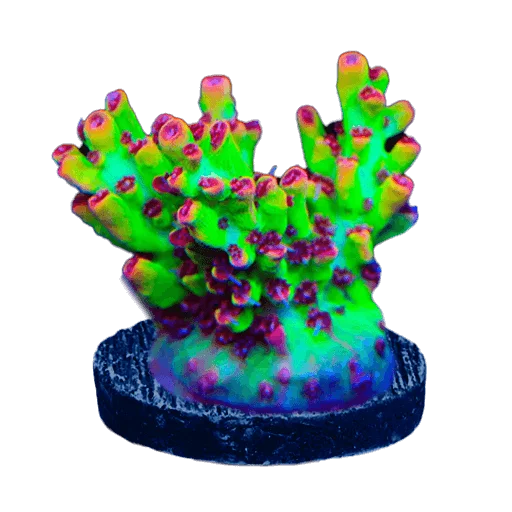
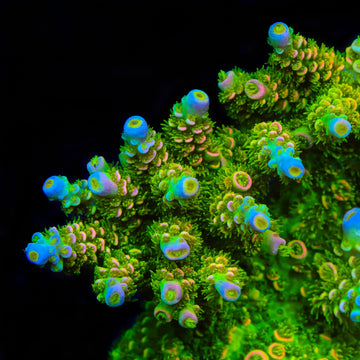
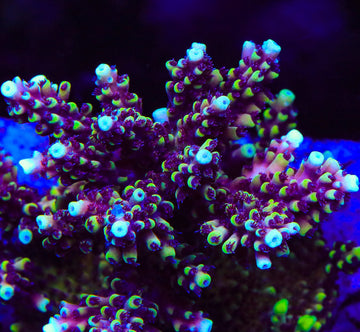
Blue Flame Acropora Coral shows thin, upright branches with bright blue tips and tight corallites. Acropora sp., a small-polyp stony branching coral, prefers strong lighting and strong, turbulent water flow. It relies on symbiotic algae for most nutrition but can benefit from occasional small planktonic foods to support growth and color. Place high on stable rockwork with room to grow, and keep clear of aggressive neighbors and sudden changes in water conditions.
Quick Facts
Care
Difficult
Lighting
High
Flow
High, turbulent
Placement
High
Temperament
Peaceful (3–6 inches spacing)
Recommended Parameters
Temp
77–80°F
pH
8.1–8.4
Salinity
1.025–1.026
Calcium
420–450 ppm
AlkAlkalinity
7–9 dKH
Magnesium
1250–1350 ppm
Feeding
photosynthetic (primary), microplankton, rotifers, copepod nauplii, oyster eggs, powdered coral foods (e.g., Reef-Roids), amino acid supplements
Care & Placement
FAQ
Frequently Asked Questions
About the TSA Blue Flame Acropora Coral
-
Why are the vivid blue tips on my Blue Flame Acropora Coral fading to teal or brown?
Color shift often tracks light spectrum, nutrients, and trace balance. Aim for PAR ~250–350 with strong blue/UV channels. Keep NO3 around 2–10 ppm and PO4 0.03–0.08 ppm; too lean or too dirty both mute color. Maintain alk 7.5–8.5 dKH with minimal swing. Potassium 380–420 ppm and a small amount of iron help blue fluorescence. Avoid excessive white intensity that can wash pigments. -
What flow pattern keeps Acropora sp. polyp extension high without causing tissue recession?
Provide strong, random, crossflow rather than a single laminar blast on the axial tips. Use alternating pumps or gyres to create turbulent surges, targeting 30–50x display turnover. Ensure flow reaches the base to prevent detritus buildup. If tips look “burned,” reduce direct velocity, not overall flow. Good gas exchange and stable temperature also improve extension, especially after lights ramp up. -
What are early STN/RTN signs in this coral, and how should I respond?
Watch for matte, receding tissue at the base (STN) or rapid, sloughing loss (RTN). Immediately frag 5–10 mm into healthy tissue, perform an iodine or antiseptic dip, and boost flow around the colony. Check for parameter instability—alk swings are a common trigger. Verify temperature 24–26°C, rule out pests, and consider short-term carbon use to reduce allelopathic stress from neighboring corals. -
Can Blue Flame Acropora Coral be placed near LPS or other fast growers?
Keep several inches of space from LPS with long sweepers (e.g., Euphyllia) and avoid direct shade from plating corals. Run carbon and ensure good skimming if the tank hosts chemical-aggressive species. Among Acropora sp., separate colonies to prevent base-to-base warfare and pest transfer. Plan the scape for upward, branching growth and future spacing; trimming surrounding corals prevents light deprivation that leads to base recession.