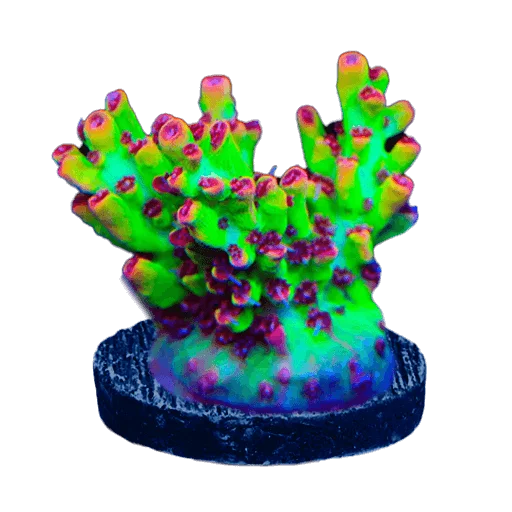
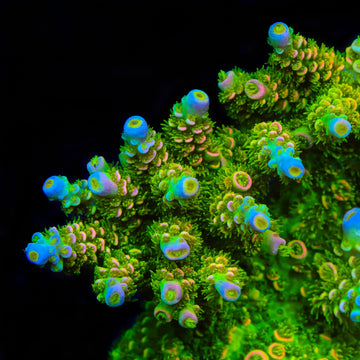
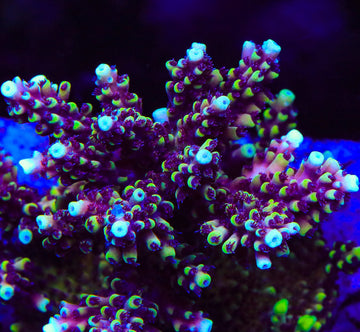
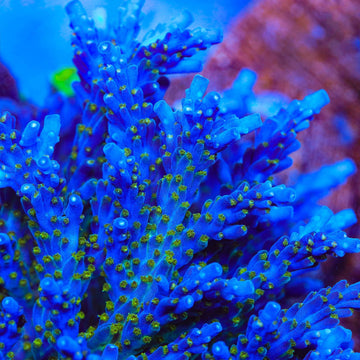
TSA Bill Murray Acropora Coral
Overview
Bill Murray Acropora Coral displays tight, upward-branching tips with contrasting polyp color. Acropora tenuis is a small-polyp stony branching coral that prefers strong light and moderate to high, turbulent water flow. It relies mainly on symbiotic algae for energy but benefits from occasional small-particle foods, which can support growth and color. Place high on stable rockwork with ample space from aggressive neighbors, and maintain steady alkalinity and nutrient levels.
Quick Facts
Care
Difficult
Lighting
High
Flow
High
Placement
High
Temperament
Peaceful (3–4 inches spacing)
Recommended Parameters
Temp
76–80°F
pH
8.1–8.4
Salinity
1.025–1.026
Calcium
420–450 ppm
AlkAlkalinity
7–9 dKH
Magnesium
1280–1350 ppm
Feeding
photosynthetic (primary), microplankton, zooplankton, rotifers, copepod nauplii, oyster eggs, powdered coral foods, amino acids
Care & Placement
FAQ
Frequently Asked Questions
About the TSA Bill Murray Acropora Coral
-
Why does my Bill Murray Acropora (Acropora tenuis) lose its yellow/pink highlights while the base stays green?
This strain’s pigments respond strongly to spectrum and nutrients. Aim for PAR 250–350 with strong 420–450 nm blue and some 390–405 nm violet. Keep NO3 around 5–15 ppm and PO4 0.03–0.08 ppm; too lean or sudden drops wash out tips and corallite color. Maintain alk 7.5–8.5 dKH; high alk under intense light with low nutrients can cause pale or “burnt” tips. -
The colony encrusts well but stalls before branching—how can I kickstart vertical growth?
Give it room to plate out first; tenuis often builds a thick base before pushing axial tips. Use high, indirect flow that sweeps across the rim, not straight at the axial corallites. Slowly ramp PAR over weeks once the base rims the plug/rock. Trimming a few outer nubs can redirect energy to new vertical shoots; avoid large cuts all at once. -
I’m seeing base recession in shaded areas—what’s the best fix without moving the whole colony?
Reduce self-shadowing by pruning a couple of inner branches to open light lanes, and rotate the frag or colony 30–60 degrees. Add a side-light source or slightly widen spread if using LEDs. Increase cross-flow to keep the base clean. Check alk stability and nutrients; RTN/STN at the base often follows small alk swings combined with low PO4. -
Are there pests or subtle signs this strain shows earlier than other Acropora?
Tenuis often “telegraphs” trouble with reduced daytime polyp extension and faint bite tracks before flatworms are evident. Blast the colony with a baster to check for AEFW plumes and inspect for eggs on the underside rim. Red bugs cause tip dulling and poor polyp extension. Implement a regular dip/inspection schedule and consider quarantining new acros.