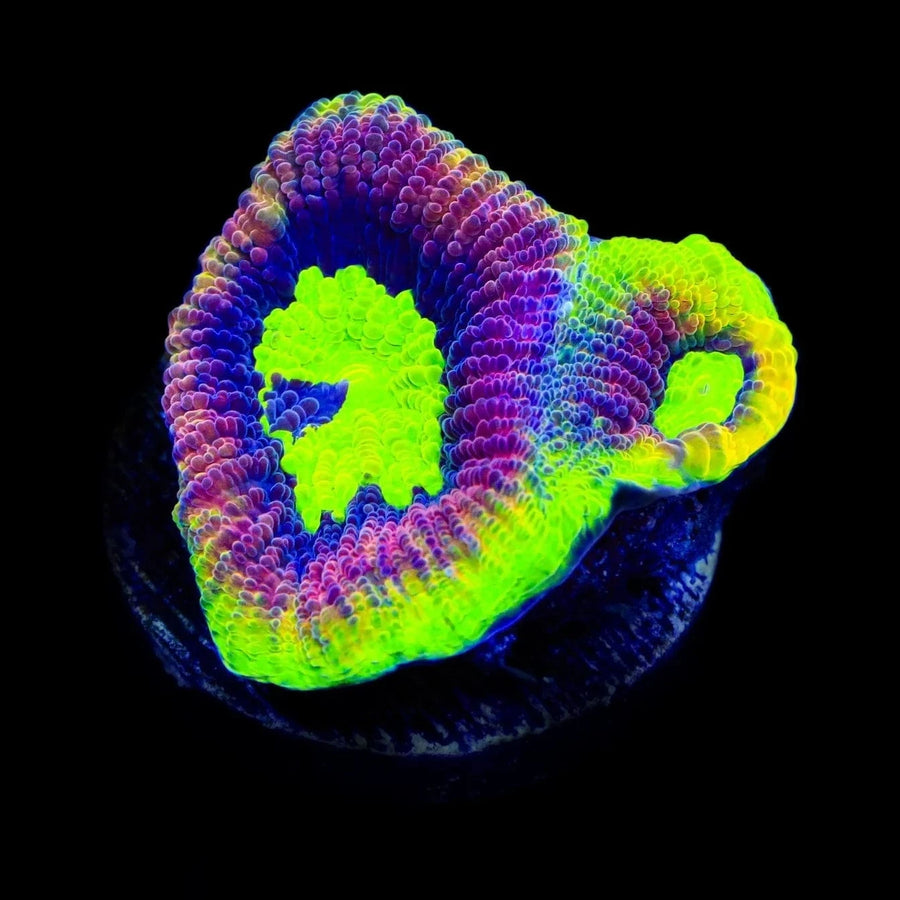
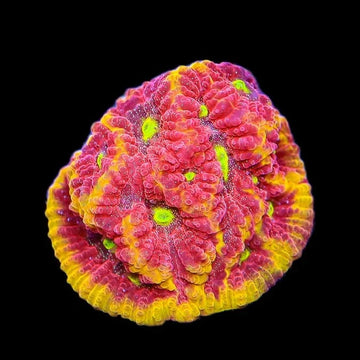
TSA Big Bang Favia Coral
Overview
Big Bang Favia Coral features large, round corallites with contrasting mouths and ridged walls. Favia favus is a stony, massive brain coral; it does well under moderate light and low to moderate, indirect flow. It is photosynthetic via symbiotic algae but benefits from occasional small meaty foods at night, which can improve growth and color. Place with space around it, as sweeper tentacles can sting nearby corals.
Quick Facts
Care
Moderate
Lighting
Low–Moderate
Flow
Moderate indirect
Placement
Low–Mid
Temperament
Semi-aggressive (night sweeper tentacles; 4–6" spacing)
Recommended Parameters
Temp
76–80°F
pH
8.1–8.4
Salinity
1.025–1.026
Calcium
400–450 ppm
AlkAlkalinity
8–10 dKH
Magnesium
1250–1350 ppm
Feeding
photosynthetic, mysis shrimp, enriched brine shrimp, finely chopped seafood (krill, clam, shrimp), zooplankton, microplankton, coral-specific powdered foods (reef roids), target-fed small meaty foods
Care & Placement
FAQ
Frequently Asked Questions
About the TSA Big Bang Favia Coral
-
How does Big Bang Favia (Favia favus) actually expand, and how much space should I give it?
It grows as a thick encrusting dome with tight, polygonal corallites, then plates outward over rock. Expect slow but steady lateral creep that can overrun small frags nearby. At night it extends short but potent sweepers; allow 3–5 inches of clearance, more from fleshy LPS. Mount on a stable, slightly elevated surface so the rim doesn’t rub sand or trap detritus. -
My Big Bang’s neon speckles faded—what’s the likely cause and fix?
Color muffling often comes from excess PAR or elevated nutrients. If it looks pale, reduce white intensity and PAR; if it’s browning, gradually lower nitrate/phosphate to moderate levels. A blue/UV-leaning spectrum brings out fluorescence. Keep alk stable (8–9 dKH) and avoid rapid shifts. Target-feed at night 1–2 times weekly. Only adjust trace elements with testing data. -
I’m seeing localized tissue recession on one corallite—how should I respond?
First stabilize parameters (alk, temp, salinity) and increase gentle, laminar flow to keep the rim clean. Inspect for vermetids or stinging neighbors. Trim sharp dead skeleton edges that can cut tissue. Perform an iodine-based dip and place the coral on a clean, raised plug. Feed small meaty foods after lights out to support recovery. Avoid sand abrasion and strong, direct jetting. -
Can I train Big Bang Favia to accept food with lights on?
Yes. Start feeding 30–60 minutes after lights out when feeders are extended, then progressively shift earlier by ramping blues while keeping whites low. Turn off pumps, waft scent with aminos or thawed food juice, then offer fine meaty foods. Keep portions small to avoid film algae. With consistency, it will show a reliable daytime feeding response.