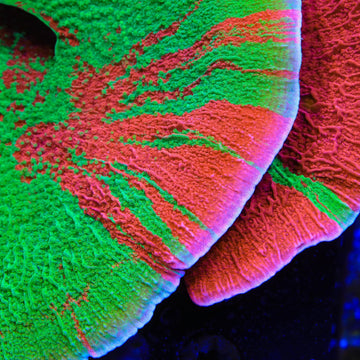
TSA Beast Montipora Coral
Overview
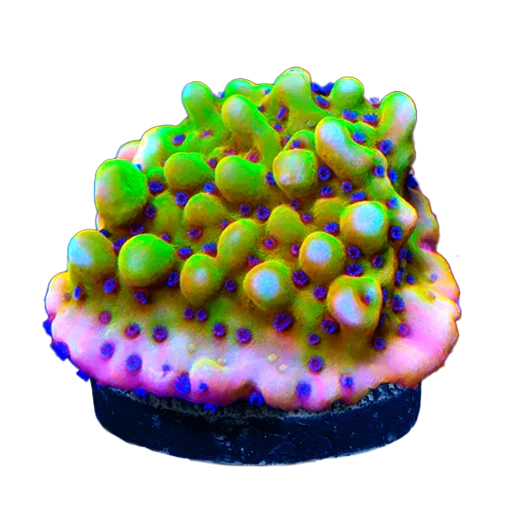
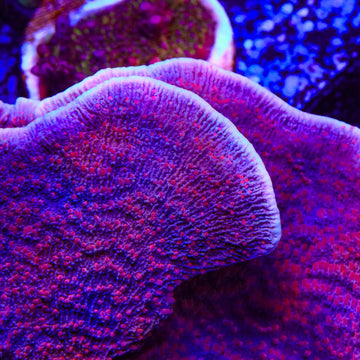
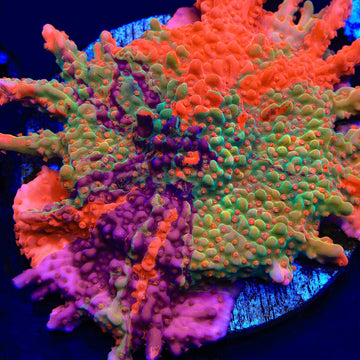
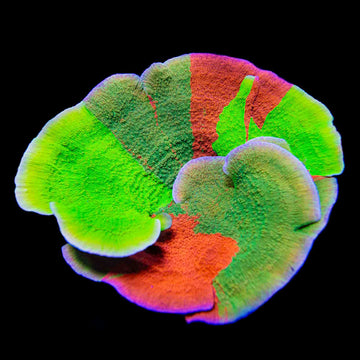
Beast Montipora Coral shows rugged plating with nodular ridges and contrasting polyps. Montipora sp. is a small-polyp stony coral forming plates and encrusting shelves; it prefers moderate to strong lighting and moderate to high, turbulent water flow. It is primarily photosynthetic through symbiotic algae but accepts fine particulate foods, which can support faster growth and deeper coloration. Place on stable rock with space to expand, and prevent contact with aggressive stinging corals or shading by fast growers.
Quick Facts
Care
Moderate
Lighting
Moderate–High
Flow
Moderate, indirect
Placement
Mid–High
Temperament
Peaceful to semi-aggressive (2–3 inches spacing)
Recommended Parameters
Temp
76–80°F
pH
8.1–8.4
Salinity
1.025–1.026
Calcium
400–450 ppm
AlkAlkalinity
8–9 dKH
Magnesium
1250–1350 ppm
Feeding
photosynthetic (primary), phytoplankton, microplankton, rotifers, copepod nauplii, marine snow, amino acid supplements, coral-specific powdered foods
Care & Placement
FAQ
Frequently Asked Questions
About the TSA Beast Montipora Coral
-
Why does my Beast Montipora switch between plating, encrusting, and nodular growth?
Morphology shifts with environment. Lower light/flow encourages broad plating to capture light; higher, turbulent flow and brighter light favor tighter nodules and stronger encrustment. Nutrient levels also guide thickness—lean systems produce thinner plates. To steer shape, adjust PAR (target ~200–350), create chaotic flow, and place the coral where it can expand without shading itself. -
My Beast Montipora’s colors dulled from neon to brown—what’s the likely cause?
Usually excess zoox density from low PAR or elevated nutrients, or spectrum skewed too warm. Aim for steady NO3 ~5–15 ppm, PO4 0.03–0.1, PAR 200–350, and strong blue/violet peaks (400–470 nm). Avoid rapid light increases that bleach tissue. Trace balance (especially iron/manganese) and stable alk 8–9 dKH support fluorescence. -
The base is receding while the rim grows—how do I stop basal STN?
This often follows self-shading, detritus accumulation, or alkalinity instability. Trim or reposition to reduce shadow, increase cross-flow under the colony, and keep alk swings under 0.3 dKH/day. Check for vermetid snails irritating tissue. Siphon detritus routinely; a small tilt in mounting can improve underside flushing. -
How do I identify and eliminate Montipora-eating nudibranchs?
Look for scalloped bite marks and white patches starting on shaded undersides; check at night for tiny white nudis. Dip new and affected pieces, but manually remove egg spirals—they resist dips. Quarantine, repeat dips every 3–4 days for 2–3 weeks, and consider a hungry Halichoeres wrasse. Isolate all Montipora until clear.