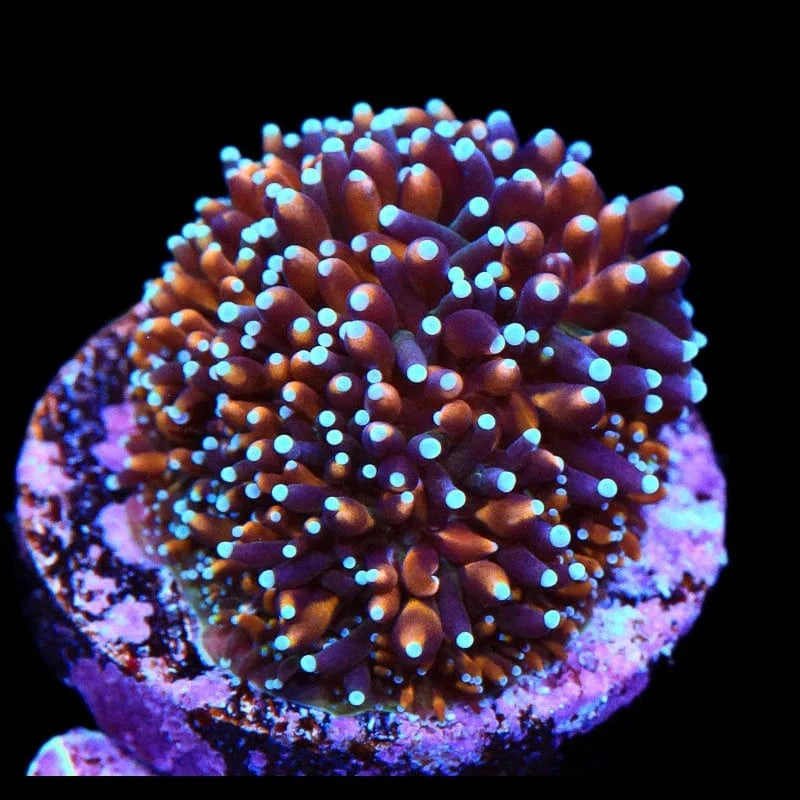
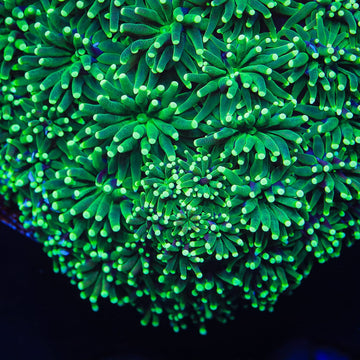
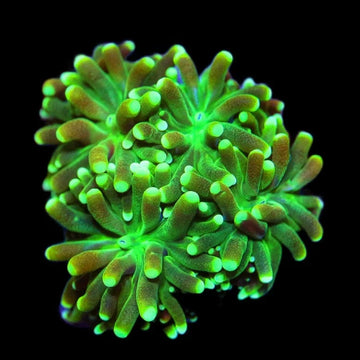
TSA Battlestar Galaxea Coral
Overview
Galaxy Coral displays star-like clusters of polyps with long sweeper tentacles that extend at night. Galaxea fascicularis is a large-polyp stony coral forming encrusting to branching colonies; it prefers moderate lighting and moderate, indirect water flow. It hosts symbiotic algae for most of its energy but accepts small meaty foods or planktonic fare, which can boost growth and polyp fullness. Place it with ample space from other corals, as sweeper tentacles can sting several inches away.
Quick Facts
Care
Moderate
Lighting
Moderate
Flow
Moderate–High
Placement
Mid–Low
Temperament
Highly aggressive; long sweeper tentacles (6–10 inches clearance)
Recommended Parameters
Temp
75–80°F
pH
8.1–8.4
Salinity
1.025–1.026
Calcium
400–450 ppm
AlkAlkalinity
8–10 dKH
Magnesium
1250–1350 ppm
Feeding
photosynthetic (primary), mysis shrimp, enriched brine shrimp, finely chopped seafood, zooplankton, microplankton, coral-specific powdered foods
Care & Placement
FAQ
Frequently Asked Questions
About the TSA Battlestar Galaxea Coral
-
Why does my Galaxy Coral (Galaxea fascicularis) send out extra-long sweepers some nights but not others?
Sweeper length varies with feeding cycles, nearby rivals, and flow. After heavy feeding or when sensing neighbors, it can push 6–12-inch sweepers. In very low flow, they travel farther and linger. Give it an “island” with 8–12 inches of buffer, maintain random, moderate–strong flow at night, and run carbon if mixing with allelopathic softies to reduce chemical triggers. -
My Galaxea is receding from the edges despite stable parameters. What’s a less obvious cause?
Edge recession often ties to sediment loading and vermetid snail irritation rather than chemistry alone. Galaxea’s sharp septa trap detritus; smothering leads to slow tissue loss. Turkey-baste the colony and surrounding rock weekly, trim or control vermetids, and increase crossflow to keep pores clean. If tips are paling under high PAR, reduce intensity slightly and extend photoperiod instead. -
What lighting best preserves its neon greens without washing out or browning?
Aim for moderate PAR (100–200) with strong blue/royal channels. Intense white-heavy spectra can thin tissue at the margins; overly dim or nutrient-rich setups can brown it. Balance nutrients (nitrate 5–15 ppm, phosphate 0.03–0.1 ppm), keep alk steady, and tune blues for pop while avoiding harsh hotspots. Gradually acclimate when changing LEDs or lenses. -
Galaxea seems “happier” in slightly dirtier water. Is that safe long-term?
It tolerates turbid, higher-nutrient environments better than many LPS, but needs brisk, chaotic flow to prev