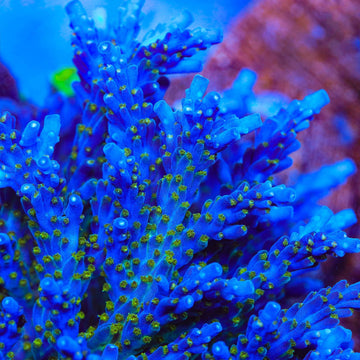
TSA Aquamarine Stag Acropora Coral
Overview
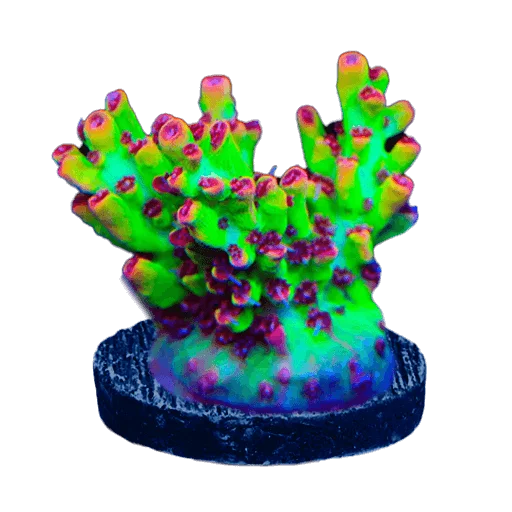
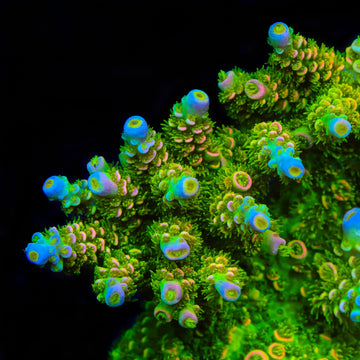
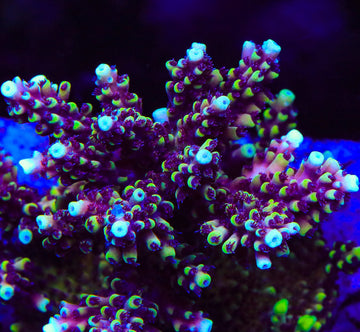
Aquamarine Stag Acropora Coral forms branching, stag-horn clusters with blue-green tips. Acropora sp. is a small-polyp stony coral that prefers strong lighting and high, turbulent water flow. It is primarily photosynthetic through symbiotic algae, though occasional small plankton feedings can support growth and color. Place high on stable rockwork with room for upward growth and avoid contact with stinging corals.
Quick Facts
Care
Difficult
Lighting
High
Flow
High, turbulent
Placement
High
Temperament
Peaceful (fast-growing; allow 3–4 inches spacing)
Recommended Parameters
Temp
76–80°F
pH
8.1–8.4
Salinity
1.025–1.026
Calcium
420–460 ppm
AlkAlkalinity
7–9 dKH
Magnesium
1280–1350 ppm
Feeding
photosynthetic (primary), microplankton, rotifers, copepod nauplii, coral powders (e.g., Reef-Roids), oyster eggs, very fine phytoplankton, amino acid supplements
Care & Placement
FAQ
Frequently Asked Questions
About the TSA Aquamarine Stag Acropora Coral
-
Why does my Aquamarine Stag Acropora shift from blue-green to brown or pastel, and how can I keep its aquamarine hue?
Color shifts reflect light spectrum, PAR, and nutrients. Target 250–350 PAR with strong blue/royal blue. Keep nitrate 2–10 ppm and phosphate 0.02–0.08 ppm; zeroed nutrients yield washed-out pastels, while excess phosphate causes browning. Maintain stable alkalinity (7.5–8.5 dKH). Minor iron and iodine via balanced trace can deepen tones, but avoid chasing color with large, sudden dosing changes. -
My Acropora sp. is forming thin, upward antlers with shadowed bases—normal or a flow/lighting issue?
Staghorns prioritize axial tip growth in high light and flow; thin, fast-growing tips are normal. Shadowed bases indicate insufficient side lighting and turbulent flow. Increase cross-flow to ruffle polyps on all sides, and adjust fixtures or add a fill light to reduce self-shading. Periodic tip pruning opens the colony, improving light penetration and base encrustation. -
How can I tell the difference between healthy pale tips and early tissue loss on this coral’s branches?
Healthy axial tips look matte-white from fresh skeleton with quick tissue overgrowth and strong polyp extension below. Early STN/RTN shows stark, peeling margins and receding tissue with dull polyps. Check for alk spikes, temperature swings, and pests (AEFW bite marks, red bugs). Stabilize parameters, increase aeration/flow, and perform targeted dips if pests are confirmed. -
Are there unique compatibility concerns—can I place it near Montipora or Euphyllia?
Keep several inches of space from fleshy LPS (e.g., Euphyllia) to avoid nightly stings. Montipora caps won’t sting but can overgrow and shade stags; plan for upward growth and future diameter. Avoid nipping fishes (many angels, some butterflies). Run moderate carbon and maintain good export to manage chemical warfare in mixed reefs, and prevent slugging flow with dense neighbors.