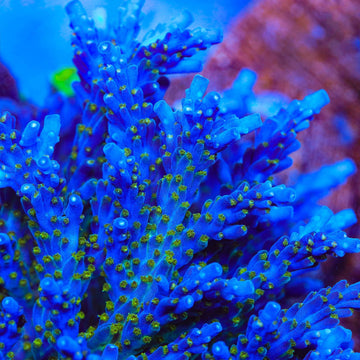
TSA Aqua Matrix Acropora Coral
Overview
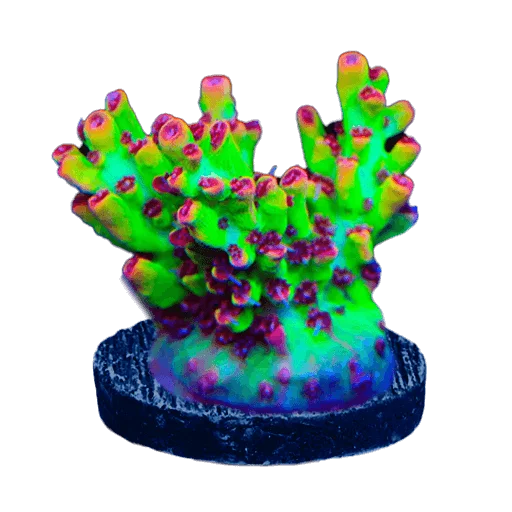
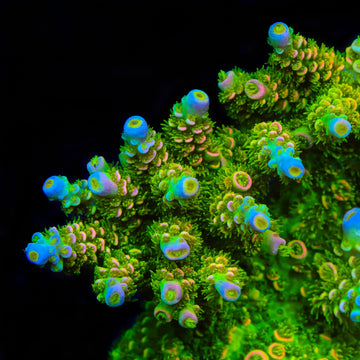
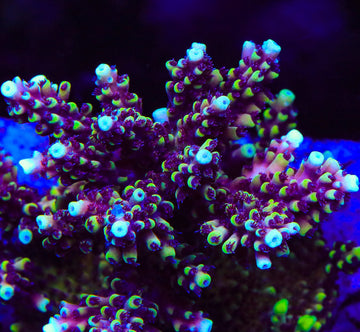
Aqua Matrix Acropora Coral shows tightly spaced, branching growth with fine axial tips. Acropora sp. is a hard, branching stony coral that prefers strong lighting and high, turbulent water flow. It relies mainly on symbiotic algae for energy, but occasional small-polyp foods can support growth and color. Place high on stable rockwork with room from neighbors, and keep alkalinity and calcium steady to avoid stress.
Quick Facts
Care
Difficult
Lighting
High
Flow
High, turbulent
Placement
High
Temperament
Peaceful (3–4 inches spacing)
Recommended Parameters
Temp
77–80°F
pH
8.1–8.4
Salinity
1.025–1.026
Calcium
420–450 ppm
AlkAlkalinity
7–9 dKH
Magnesium
1250–1350 ppm
Feeding
photosynthetic (primary), microplankton, zooplankton (rotifers, copepod nauplii), oyster eggs, reef roids, phytoplankton (sparingly), amino acid supplements
Care & Placement
FAQ
Frequently Asked Questions
About the TSA Aqua Matrix Acropora Coral
-
Why does my Aqua Matrix Acropora grow thick branch tips but stall at the base?
This morph often prioritizes axial tip growth under strong light and flow. If the base stalls or recedes, suspect shadowing, insufficient random turbulence, or elevated phosphate causing detachment of tissue from older skeleton. Increase cross-flow to sweep detritus from the base, trim neighboring overhangs, and nudge PAR to 275–350 at the colony’s lower half. Maintain alkalinity stability; even small swings can halt encrust -
How can I keep the signature blue/teal “matrix” coloration from washing out to brown or pale?
Balance light, nutrients, and key traces. Keep NO3 around 2–10 ppm and PO4 0.03–0.08 ppm; too lean causes paling, too rich leads to browning. Provide strong blue spectrum (peaks near 420–460 nm) with a modest white channel. Maintain potassium 390–420 ppm and iodine in natural seawater ranges; low K+ and I often mute blue/green tones. Avoid rapid intensity changes. -
I’m seeing daytime polyp retraction and micro-bite marks—what’s the likely culprit and fix?
Two common offenders: red bugs (Tegastes) and Acropora-eating flatworms (AEFW). Red bugs cause persistent low PE; AEFW leave crescent bite scars and beige egg clusters on undersides. Inspect at night with a flashlight. Treat red bugs via in-tank interceptor protocol; for AEFW, remove, dip (e.g., iodine or Bayer method), scrape eggs, and repeat weekly for 4–6 weeks. Increase wrasse predation and quarantine new frags. -
Why do I get sudden basal tissue necrosis after a water change even though parameters look fine?
Rapid shifts in carbonate saturation, temperature, or ionic balance (especially alkalinity or potassium) can trigger STN at the base. Large carbon changes after heavy allelopathy also shock tissue. Match temp and salinity precisely, cap alkalinity swings to ≤0.3 dKH per day, and refresh carbon in smaller portions. If STN starts, stabilize parameters, increase flow at the base, iodine dip affected areas, and preemptively frag healthy tips.