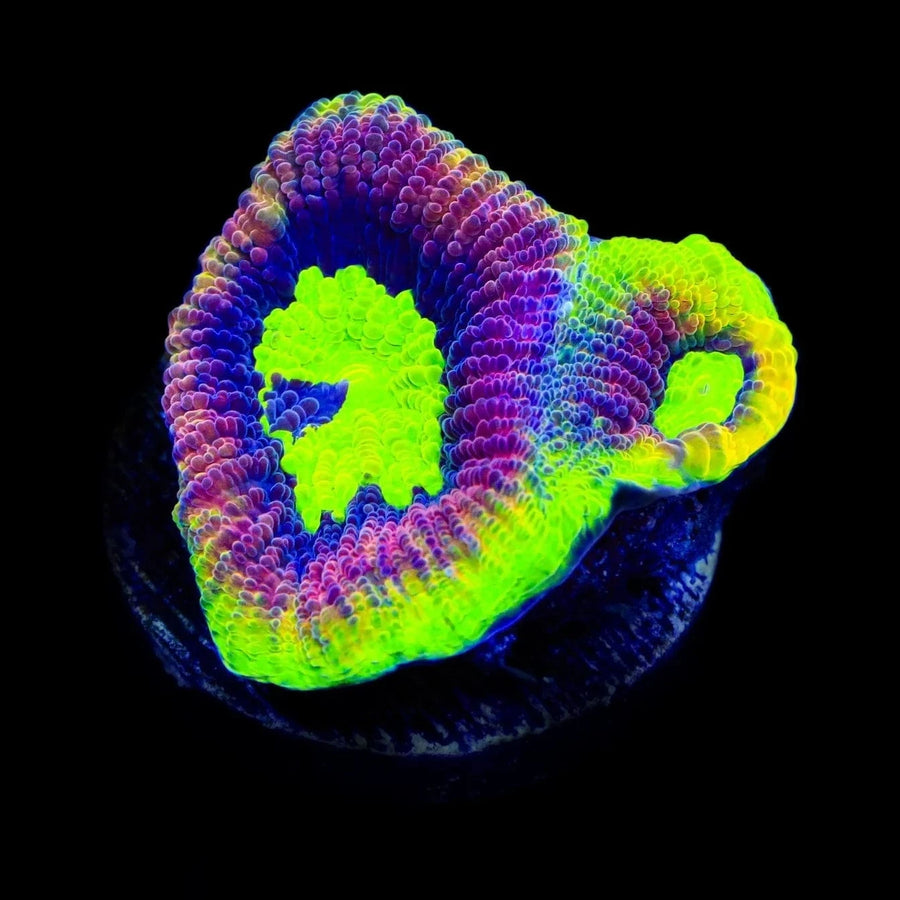
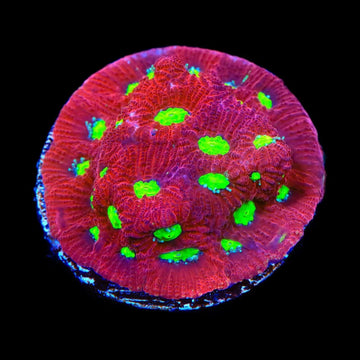
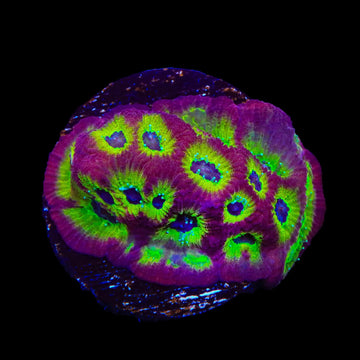
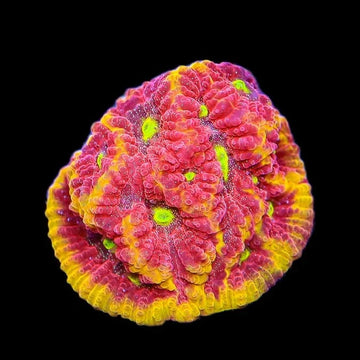
TSA Antivenom Favia Coral
Overview
Antivenom Favia Coral shows tight, hexagonal corallites with contrasting mouths and ridges. Favia favus is a stony, massive brain coral; it does well under moderate light and moderate, indirect flow. It is photosynthetic via symbiotic algae but accepts small meaty foods at night, which can boost growth and deepen color. Give several inches of space due to nighttime sweeper tentacles, and place on stable rock or sand with room to expand.
Quick Facts
Care
Moderate
Lighting
Low–Moderate
Flow
Moderate, indirect
Placement
Low–Mid
Temperament
Semi-aggressive (3–6 inches spacing due to long night sweepers)
Recommended Parameters
Temp
76–80°F
pH
8.1–8.4
Salinity
1.025–1.026
Calcium
400–450 ppm
AlkAlkalinity
8–9.5 dKH
Magnesium
1250–1350 ppm
Feeding
photosynthetic, mysis shrimp, enriched brine shrimp, finely chopped marine meats, zooplankton, microplankton, coral-specific powdered foods, marine snow
Care & Placement
FAQ
Frequently Asked Questions
About the TSA Antivenom Favia Coral
-
Why does my Antivenom Favia send out very long sweepers some nights and barely any on others?
Favia favus responds to nearby chemical cues and feeding opportunities. After spot-feeding or when sensing neighbors, it can extend 2–6 inch sweepers to claim space. Variability also tracks flow and nocturnal pH/ORP shifts. Give at least 4–6 inches of clearance, run a stable flow pattern, and feed earlier in the photoperiod to reduce late-night aggression. -
My colony’s rim grows fast but the center looks dull—what’s causing the “shadow fade”?
As the rim thickens, it can shade central corallites, reducing PAR and food capture. Rotate the colony 90° every 1–2 weeks, increase gentle cross-flow to deliver particulates to the center, and target-feed inner mouths. Slightly raise overall PAR gradually (10–15% over two weeks) to re-energize shaded tissue. -
How can I keep the Antivenom colors from shifting toward brown or washed-out?
This morph stays vivid under stable nutrients (NO3 5–15 ppm, PO4 0.03–0.08), moderate PAR (100–180), and a blue-heavy spectrum (peaks 420–470 nm). Excess white or UV can bleach tips; ultra-low nutrients mute fluorescence. Feed small meaty foods 2–3x weekly, avoid abrupt light changes, and maintain consistent iron/iodine via regular water changes. -
I’m seeing nocturnal tissue lifting—could this be polyp bailout, and how do I stop it?
Yes, bailout can follow acute stress: high velocity flow, sudden PAR spikes, or alkalinity swings. Immediately lower flow intensity, reduce light 20–30% for a week, and correct chemistry slowly (alk 8–9 dKH, Ca ~420, Mg ~1300). Perform an iodine dip if tissue is ragged. Resume gentle feeding once inflation returns at night.