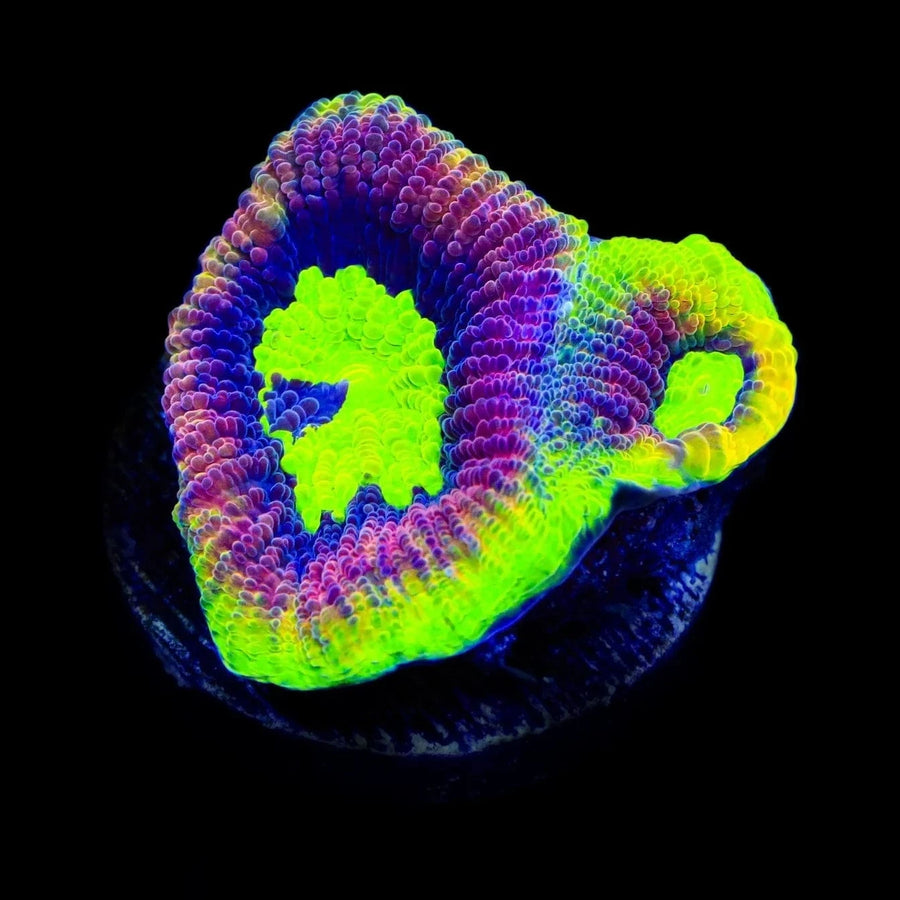
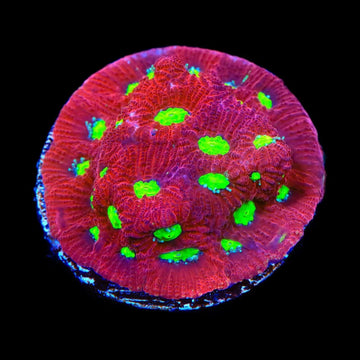
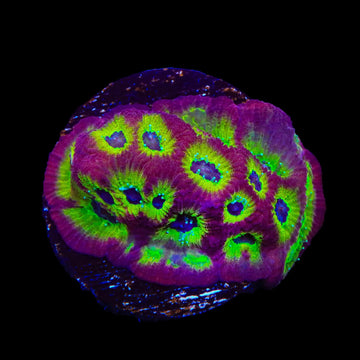
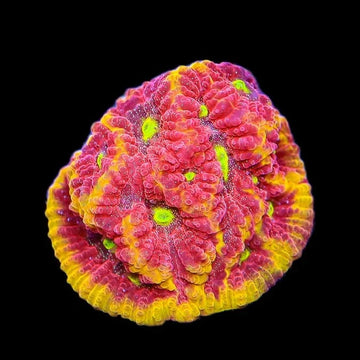
TSA Alien Eye Favia Coral
Overview
Alien Eye Favia Coral shows bright neon centers (“eyes”) within polygonal corallites bounded by thick ridges. Favia favus is a large-polyp stony, dome-forming coral; provide moderate light and moderate, indirect water flow. It is photosynthetic with symbiotic algae but benefits from occasional small meaty foods at night, which can support faster growth and richer color. Place on stable rock with space around it, as sweeper tentacles extend after dark and can sting nearby corals.
Quick Facts
Care
Easy
Lighting
Low–Moderate
Flow
Moderate, indirect
Placement
Low–Mid
Temperament
Semi-aggressive (4–6 inches spacing)
Recommended Parameters
Temp
76–80°F
pH
8.1–8.4
Salinity
1.025–1.026
Calcium
400–450 ppm
AlkAlkalinity
8–10 dKH
Magnesium
1280–1350 ppm
Feeding
photosynthetic, mysis shrimp, enriched brine shrimp, finely chopped seafood, chopped krill, zooplankton, microplankton, marine snow, coral-specific powdered foods (e.g., Reef-Roids), small LPS pellet foods
Care & Placement
FAQ
Frequently Asked Questions
About the TSA Alien Eye Favia Coral
-
How do I keep the “alien eye” colors from fading on Alien Eye Favia Coral?
Prioritize spectrum and nutrients. Moderate PAR (80–150) with strong blue bias preserves neon centers and contrasting rims; very high PAR can wash them out. Keep alk 8–9 dKH, nitrate 5–15 ppm, phosphate 0.03–0.10. Target feed small meaty foods weekly to deepen pigments. Avoid chronic shading or dirty film on tissue. Color often rebounds over 2–6 weeks once conditions stabilize. -
How aggressive are the sweepers, and how much space should I give it?
At night, Alien Eye Favia can throw 1–3 inch sweepers, occasionally longer in higher flow or after heavy feeding. Plan for at least 3–4 inches of buffer from fleshy LPS and acans; more if you run strong, laminar flow. If neighbors show sting marks, rotate flow to be more random, reduce heavy feeding near lights-out, and increase spacing. Daytime tentacles are much shorter. -
What growth pattern should I expect, and how should I frag it safely?
Favia favus will encrust first, then develop a low dome with ridges and shared walls. Place on rock with open perimeter for future spread; avoid tight crevices that trap detritus. For frags, cut in the valleys between mouths using a diamond saw or sharp bone cutters; avoid splitting a corallite. Dip in iodine, moderate flow for healing, and stable alk/calcium. New growth usually skins over within 1–3 weeks. -
Why is tissue receding from the base even though parameters look fine?
Base recession often stems from detritus accumulation and low microflow under the rim. Increase random flow to the collar, turkey-baste weekly, and check for vermetid snails or hydroids irritating tissue. You can halt creep by sealing the edge with a thin line of gel superglue after an iodine dip. Verify steady alkalinity (no daily swings) and avoid sand abrasion along the lower edge.