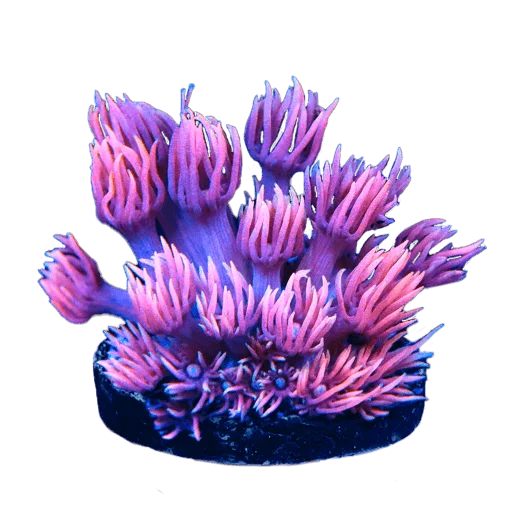
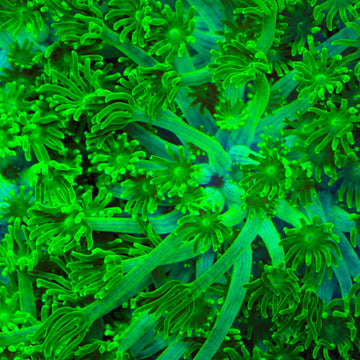
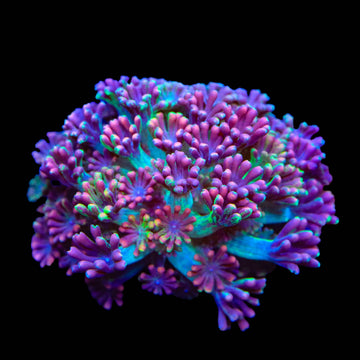
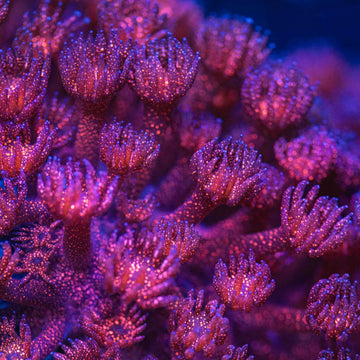
TSA Alice In Wonderland Goniopora Coral
Overview
Flowerpot Coral has long, daisy-like polyps on thin stalks that form a rounded bouquet. Goniopora stokesi is an LPS stony coral with a porous skeleton that prefers moderate light and gentle to moderate, indirect flow. It is photosynthetic through symbiotic algae but benefits from small particulate or meaty foods, which can support growth and fuller polyp extension. Place on a stable sandbed or low rock with open space, and avoid strong, direct flow and contact with aggressive corals.
Quick Facts
Care
Difficult
Lighting
Moderate
Flow
Moderate, indirect
Placement
Low
Temperament
Semi-aggressive (3–6 inches spacing)
Recommended Parameters
Temp
76–80°F
pH
8.1–8.4
Salinity
1.025–1.026
Calcium
420–450 ppm
AlkAlkalinity
8–9 dKH
Magnesium
1280–1350 ppm
Feeding
photosynthetic, microplankton, phytoplankton, zooplankton, rotifers, baby brine shrimp (nauplii), cyclops, oyster eggs, powdered coral foods (e.g., Reef-Roids), marine snow
Care & Placement
FAQ
Frequently Asked Questions
About the TSA Alice In Wonderland Goniopora Coral
-
Why do my Flowerpot Coral polyps extend fully for weeks, then retract for days without visible stress?
Goniopora stokesi often follows sporadic expansion cycles tied to feeding success and flow shifts. Brief “rest” periods are common, especially after heavy feeding or slight alkalinity changes. Check for vermetid snails or detritus accumulation at the base, and ensure moderate, indirect flow that sways but doesn’t bend stalks. Stable alkalinity and small, frequent feedings (e.g., rotifers, reef roids, oyster eggs) usually restore consistent extension. -
My green Goniopora is fading toward pastel—light issue or nutrition?
Often both spectrum and micronutrients matter. G. stokesi tends to hold greens under broad blue with some white; excessive blue-only can wash tones. Low iron and manganese can dull greens and reduce polyp vigor. Maintain measurable, not ultra-low, nutrients (NO3 5–15 ppm, PO4 0.03–0.1 ppm) and dose trace elements cautiously. Observe response over 2–3 weeks before making further spectrum changes. -
Can I keep Goniopora with clownfish that try to host in it?
It’s risky. Clownfish can abrade the delicate oral discs and cause recession or brown jelly infections. If hosting behavior starts, rehome the clowns or install a nem/alternative host. A protective mesh “cage” for a week or two can break the habit. Ensure the coral isn’t shaded by clown activity and keep flow consistent; stressed tissues are far more infection-prone. -
My Goniopora recedes from the base upward while tips stay extended—what’s causing this?
Base recession often signals abrasion or smothering. Sand movement, detritus under the rim, or a too-tight rock crevice can damage tissue. Place the colony where the skirt clears surrounding surfaces at full expansion, with gentle, oscillating flow to keep the base clean. Inspect for vermetid snails and filamentous algae encroachment. A short iodine dip and improved housekeeping usually halt the progression.