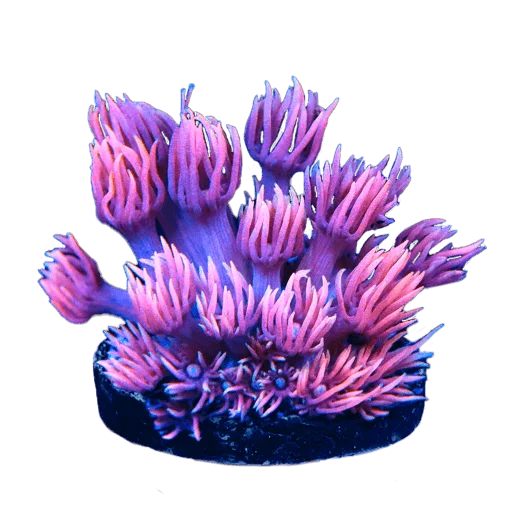
TSA Afterburn Goniopora Coral
Overview
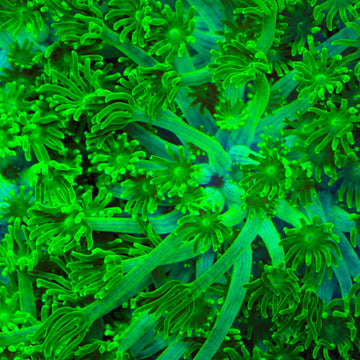
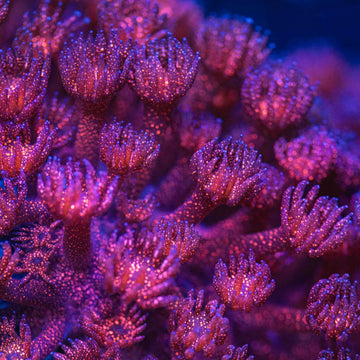
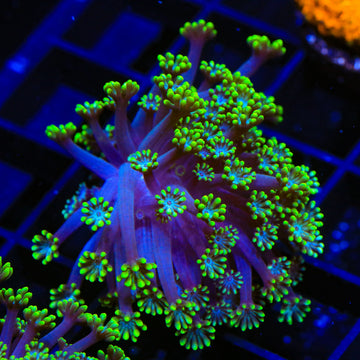
Afterburn Goniopora Coral shows long, daisy-like polyps with bright orange-red centers and contrasting tentacles. Goniopora sp. is a large-polyp stony coral forming encrusting to mound colonies; it prefers moderate light and gentle to moderate, indirect water flow. It is photosynthetic via symbiotic algae but benefits from occasional small particulate foods, which can support faster growth and fuller polyp extension. Place it on stable rock with space around the colony to prevent contact with neighbors and avoid strong, direct flow that collapses the polyps.
Quick Facts
Care
Difficult
Lighting
Moderate
Flow
Low–Moderate
Placement
Low–Mid
Temperament
Semi-aggressive (3–6 inches spacing)
Recommended Parameters
Temp
76–82°F
pH
8.1–8.4
Salinity
1.025–1.026
Calcium
400–450 ppm
AlkAlkalinity
8–9.5 dKH
Magnesium
1280–1350 ppm
Feeding
photosynthetic, phytoplankton, microplankton, rotifers, copepods, cyclops, coral-specific powdered foods, enriched brine shrimp nauplii, finely minced mysis shrimp
Care & Placement
FAQ
Frequently Asked Questions
About the TSA Afterburn Goniopora Coral
-
Why does my Afterburn Goniopora extend fully some days and stay tight on others?
Extension swings often track flow pulses, trace element availability, and micro-particulate food levels. Check for recent changes in gyres or clogged pumps causing direct blast. Maintain moderate, alternating flow and stable alkalinity (8–9 dKH). Slightly raise NO3 (5–15 ppm) and PO4 (0.03–0.08 ppm) if running ultra‑clean. Many see better extension with consistent small feedings and periodic iron/manganese dosing, but test and avoid overdosing. -
My bright orange coloration is fading—how can I keep the Afterburn look?
Color loss usually follows insufficient PAR or prolonged heavy blues without enough white/neutral spectrum. Target 90–150 PAR with a balanced spectrum and avoid sudden increases. Keep nutrients nonzero; starving systems wash out pigments. Feed fine foods (5–200 µm) 2–3× weekly. If moved, acclimate light over 2–3 weeks. Watch vermetid snails and film algae on tissue—they cause retraction that mimics color loss. -
How do I stop the slow “base-up” recession sometimes seen in Goniopora?
Act fast: stabilize alkalinity and pH, increase intermittent flow to keep detritus off the base, and adjust nutrients out of ULNS territory. Inspect for pests (vermetids, aiptasia at the base) and nip them. Siphon any brown jelly, then do an iodine dip. Consider a short cipro bath only if severe bacterial signs persist. Slightly elevate the colony off the sand to improve circulation around the skeleton. -
Can this coral live near torches or clowns that want to host it?
Torches and other aggressive LPS can sting and trigger chronic retraction; give several inches of space and an upstream position for the Goniopora. Clownfish “hosting” often leads to tissue wear and infections—discourage it or provide alternative anemone substitutes. Keep neighbors that cast shade (fast SPS) from overgrowing above it. Gentle, alternating flow helps minimize contact and keeps the polyps clean.