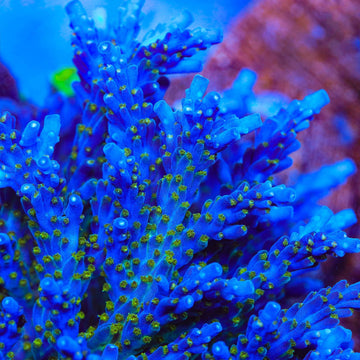
Tricolor Valida Acropora Coral
Overview
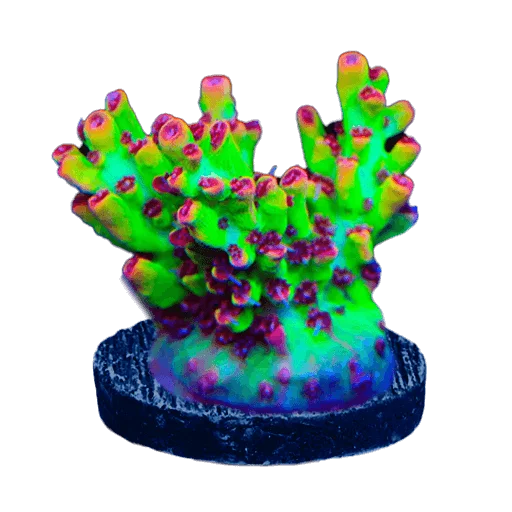
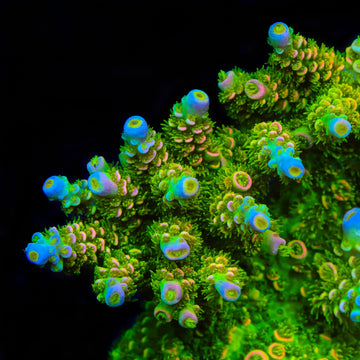
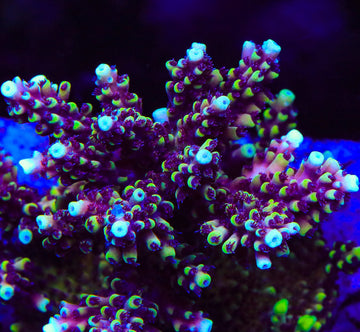
Tri-Color Valida Acropora Coral displays contrasting purple tips, green to tan branches, and pale axial growth points. Acropora valida is a small-polyp stony branching coral that thrives under strong lighting and high, turbulent water flow. It relies primarily on symbiotic algae for energy but can benefit from occasional fine particulate foods, which may support coloration and steady growth. Place high on the rockwork with ample space and avoid contact with aggressive neighbors, as its delicate branches can be damaged by stings or falls.
Quick Facts
Care
Difficult
Lighting
High
Flow
High
Placement
High
Temperament
Semi-aggressive (3–4 inches spacing)
Recommended Parameters
Temp
76–80°F
pH
8.1–8.4
Salinity
1.025–1.026
Calcium
420–450 ppm
AlkAlkalinity
7–9 dKH
Magnesium
1280–1350 ppm
Feeding
photosynthetic (primary), microzooplankton, rotifers, copepod nauplii, bacterioplankton/marine snow, coral-specific powdered foods, amino acids
Care & Placement
FAQ
Frequently Asked Questions
About the Tricolor Valida Acropora Coral
-
How do I keep the “tri-color” (cream/green base, purple tips, dark polyps) on Tri-Color Valida Acropora Coral?
Target PAR ~250–350 with strong violet/UV (400–430 nm), high, turbulent flow, and steady alkalinity 7.5–8.5 dKH. Avoid near-zero nutrients; aim NO3 2–10 ppm, PO4 0.03–0.08. Maintain potassium 380–420 and balanced trace metals. Acclimate to light over 2–3 weeks to prevent bleaching. Color dulls if nutrients bottom out or if PAR is high with unstable alkalinity. -
Why does my Acropora valida encrust for months before growing branches?
It’s “banking” energy and strengthening its base for stability in high-energy zones. Encourage by giving it space to plate out, strong cross-flow, and moderate-to-high PAR without shading. Avoid moving the frag; micro-movements slow calcification. Once the base is secure and axial corallites mature, vertical growth accelerates and maintains better tip coloration. -
What causes tip burn or sudden tissue loss on valida under bright light?
Often a mix of high PAR with alkalinity spikes (>0.2 dKH/day), rapid temperature swings, or low phosphate. Tips pale or burn when growth outruns nutrition. Stabilize alk and temp, keep PO4 detectable (0.03–0.08), increase random flow across tips, and reduce PAR 10–20% temporarily. For STN, frag into healthy sections, dip in iodine, and remount with strong flow around the margins. -
Are there pests that target Tri-Color Valida more than other Acropora?
AEFW and red bugs are common culprits. Watch for sandpaper-like bite tracks, tissue thinning between polyps, and poor polyp extension. Inspect at night with a blue flashlight; look for egg clusters on undersides. Quarantine, perform staged dips (commercial coral dips) for AEFW, and treat red bugs in QT with appropriate medication. Maintain wrasses as sentries, but don’t rely on fish alone.