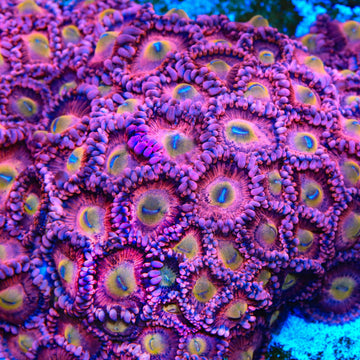
Time Warp Zoanthids Coral
Overview
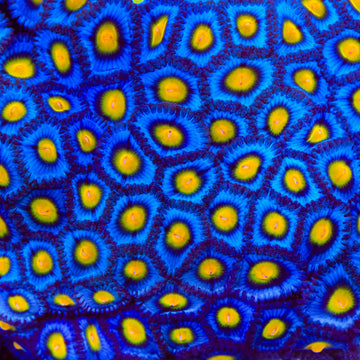
Time Warp Zoanthids Coral shows tightly packed polyps with contrasting inner rings and skirted edges. Classified as Zoanthus sp., it is a soft colonial polyp coral that does well under moderate light and moderate, steady water flow. It is primarily photosynthetic via symbiotic algae but accepts fine meaty foods, which can boost growth and deepen color. Place on isolated rock to control spreading, and keep space from aggressive neighbors to avoid stings.
Quick Facts
Care
Easy
Lighting
Low–Moderate
Flow
Moderate
Placement
Low–Mid
Temperament
Semi-aggressive (fast grower; 2–3 inches spacing)
Recommended Parameters
Temp
76–80°F
pH
8.1–8.4
Salinity
1.025–1.026
Calcium
380–450 ppm
AlkAlkalinity
8–10 dKH
Magnesium
1280–1350 ppm
Feeding
photosynthetic (primary), microplankton, phytoplankton, rotifers, cyclops, baby brine shrimp nauplii, powdered coral foods (e.g., Reef-Roids), marine snow
Care & Placement
FAQ
Frequently Asked Questions
About the Time Warp Zoanthids Coral
-
Why are my Time Warp Zoanthids stretching or fading under strong lights while other zoas look fine?
This morph tends to keep its blues and purples best under strong blue/UV with moderate PAR (roughly 80–180). Intense white-heavy lighting can wash tones or trigger polyp “reaching.” Acclimate slowly, increase flow to help gas exchange, and watch for squinting or persistent closure as early stress cues. Slightly nutrient-rich water (non-zero NO3/PO4) helps color retention; ultra-low nutrients plus high light often leads to paling. -
How do I handle sudden “melt” or suspected zoa pox on Time Warp colonies?
Look for raised white bumps and receding skirts. Isolate the frag, improve flow, and stabilize alkalinity, salinity, and temperature. Perform a Furan-2 bath per label, followed by a light iodine dip, then rest in moderate flow and subdued light for several days. Trim necrotic tissue with sterile tools. Replace old carbon and check for pests—nudibranch eggs and sundial snails often sneak in with infections. -
Which pests selectively target Time Warp Zoanthids and how can I catch them early?
Zoa-eating nudibranchs (and their eggs), sundial snails, and zoa spiders are prime threats. Because Time Warp polyps can be darker, nudis camouflage well—inspect at night with a blue flashlight. Use a consistent dip protocol (e.g., iodine or commercial coral dips) and manually remove egg spirals. A vigilant six-line or melanurus wrasse helps control mobile predators, but dips remain necessary for eggs and spiders. -
Will Time Warp Zoanthids overrun neighbors or get damaged by nearby corals?
They can mat over rockwork and smother slower encrusters. Create an “island” rock with sand gaps for easy pruning. Run fresh carbon and maintain good skimming to reduce chemical warfare with SPS/soft corals. Avoid close placement to LPS with long sweepers (e.g., euphyllia or galaxea) that can burn skirts. Periodic trimming with a sharp blade around the colony’s perimeter keeps growth in check.