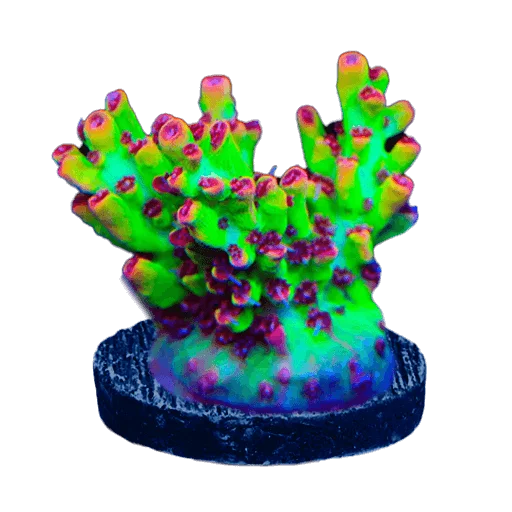
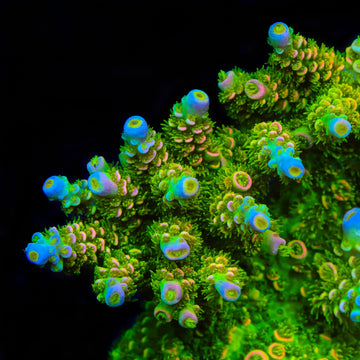
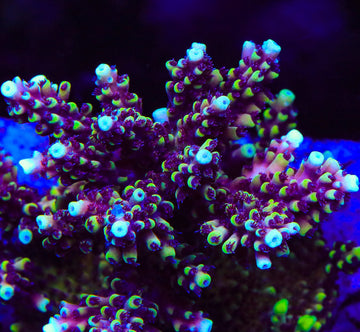
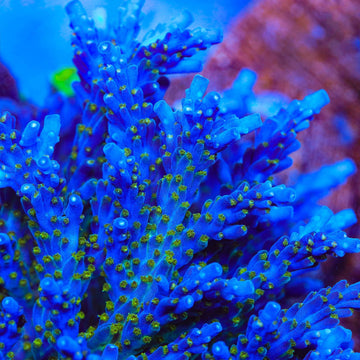
TGC Grave Digger Acropora Coral
Overview
TGC Orange Creamsicle Acropora Coral shows bright orange to cream coloration with slender, branching tips. Acropora sp., a small-polyp stony branching coral, thrives under strong light and high, turbulent water flow. It is primarily photosynthetic via symbiotic algae but can take fine particulate foods, which may support growth and coloration. Place high on stable rockwork with space from aggressive neighbors, and keep alkalinity and calcium stable to prevent stress.
Quick Facts
Care
Difficult
Lighting
High
Flow
High
Placement
High
Temperament
Peaceful (2–3 inches spacing)
Recommended Parameters
Temp
76–80°F
pH
8.1–8.4
Salinity
1.025–1.026
Calcium
420–450 ppm
AlkAlkalinity
8–9 dKH
Magnesium
1250–1350 ppm
Feeding
photosynthetic, microplankton, rotifers, copepod nauplii, oyster eggs, coral-specific powdered foods, amino acid supplements, bacterioplankton
Care & Placement
FAQ
Frequently Asked Questions
About the TGC Grave Digger Acropora Coral
-
How do I keep the signature orange and cream colors on a TGC Orange Creamsicle Acropora?
Prioritize strong, stable blue-heavy spectrum (420–470 nm) at high PAR (275–375), with moderate white to avoid washing out tones. Maintain alk 8.0–8.6 dKH, NO3 5–15 ppm, PO4 0.03–0.08 ppm; ultra-low nutrients can pale it, excess can brown it. Consistent potassium (380–420 ppm) and iron trace levels aid pigment expression. Ramp light slowly after any change to prevent photo-shock and tip burn. -
Why does my colony encrust for months before forming vertical branches?
This morph often lays a broad, tight base to secure itself in high-flow zones before axial corallites push upward. Strong, turbulent flow encourages thicker branches and tighter polyp structure. If growth seems stalled, check for low flow at the base, unstable alkalinity, or shadowing from nearby colonies. Slightly increasing PAR and spacing can prompt new axial tips without stressing the tissue. -
My Orange Creamsicle is receding from the base up—what’s the likely cause?
Base STN often ties to low or laminar flow at the encrustment edge, unstable alkalinity, or pests. Inspect at night for AEFW bite marks and use a white light to spot red bugs. Increase turbulent flow around the base, correct alk swings, and perform a targeted dip if pests are suspected. If shadowing is severe, trim neighboring branches to restore light to the base. -
How should I acclimate it to high light without bleaching or tip burn?
Start 40–50% lower PAR than your target and increase 10–15% weekly. Use screen layers or reduce photoperiod rather than only dimming blues, which can distort color. Watch for pastel tips or retracted polyps—both signal too much intensity or unstable alkalinity. Maintain strong cross-flow from multiple pumps so tissue stays cool and well-oxygenated during the ramp-up period.