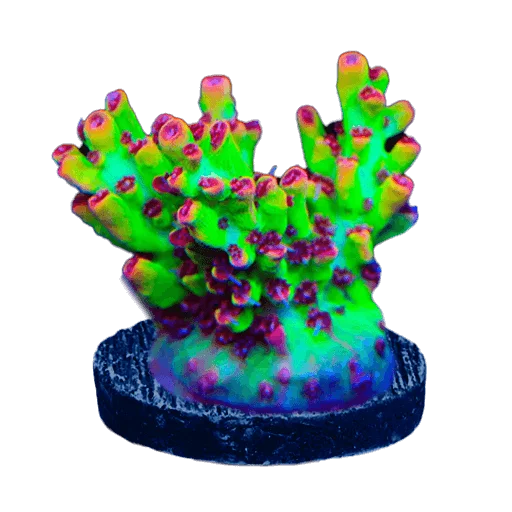
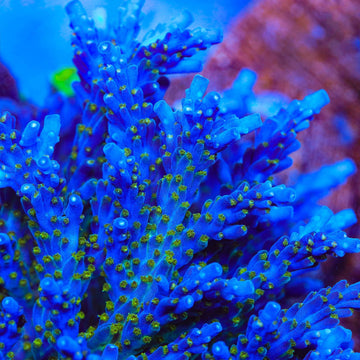
TGC Cherry Bomb Tenuis Acropora Coral
Overview
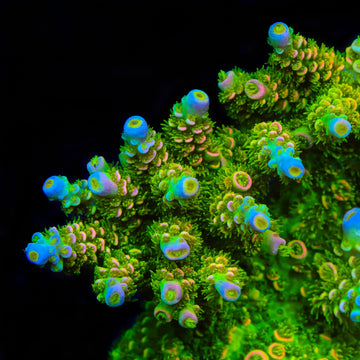
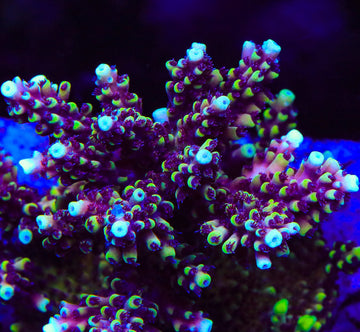
TGC Cherry Bomb Acropora Coral shows bright red to pink branch tips with contrasting green polyps. Acropora tenuis is a branching stony coral that prefers strong light and high, turbulent water flow. It is photosynthetic via symbiotic algae, but occasional small particulate foods can support growth and deepen coloration. Place high on stable rockwork with ample space from aggressive corals, and maintain very stable alkalinity and nutrients.
Quick Facts
Care
Difficult
Lighting
High
Flow
High
Placement
High
Temperament
Peaceful (2–3 inches spacing)
Recommended Parameters
Temp
76–82°F
pH
8.1–8.4
Salinity
1.025–1.026
Calcium
420–450 ppm
AlkAlkalinity
8–9 dKH
Magnesium
1250–1350 ppm
Feeding
photosynthetic (primary), microplankton, powdered zooplankton, rotifers, copepod nauplii, phytoplankton, oyster eggs, amino acid supplements, coral-specific powdered foods
Care & Placement
FAQ
Frequently Asked Questions
About the TGC Cherry Bomb Tenuis Acropora Coral
-
Why does my TGC Cherry Bomb Acropora shift from cherry-red to washed-out pink or green, and how can I regain the deep coloration?
Color shifts stem from spectrum, PAR, and nutrients. Aim for 250–350 PAR with strong 420–460 nm blues; avoid excessive white. Keep NO3 around 5–15 ppm and PO4 0.03–0.08. Stabilize alkalinity at 7.5–8.5 dKH. Consider potassium (380–420 ppm), iron, and manganese at trace levels; test before dosing. Sudden swings or ultra-low nutrients wash out reds. -
Growth seems stalled—only encrusting with minimal branches. Is this normal for Acropora tenuis like Cherry Bomb?
Yes. Tenuis often encrusts aggressively before axial corallites push upward. Provide high, randomized flow (30–50x turnover) to prevent detritus at the base, which can trigger basal recession. Maintain stable alk and pH 8.2–8.4. Slightly increase PAR within target range and ensure enough space above the colony to avoid self-shading as branches initiate. -
What are early warning signs of STN/RTN in this strain, and how should I respond?
Watch for dulling tissue at the base, reduced daytime polyp extension, and a pale ring creeping upward. Immediately verify temp, alk, and salinity; correct gently if off. Perform an iodine dip, frag 3–5 mm into healthy tissue above the recession line, and remount in moderate light/strong flow. Check for pests (AEFW, red bugs) and run fresh carbon to mitigate chemical warfare. -
My Cherry Bomb looks fine but shows poor nighttime polyp extension—could something be suppressing feeding behavior?
Continuous, narrow laminar flow or nearby aggressive corals can inhibit extension. Shift to crossflow patterns and relocate away from sweeper-tentacled LPS or allelopathic soft corals; run activated carbon and ensure adequate export. Check for micro-predators at night with a flashlight. Briefly target-feed fine particulate foods after lights down to encourage routine nocturnal extension.