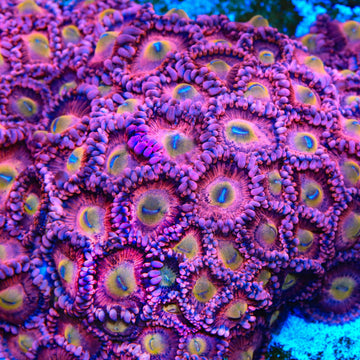
Star Foxx Zoanthids Coral
Overview
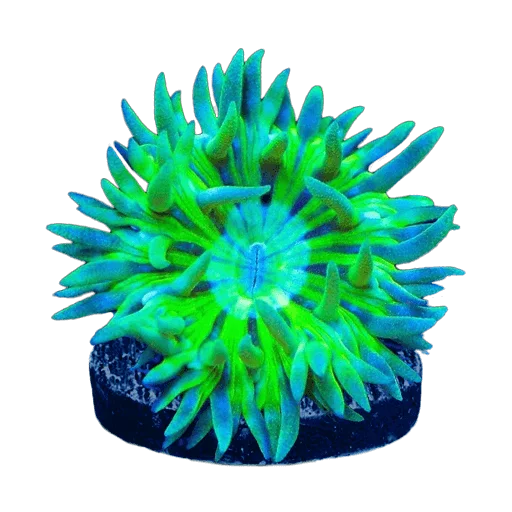
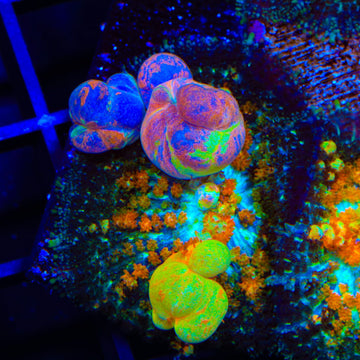
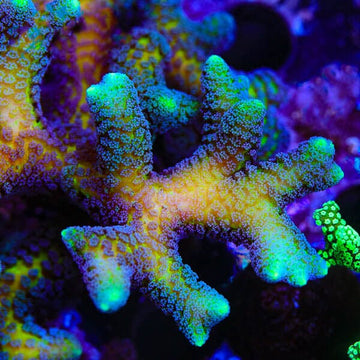
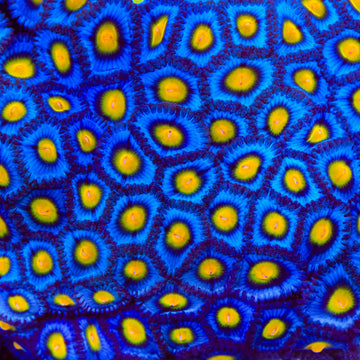
Star Foxx Zoanthids Coral features small button-shaped polyps with bright, star-like centers and contrasting skirts. Zoanthus sp., a colonial soft polyp, forms encrusting mats and prefers moderate light with moderate, indirect water flow. Primarily photosynthetic through symbiotic algae, it also accepts occasional fine foods to support growth and maintain color. Place on isolated rock to control spreading, keep distance from stinging corals, and handle carefully.
Quick Facts
Care
Easy
Lighting
Low–Moderate
Flow
Moderate
Placement
Low–Mid
Temperament
Peaceful to semi-aggressive (can overgrow neighbors; provide ample spacing)
Recommended Parameters
Temp
76–82°F
pH
8.1–8.4
Salinity
1.025–1.026
Calcium
380–430 ppm
AlkAlkalinity
8–10 dKH
Magnesium
1250–1350 ppm
Feeding
photosynthetic, microplankton, phytoplankton, rotifers, cyclops, powdered coral foods (e.g., Reef-Roids), marine snow, dissolved organics
Care & Placement
FAQ
Frequently Asked Questions
About the Star Foxx Zoanthids Coral
-
Why did my Star Foxx Zoanthids lose their speckled “star” pattern or shift color?
Spectrum and nutrients drive pigment. Maintain stable NO3 5–15 ppm, PO4 0.03–0.1 ppm; too “ultra-clean” can dull colors. Favor strong blue/violet (420–460 nm) with moderate PAR (70–150) and light-acclimate over 2–3 weeks. Trace balance matters—avoid heavy-metal spikes from rusting magnets. If fading persists, try modest feeding of fine zooplankton or aminos 1–2× weekly. -
My colony forms a dome and the center stalls or recedes—what’s happening?
Zoanthus can trap detritus in dense mats, starving inner polyps. Increase random flow to keep skirts moving, turkey-baste weekly, and elevate the frag for better underside circulation. Thin or “ring frag” outer rows to open pathways for light/flow. Avoid laying mats on soft sand where grit irritates the base. -
Best practice to frag Star Foxx safely without triggering melt?
Wear eye/hand protection and work in ventilation; avoid crushing polyps. Use a sharp scalpel to cut the mat between polyps, then glue the base (not mouths) to a clean plug. Post-cut, give an iodine dip, place in low–moderate flow and moderate light for 5–7 days, and keep parameters steady to prevent bacterial melt. -
How do I spot and treat pest issues unique to zoas like these?
Look for nocturnal nudi egg spirals, sundial snails, or zoa-eating spiders; polyps stay closed or show bite marks. Manually remove adults, scrape eggs, and follow with a dip (iodine or coral-specific). “Zoa pox” shows as tan pustules—treat with Furan-2 baths and improved flow. Quarantine new frags; repeat dips every 3–4 days until resolved.