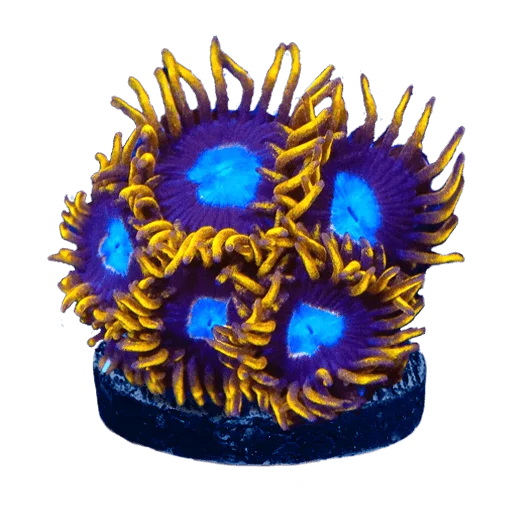
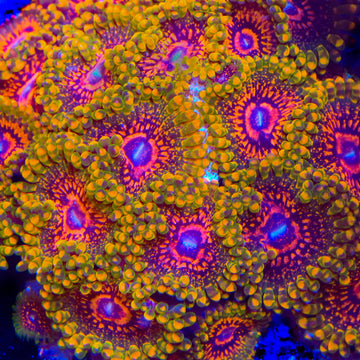
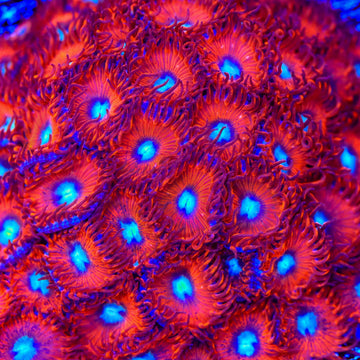
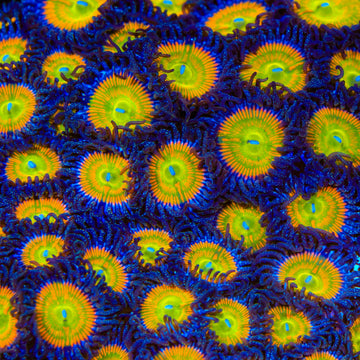
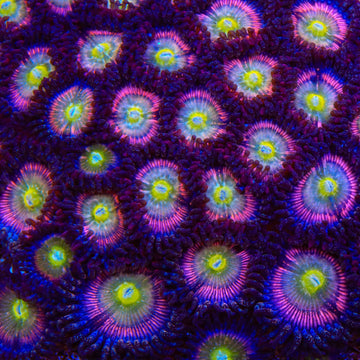
Scrambled Eggs Zoanthids Coral
Overview
Scrambled Eggs Zoanthids Coral features small button polyps with bright yellow centers and dark skirts. Classified as Zoanthus sp., it is a soft, mat-forming colonial polyp; provide moderate light and low to moderate, stable water flow. Primarily photosynthetic via symbiotic algae, but will accept occasional small particulate foods to support faster growth and maintain color. Place on isolated rock to control spreading, and keep space from aggressive stingers.
Quick Facts
Care
Easy
Lighting
Low–Moderate
Flow
Moderate, indirect
Placement
Low–Mid
Temperament
Peaceful to Semi-aggressive (2–3 inches spacing)
Recommended Parameters
Temp
76–80°F
pH
8.1–8.4
Salinity
1.025–1.026
Calcium
380–430 ppm
AlkAlkalinity
8–10 dKH
Magnesium
1250–1350 ppm
Feeding
photosynthetic (primary), microplankton, phytoplankton, zooplankton, rotifers, copepods, oyster eggs, fine powdered coral foods (e.g., Reef-Roids), marine snow
Care & Placement
FAQ
Frequently Asked Questions
About the Scrambled Eggs Zoanthids Coral
-
Why did my Scrambled Eggs lose the bright yellow ring after moving to stronger lights?
These Zoanthus often wash out under intense white light. Shift to a blue-heavy spectrum, reduce overall intensity 15–25%, and extend photoperiod slowly. Maintain stable nutrients (NO3 5–15 ppm, PO4 0.03–0.1 ppm); ultra-low nutrients mute pigment. Give 2–4 weeks after each change. Amino/trace dosing in moderation can help, but avoid large, frequent swings. -
My colony opens during the day but random polyps stay closed—what targeted checks should I do?
Inspect at night with a red flashlight for zoa-eating nudibranchs and sundial snails; their patterns often match the polyps. Look for egg spirals on the mat. Check for vermetid mucous strands and detritus accumulation. Increase varied flow, perform a 5–10 minute iodine/coral dip, and manually remove pests. Stabilize alkalinity and avoid abrupt carbon dosing shifts. -
Can Scrambled Eggs overrun rockwork, and how do I guide growth without stressing them?
They spread via a matting stolon. Create “islands” with sand moats or use frag tiles as growth fences you can lift and prune. Trim by cutting between polyps with a sharp scalpel; rinse, then iodine dip both frags and mother colony. Wear eye/skin protection. Aim for moderate, crossflow to keep edges clean and reduce detritus-fueled spurts. -
How do I keep the centers vivid while also pushing faster growth?
Balance energy and nutrients: moderate PAR (80–150) with strong blue spectrum preserves yellows; slightly richer nutrients support growth. Feed fine powdered zooplankton or reef roids 1–2x weekly with pumps off for 10–15 minutes. Avoid heavy feeding that spikes phosphate; run consistent export (skimmer, refugium). Stability in alk 8–9.5 dKH prevents growth stalls.