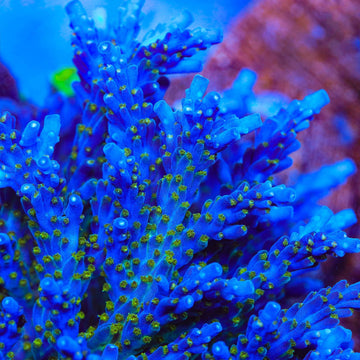
RRC Goldenrod Anacropora Coral
Overview
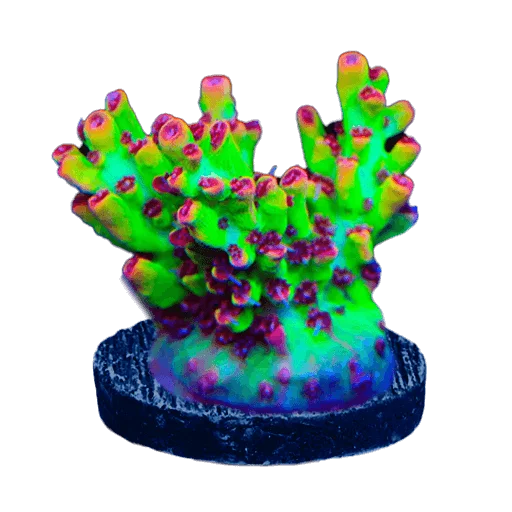
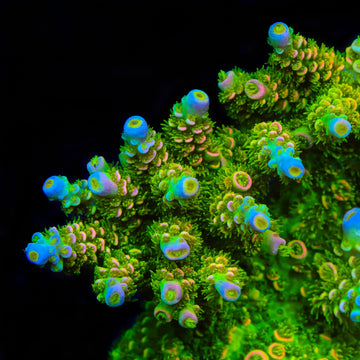
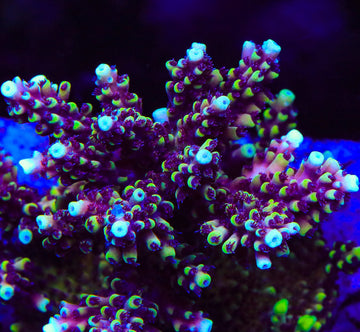
RRC Goldenrod Anacropora Coral shows thin, bushy golden branches with fine polyps. Anacropora sp. is a small-polyp stony branching coral; it prefers moderate to high light and strong, turbulent water flow. It is primarily photosynthetic via symbiotic algae but benefits from occasional small-particle foods, which support growth and coloration. Place higher on rockwork with room for branches to grow, and keep it away from aggressive neighbors to avoid tissue damage.
Quick Facts
Care
Difficult
Lighting
Moderate–High
Flow
High, indirect
Placement
Mid–High
Temperament
Peaceful (2–3 inches spacing)
Recommended Parameters
Temp
76–80°F
pH
8.1–8.4
Salinity
1.025–1.026
Calcium
420–450 ppm
AlkAlkalinity
7.5–9 dKH
Magnesium
1280–1350 ppm
Feeding
photosynthetic, microplankton, rotifers, copepod nauplii, marine snow, powdered SPS coral foods, amino acid supplements
Care & Placement
FAQ
Frequently Asked Questions
About the RRC Goldenrod Anacropora Coral
-
Why does my RRC Goldenrod Anacropora shift from bright yellow to beige or green under the same lighting?
Yellow tones in Anacropora sp. are sensitive to nutrient balance and spectrum. Slightly elevated nitrate (2–10 ppm) and phosphate (0.02–0.08 ppm) help maintain pigments, but excess fuels browning. Too-clean water or sudden alkalinity spikes can wash out color. Use strong blue spectrum with diffuse PAR 200–300, stable alk 7.5–8.5 dKH, and avoid abrupt changes to keep the golden hue. -
What growth pattern should I expect, and how do I place it to avoid self-shading?
This species grows as a dense, bottlebrush bush with very thin, brittle branchlets. If placed vertically in tight spaces, interior branches starve for light and flow. Mount frags slightly angled or horizontally on a ridge to encourage outward, open branching. Provide cross-flow rather than a single jet so polyps get oxygenation without scouring the tissue at the tips. -
My colony shows sudden tip burn and slow tissue loss despite “good” parameters—what’s the hidden culprit?
Tip burn often follows high alkalinity paired with ultra-low nutrients, or abrupt PAR increases. Check for alk swings >0.3 dKH/day, raise nutrients into a moderate range, and reduce peak intensity 15–20% while increasing diffusion. Inspect for vermetid snails and their mucus threads, which can irritate fine branches and trigger recession. Improve flow randomness and keep detritus off the interior. -
Are there pests or chemical aggressors that uniquely bother this coral compared to other SPS?
Thin tissue and branchlets make it sensitive to Acropora-specific pests (e.g., red bugs) and to mucus nets from vermetids. It also reacts strongly to allelopathy from soft corals and long-sweeper LPS. Run carbon, maintain good export, and keep down-current distance from Euphylliids. During dips, use gentler concentrations and shorter durations; harsh dips can do more harm than minor pests.