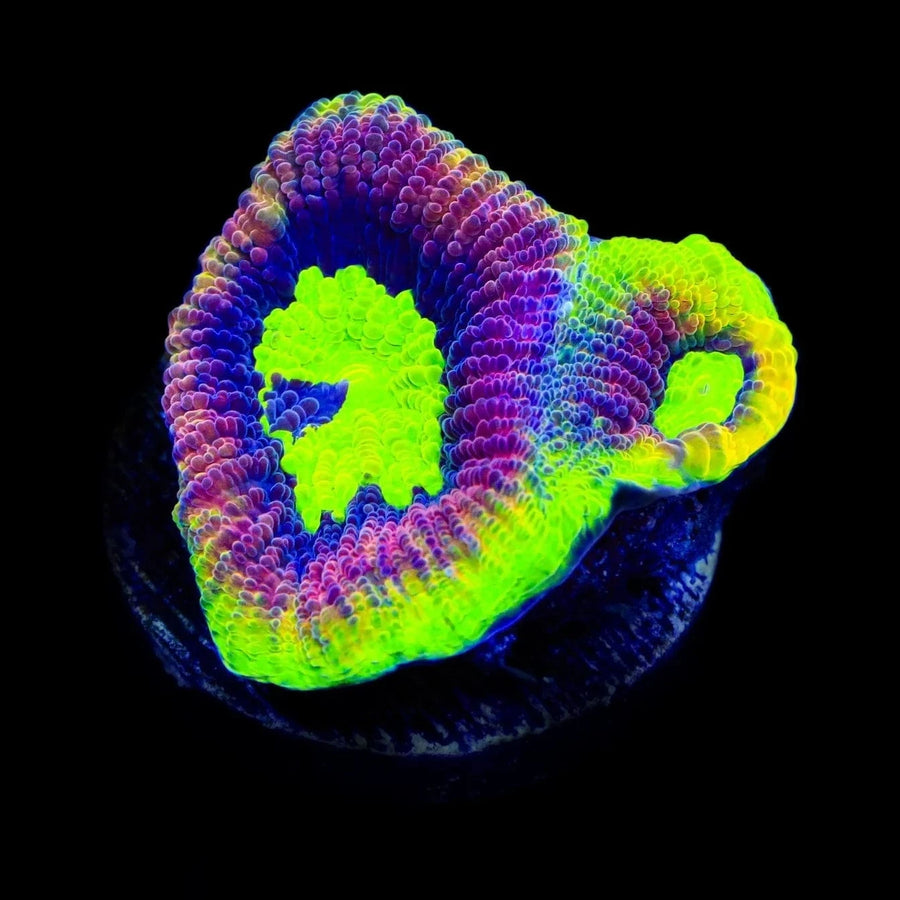
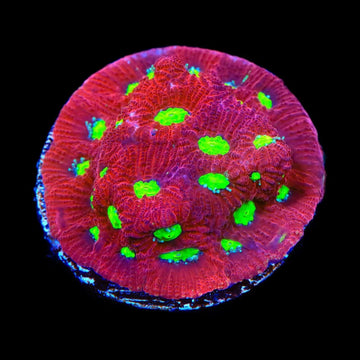
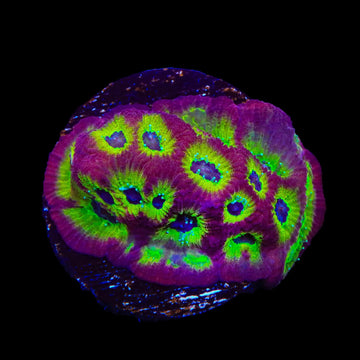
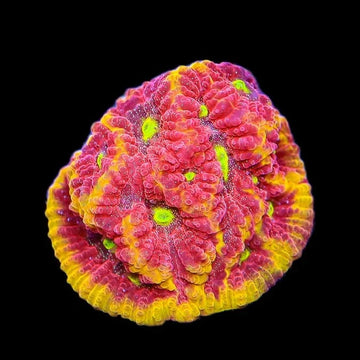
RR Spicy Lemon Favia Coral
Overview
RR Spicy Lemon Favia Coral displays yellow-green, hexagonal corallites with raised walls and distinct mouths. Favia favus is a large-polyp stony brain coral; provide moderate light and low to moderate, indirect flow. It is photosynthetic with symbiotic algae and will accept small meaty foods; periodic target feeding can support growth and color stability. Place on stable rock or sand with several inches of space, as nighttime sweeper tentacles can sting nearby corals.
Quick Facts
Care
Moderate
Lighting
Low–Moderate
Flow
Moderate, indirect
Placement
Low–Mid
Temperament
Semi-aggressive (3–6 inches spacing)
Recommended Parameters
Temp
76–80°F
pH
8.1–8.4
Salinity
1.025–1.026
Calcium
400–450 ppm
AlkAlkalinity
8–10 dKH
Magnesium
1280–1350 ppm
Feeding
photosynthetic (primary), mysis shrimp, enriched brine shrimp, finely chopped seafood, zooplankton, microplankton, marine snow, powdered coral foods
Care & Placement
FAQ
Frequently Asked Questions
About the RR Spicy Lemon Favia Coral
-
Why does my RR Spicy Lemon Favia shift from neon yellow with red eyes to dull green or washed-out colors?
This morph is sensitive to spectrum and intensity. Too much blue/UV can push it toward green; excessive PAR bleaches the yellow. Aim for moderate PAR (100–150), add some balanced white, and keep nutrients detectable (NO3 5–15 ppm, PO4 0.03–0.08). Stable alkalinity and low organics help. Color rebounds slowly over weeks; avoid rapid light changes and heavy carbon that can strip trace organics. -
How aggressive are its sweeper tentacles, and how should I place it to avoid stings?
Favia favus can extend sweepers 2–4 inches at night, sometimes longer in higher flow. Give 4–6 inches of clearance from fleshy LPS and chalices, and avoid directing flow that whips sweepers into neighbors. If space is tight, place it slightly down-current from sensitive corals. Feeding before lights-out can reduce nightly foraging reach. -
My colony inflates at night but won’t accept food—what’s the workaround?
Train feeding response. About 10–15 minutes after lights out, dose a small amount of fine particulate food to trigger feeder tentacles. Then target-feed tiny portions of mysis or reef roids. Keep flow low to moderate so food settles but detritus won’t. Consistency (2–3 times weekly) improves capture; avoid overfeeding, which can cause bacterial film and tissue irritation. -
Tissue recession started from one edge after a minor alkalinity swing—how do I halt it?
Stabilize parameters first (alk changes <0.3 dKH/day). Gently turkey-baste detritus from valleys, perform an iodine dip, and increase indirect flow to the affected edge. If recession progresses, create a small safety cut in dead skeleton ahead of the necrotic line. Reduce light slightly for a week, and feed lightly to support recovery. Watch for vermetids or hidden irritation points.