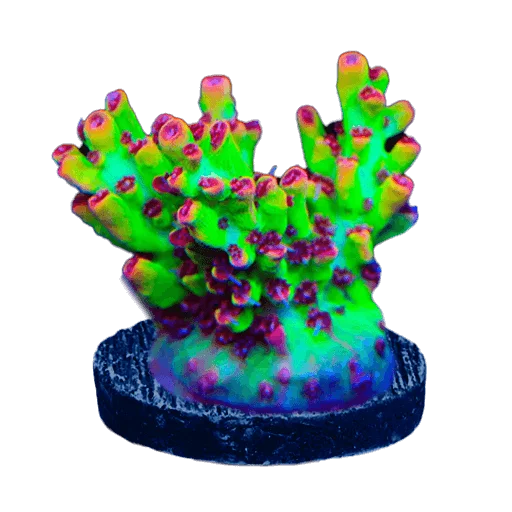
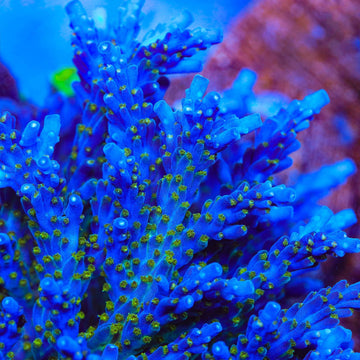
RR Garden of Eden Tenuis Acropora Coral
Overview
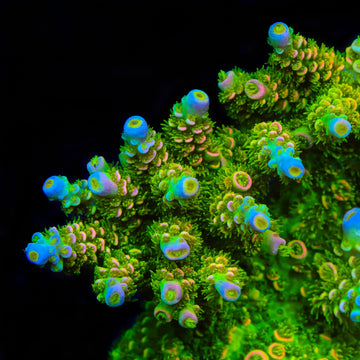
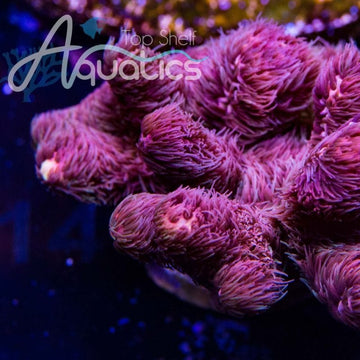
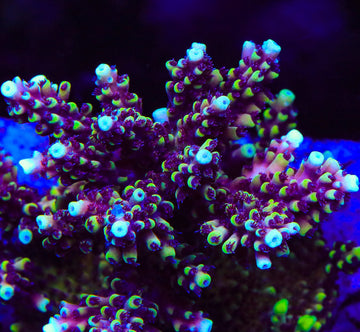
RR Garden of Eden Tenuis Acropora Coral shows tightly spaced axial corallites and branching tips with fine polyp extension. Acropora tenuis is a small-polyp stony branching coral that prefers strong lighting and high, turbulent water flow. It is primarily photosynthetic via symbiotic algae, but occasional broadcast feeding of fine plankton can support growth and color. Place high on stable rockwork with space from aggressive neighbors, and keep alkalinity stable with low nutrients to avoid tissue loss.
Quick Facts
Care
Difficult
Lighting
High
Flow
High
Placement
High
Temperament
Semi-aggressive (2–4 inches spacing)
Recommended Parameters
Temp
76–80°F
pH
8.1–8.4
Salinity
1.025–1.026
Calcium
420–450 ppm
AlkAlkalinity
7.5–9 dKH
Magnesium
1280–1350 ppm
Feeding
photosynthetic (primary), microplankton, zooplankton, rotifers, copepods, cyclops, oyster eggs, coral-specific powdered foods, amino acid supplements
Care & Placement
FAQ
Frequently Asked Questions
About the RR Garden of Eden Tenuis Acropora Coral
-
Why does my RR Garden of Eden Tenuis lose rainbow tones and turn pastel under strong LEDs?
Rapid pastel shift often stems from high PAR paired with ultra-low nutrients. Aim for moderate, steady NO3 (5–15 ppm) and PO4 (0.03–0.08 ppm), then slowly ramp violet/UV (380–430 nm) rather than white intensity. Ensure high, randomized flow to prevent base shading and detritus. If tips pale while bases stay colored, reduce PAR 10–15% and increase feeding frequency slightly. -
My tenuis shows tip burn while alk tests fine—what else should I check?
Tip burn occurs when PAR and alkalinity outpace available nutrients. Stable alk at 7.5–8.5 dKH works best with non-zero NO3/PO4. Verify potassium (target ~400–420 ppm) for blue/violet retention and iron for greens. Avoid big water chemistry swings—dose traces slowly. Improve chaotic flow; laminar blasts can worsen necrosis at tips and bases. -
What’s a telltale sign of pests on RR Garden of Eden Tenuis, and how should I respond?
Crescent bite marks and patchy polyp retraction point to Acropora-eating flatworms; red bugs appear as tiny orange dots on polyps. Remove and dip the colony, turkey-baste daily to dislodge eggs, and quarantine. Add a pest-hunting wrasse for prevention. If tissue loss starts, frag healthy margins ahead of the recession and stabilize nutrients and flow. -
The green base is dull but pink tips look fine—what adjustment helps color balance?
Dull greens often indicate low iron or excess white spectrum. Dose trace iron conservatively and boost violet/royal (405–470 nm) relative to cool white. Keep PO4 detectable; zeroed phosphate mutes greens. Avoid aggressive carbon use that oversharpens water and washes color. Reassess flow to eliminate detritus shading at the base for even pigment expression.