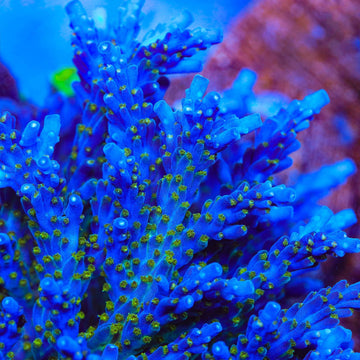
RR Firecracker Acropora Coral
Overview
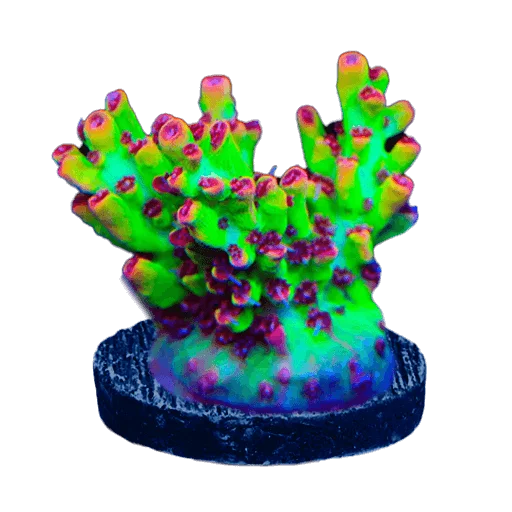
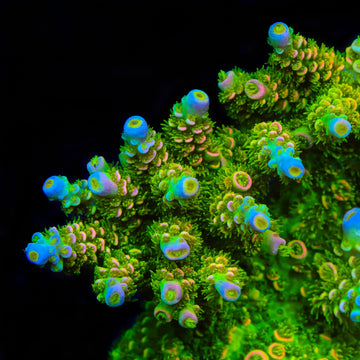
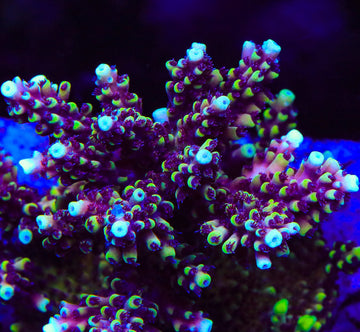
RR Firecracker Acropora Coral shows dense, upward-branching growth with bright red to orange tips and contrasting polyps. Acropora tenuis, a branching small polyp stony coral, prefers strong lighting and high, turbulent water flow. It is photosynthetic via symbiotic algae but can benefit from occasional small planktonic foods to support growth and color. Place high on stable rockwork with space from aggressive corals, and keep alkalinity stable with low nutrients to prevent stress.
Quick Facts
Care
Difficult
Lighting
High
Flow
High
Placement
High
Temperament
Peaceful (short sweepers; allow 2–3 inches for growth)
Recommended Parameters
Temp
76–80°F
pH
8.1–8.4
Salinity
1.025–1.026
Calcium
420–450 ppm
AlkAlkalinity
8–9 dKH
Magnesium
1280–1350 ppm
Feeding
photosynthetic, microplankton, zooplankton, rotifers, copepod nauplii, powdered coral foods (e.g., Reef-Roids), marine snow, amino acid supplements
Care & Placement
FAQ
Frequently Asked Questions
About the RR Firecracker Acropora Coral
-
Why does my RR Firecracker Acropora (Acropora tenuis) lose its red/orange pop and turn pinkish or brown under the same PAR?
Color in this tenuis is highly spectrum- and nutrient-dependent. It holds reds best under strong blue/UV (420–450 nm) with moderate w -
The tips are white—am I seeing healthy growth, bleaching, or alk burn?
White axial tips with visible polyp bumps are normal growth. If the white area spreads down branches and polyps vanish after a light increase, that’s likely light shock—reduce intensity 15–25% and ramp over 2–3 weeks. If tips erode with a harsh line while nutrients are low and alkalinity >8.8 dKH, think alk burn; lower alk to 7.5–8.3 and raise nutrients gradually. -
How can I prevent the base from dying off on a maturing colony?
Tenuis can self-shade. Mount the frag at a slight angle to expose the base, provide strong, random flow to keep detritus off the foot, and give 2–3 inches of clearance from neighboring corals. Periodically trim upper branches to open light paths. Avoid large colonies of aggressive LPS nearby—occasional contact stings can trigger slow tissue loss at shaded bases. -
What pests specifically trouble this tenuis, and how do I confirm them?
Watch for Acropora eating flatworms (AEFW) and red bugs. AEFW leave crescent bite marks and tan dust when blasted with a baster; eggs ring the undersides of branches. Red bugs cause dull color and poor polyp extension. Quarantine new pieces, inspect under blue light with a white flashlight, and use dips for AEFW (repeated, egg-safe protocols) and milbemycin oxime in QT for red bugs.