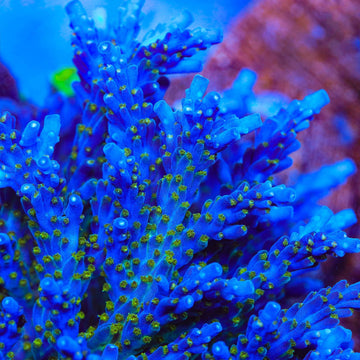
RR Bleeding Avenger's Acropora Coral
Overview
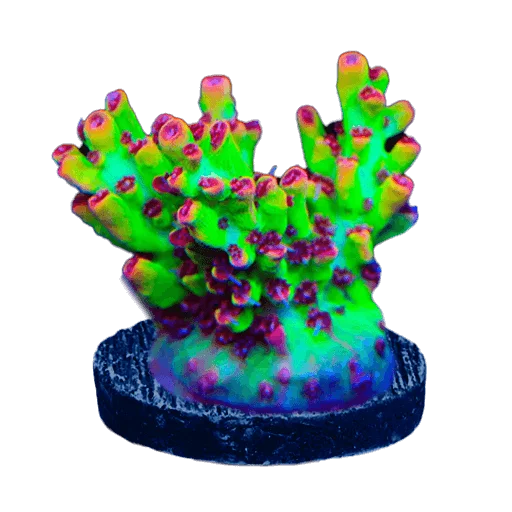
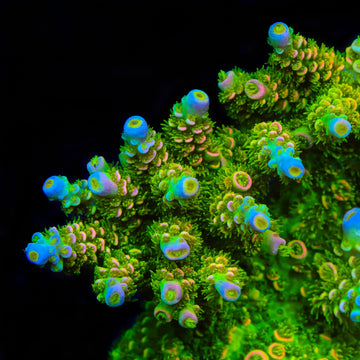
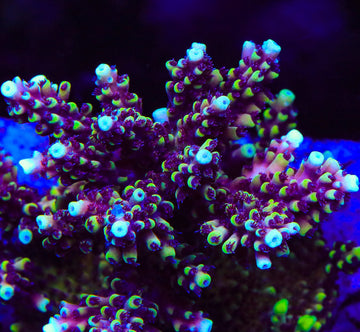
RR Bleeding Avengers Acropora Coral displays branching growth with red to scarlet tips and contrasting pale polyp rings. Acropora sp. Coral is a small-polyp stony branching coral that prefers high light and strong, turbulent water flow. It is primarily photosynthetic through symbiotic algae but will accept occasional fine planktonic foods to support growth and color stability. Place high on rockwork with ample space from neighbors, and avoid contact with aggressive corals.
Quick Facts
Care
Difficult
Lighting
High
Flow
High, turbulent
Placement
High
Temperament
Peaceful (2–3 inches spacing)
Recommended Parameters
Temp
77–80°F
pH
8.1–8.4
Salinity
1.025–1.026
Calcium
420–450 ppm
AlkAlkalinity
7.5–8.5 dKH
Magnesium
1280–1350 ppm
Feeding
photosynthetic (primary), microplankton, rotifers, copepod nauplii, powdered coral foods, marine snow, amino acid supplements
Care & Placement
FAQ
Frequently Asked Questions
About the RR Bleeding Avenger's Acropora Coral
-
Why does my RR Bleeding Avengers lose its deep red tones and look pink or brown under strong blue light?
This strain’s reds are light- and nutrient-sensitive. Too much PAR or ultra-low nutrients can wash reds to pink; too little PAR or elevated nutrients shift it brown. Target 250–350 PAR with a strong 420–460 nm component plus some 10–14K white. Keep nitrate ~5–15 ppm, phosphate 0.03–0.08 ppm. Maintain stability in alkalinity (8–9 dKH). Gradually acclimate to higher light to avoid pigment shock. -
he tips are pale or “burned” while the base encrusts well—what’s causing this?
Tip paling usually follows an alkalinity swing under high PAR. Rapid alk rise drives accelerated skeleton growth that outpaces tissue, producing pale, rough tips. Keep daily alk change under 0.2 dKH, avoid big dosing jumps, and ensure adequate amino/particulate feeding so tissue keeps up. Check for laminar flow blasting the tips; switch to randomized, high but indirect turbulence. -
How can I encourage the characteristic bushy branching and maintain color depth in this Acropora sp.?
Mount the frag with the cut end sideways to encourage multi-axial branching; allow the base to fully encrust before pushing PAR above 300. Provide crossfire, alternating flow (2–3 sources) to keep polyp extension without tissue abrasion. Keep potassium 380–420 ppm to support blues, stable temperature 24–26°C, and avoid heavy carbon dosing that strips nutrients too low for reds. -
What uncommon pests or issues specifically trouble named tenuis-type Acropora like this one?
They’re prime targets for Acropora-eating flatworms and red bugs, which first dull color then reduce polyp extension. Inspect at night with a flashlight, look for bite marks on smooth areas near tips. Dip new pieces (multiple dip types over weeks), use a turkey baster to blast colonies, and consider a quarantine frag rack. Consistent observation beats reactive treatments.