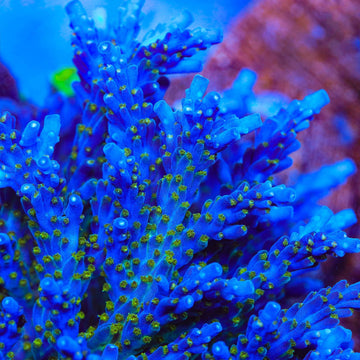
Reef Raft USA Angry Birds Acropora Coral
Overview
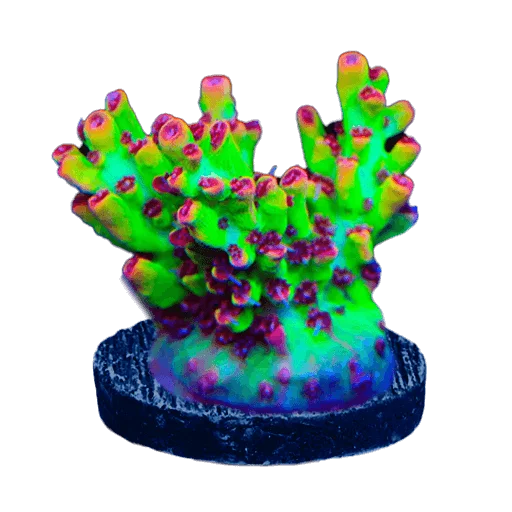
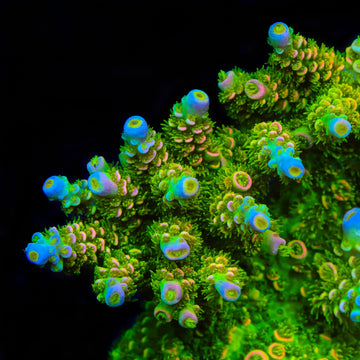
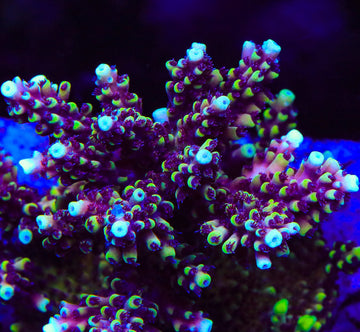
Angry Birds Acropora Coral shows vivid contrasting branch tips with tightly spaced corallites. Acropora tenuis is a branching small-polyp stony coral that prefers strong light and high, turbulent water flow. It is primarily photosynthetic via symbiotic algae, but occasional small-particle foods can support growth and color. Place high on stable rock with ample space from aggressive neighbors, and keep alkalinity stable with low nutrients to prevent tissue loss.
Quick Facts
Care
Difficult
Lighting
High
Flow
High
Placement
High
Temperament
Semi-aggressive (2–4 inches spacing)
Recommended Parameters
Temp
76–80°F
pH
8.1–8.4
Salinity
1.025–1.026
Calcium
420–450 ppm
AlkAlkalinity
8–9 dKH
Magnesium
1280–1350 ppm
Feeding
photosynthetic, microplankton, rotifers, copepod nauplii, oyster eggs, reef roids, amino acids, marine snow
Care & Placement
FAQ
Frequently Asked Questions
About the Reef Raft USA Angry Birds Acropora Coral
-
Why does my Angry Birds Acropora show amazing color on the tips but a dull or receding base?
Tenuis colonies self-shade as branches thicken, starving the base of light and flow. Prune inner branches to open channels, aim alternating, high-energy flow across the base, and avoid laminar jets. Keep PAR 250–350 at tips and 100–150 at the base. Maintain stable alkalinity; sudden spikes under high PAR often trigger tip burn while the shaded base slowly declines. -
How do I keep the red body and blue/yellow highlights from fading on this morph?
Color shifts with spectrum and nutrients. Use strong blue-heavy light (peaks around 420–450 nm) and avoid an ultra-lean system—keep detectable nitrate (5–15 ppm) and phosphate (0.03–0.08 ppm). Too clean washes colors; too rich browns them. Amino dosing can help if nutrients are low. Increase intensity slowly; rapid jumps bleach the reds first. -
I’m seeing polyp extension at night but not much by day—should I worry?
Tenuis often shows stronger nocturnal extension, especially under high flow and bright light. Look for consistent nighttime extension and new axial growth as better health signs than daytime fluff. If both day and night extension decline, check for AEFW bite marks, red bugs, or alk instability. A brief blue-only period at the end of the photoperiod can encourage feeding. -
How can I prevent sudden tissue loss (STN/RTN) episodes in this species?
Stability is key. Keep dKH within a tight window and avoid rapid boosts after consumption spikes. Ensure vigorous, randomized flow to clear mucus and detritus. Run fresh carbon when adding aggressive neighbors to limit chemical stress. Quarantine for AEFW and red bugs, and dip at the first sign of bite tracks. If necrosis starts, frag ahead of the lesion promptly.