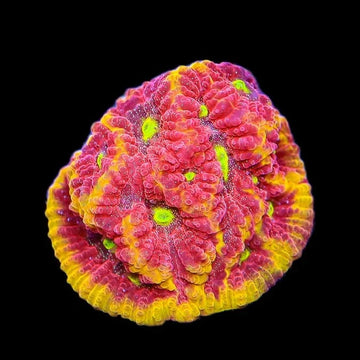
Red Eye Favia Coral
Overview
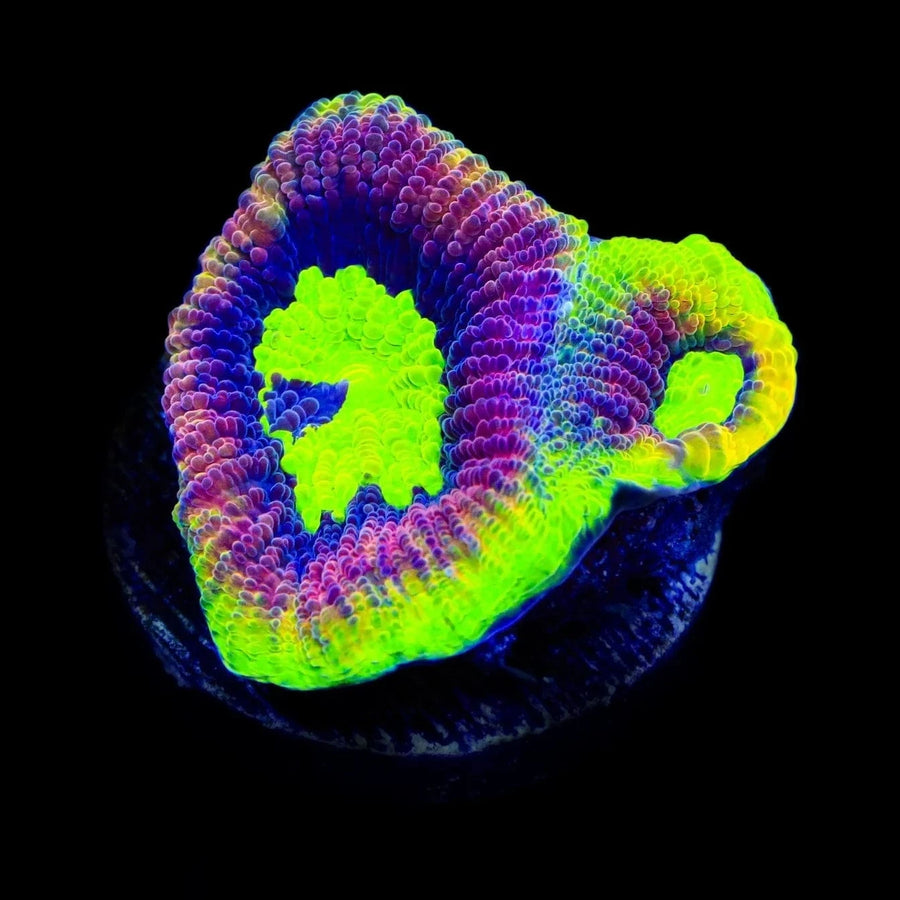
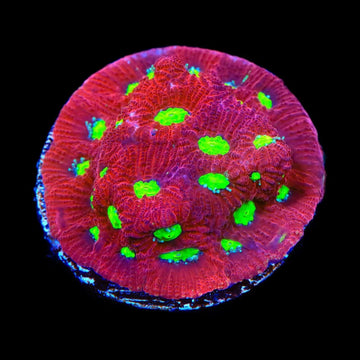
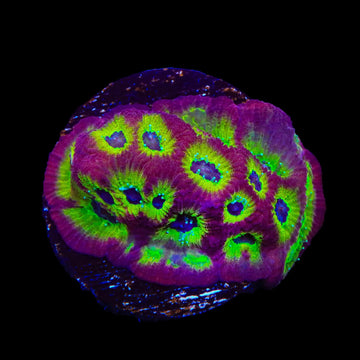
Red Eye Favia Coral shows rounded corallites with bright red centers and contrasting green to brown rims. Favia favus is a stony, dome-forming coral that prefers moderate light and gentle to moderate water flow. It relies on symbiotic algae for energy but benefits from occasional small meaty foods, which can boost growth and color. Place on stable rock or sand with space around it, as nighttime sweepers can sting nearby corals.
Quick Facts
Care
Easy
Lighting
Low–Moderate
Flow
Moderate
Placement
Low–Mid
Temperament
Semi-aggressive (3–6 inches spacing; long night sweepers)
Recommended Parameters
Temp
76–80°F
pH
8.1–8.4
Salinity
1.025–1.026
Calcium
400–450 ppm
AlkAlkalinity
8–9.5 dKH
Magnesium
1280–1350 ppm
Feeding
photosynthetic, mysis shrimp, enriched brine shrimp, finely chopped seafood, copepods, zooplankton, microplankton, coral-specific powdered foods
Care & Placement
FAQ
Frequently Asked Questions
About the Red Eye Favia Coral
-
Why do the “red eyes” on my Red Eye Favia Coral fade or shift color?
Color shifts usually follow light spectrum and nutrient balance. Keep PAR moderate (80–150), favor blue/violet channels, and reduce excess white intensity. Maintain stable alk 8–9 dKH, Ca 420–450 ppm, Mg 1300–1400 ppm, with NO3 ~5–10 ppm and PO4 0.03–0.08 ppm. Avoid rapid changes. Night feeding with fine meaty foods 1–2x weekly often deepens reds. If fading persists, check for shading by film algae in valleys and increase gentle flow. -
How aggressive are its sweepers, and how do I prevent stings on neighbors?
At night, sweepers can extend 2–4 inches. Give a wide buffer and place it on an isolated “island” rock to limit reach. Provide moderate, cross-flow so tentacles don’t drape onto adjacent corals. Target-feed lightly after lights out; a well-fed colony is less likely to extend extreme sweepers. Run fresh activated carbon to reduce chemical warfare, and avoid placing fleshy LPS or encrusting SPS within range. -
What growth pattern should I expect, and how can I keep the valleys clean?
Favia favus builds thick walls with distinct valleys, often forming a dome from an initial encrust. It prefers indirect, moderate flow that keeps detritus and film algae from settling in the valleys without lifting tissue. Position slightly off-axis from pumps and avoid hard, sharp edges beneath the tissue. A turkey baster blast during maintenance helps. Stable alkalinity and gently rising PAR over weeks improve calcification without stressing the polyps. -
My colony is receding from a few mouths—how do I stop the loss?
First, rule out vermetid snails, filament algae, or cyanobacteria irritating the valleys. Increase gentle flow, baste debris, and consider an iodine/Lugol’s dip if brown jelly is present. If recession is localized, use a diamond saw to cut 5–10 mm into healthy skeleton around the affected section and discard it. Re-mount the healthy piece with reef-safe epoxy, keep light slightly reduced for a week, and resume small, frequent feedings to speed recovery.