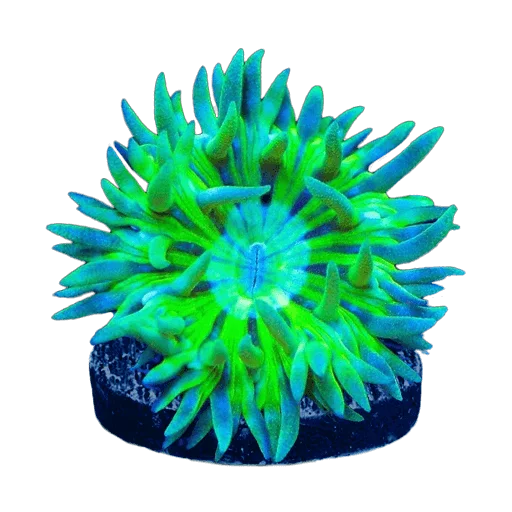
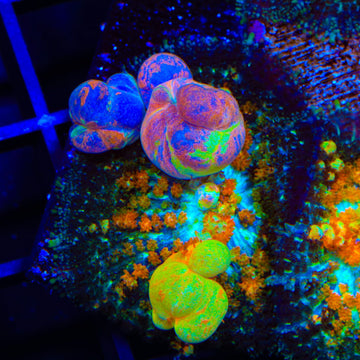
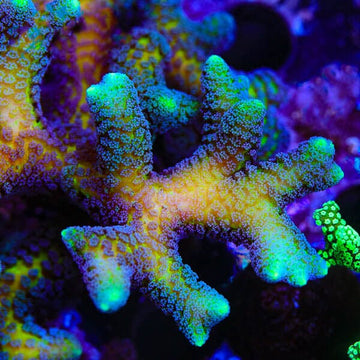
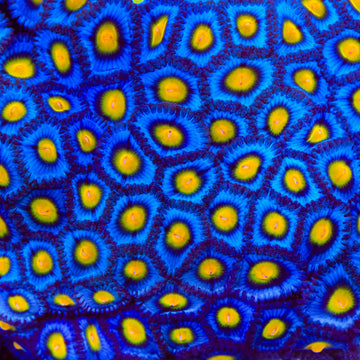
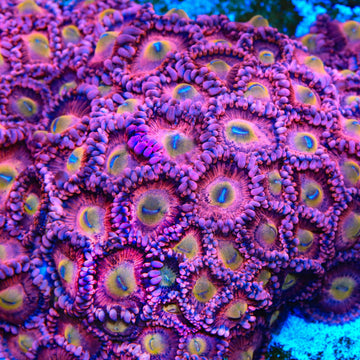
Punk Rocker Zoanthids Coral
Overview
Punk Rocker Zoanthids Coral forms tight mats of small button-like polyps with bold, contrasting centers and frilled skirts. Zoanthus sp. is a soft, colonial polyp coral that does well under moderate light and moderate, indirect water flow. It is primarily photosynthetic via symbiotic algae but will accept small particulate foods, which can boost growth and maintain color. Place on an isolated rock to control spreading and keep space from slower-growing neighbors.
Quick Facts
Care
Easy
Lighting
Low–Moderate
Flow
Moderate
Placement
Low–Mid
Temperament
Semi-aggressive (can overgrow neighbors; provide spacing)
Recommended Parameters
Temp
76–82°F
pH
8.1–8.4
Salinity
1.025–1.026
Calcium
400–450 ppm
AlkAlkalinity
8–10 dKH
Magnesium
1250–1350 ppm
Feeding
photosynthetic (primary), microplankton, phytoplankton, zooplankton, rotifers, cyclops, baby brine shrimp, powdered coral foods (e.g., Reef-Roids), marine snow
Care & Placement
FAQ
Frequently Asked Questions
About the Punk Rocker Zoanthids Coral
-
How do I keep the vivid reds and contrasting skirts on Punk Rocker Zoanthids from washing out?
Aim for moderate PAR (80–150) with a blue-heavy spectrum (420–470 nm). Avoid sudden light jumps; acclimate over 2–3 weeks. Maintain moderate nutrients (NO3 5–15 ppm, PO4 0.03–0.1 ppm). Ultra-low nutrients and excessive white light often mute reds. Stable alkalinity and trace elements (iodine, iron) help, but dose only after testing. -
Mine stopped spreading after a quick growth spurt—what usually stalls Zoanthus mats?
Common culprits are nutrient starvation, accumulated detritus under the mat, or chemical warfare. Slightly raise nutrients, increase intermittent flow to keep the mat clean, and run fresh activated carbon. Check for pests (sundial snails, zoa-eating nudibranchs) at night. If only edges stall, the colony may be shading itself—frag the perimeter to restart growth. -
What pests uniquely target this morph, and how do I treat without shocking sensitive polyps?
Zoa-eating nudibranchs, their eggs, sundial snails, and spiders are prime threats. Use a gentle dip (iodine or low-strength peroxide 1–2 mL of 3% per 100 mL tank water for 2–3 minutes) and manually remove eggs with a toothpick. Repeat every 4–5 days for three cycles. Rinse well and restore moderate flow to prevent post-dip sulking. -
Do they tolerate high-energy neighbors like Euphyllia or soft corals nearby?
They’re competitive encrusters but dislike direct stings and allelopathic chemicals from leathers and some softies. Leave a buffer from sweeper tentacles, maintain good random flow, and run carbon, swapping it monthly. If polyps stay closed despite good parameters, relocate slightly up-current from aggressive corals to keep mucus and allelochemicals moving away.