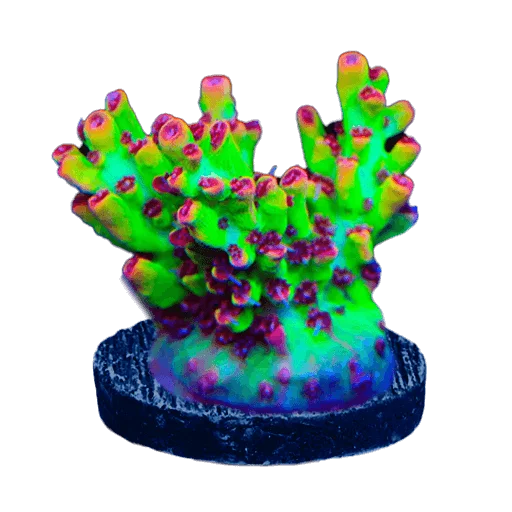
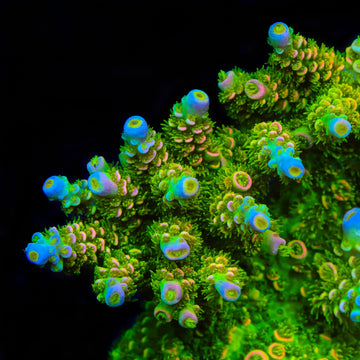
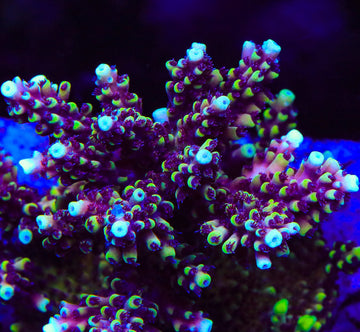
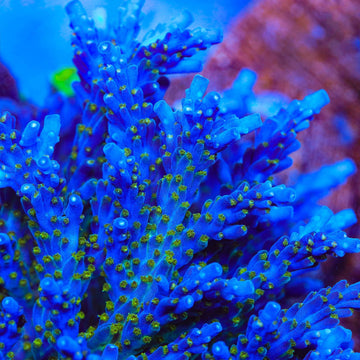
PC Superman Table Acropora Coral
Overview
PC Superman Table Acropora Coral shows flattened, table-forming plates with tightly spaced branchlets. Acropora hyacinthus is a hard, tabling stony coral that prefers high light and strong, turbulent water flow. It is primarily photosynthetic through symbiotic algae, but occasional small planktonic foods can support faster growth and improved color. Place high on stable rock with room for horizontal expansion, and keep distance from aggressive corals to prevent tissue damage.
Quick Facts
Care
Difficult
Lighting
High
Flow
High, turbulent
Placement
High
Temperament
Peaceful (2–4 inches spacing)
Recommended Parameters
Temp
76–80°F
pH
8.1–8.4
Salinity
1.025–1.026
Calcium
400–450 ppm
AlkAlkalinity
7–9 dKH
Magnesium
1280–1350 ppm
Feeding
photosynthetic (primary), microplankton, bacterioplankton, rotifers, copepod nauplii, brine shrimp nauplii, oyster eggs, coral-specific powdered foods (e.g., Reef Roids), amino acid supplements
Care & Placement
FAQ
Frequently Asked Questions
About the PC Superman Table Acropora Coral
-
How can I encourage a true tabling growth form in PC Superman Table Acropora?
Mount frags horizontally on a small disk or flat rubble with plenty of space around the rim. Provide high, turbulent flow sweeping across the top and underside to support lateral growth. Target PAR 300–450 with broad coverage rather than a single spotlight. Avoid shading from nearby colonies. Keep nutrients modest but present to fuel skeletal expansion without browning. -
My blue base is fading and red polyps look dull—what fine-tuning helps restore color?
Stabilize alkalinity at 7.5–8.5 dKH with minimal daily swing; sudden highs wash out pigments. Keep NO3 around 5–15 ppm and PO4 0.03–0.08 ppm; ultra-low levels mute reds. Favor 420–470 nm blues with moderate whites. Avoid pushing PAR beyond 450 without gradual acclimation. Occasional amino acids and iron/manganese traces can help if nutrients are steady. -
How do I prevent underside tissue recession on a wide table colony?
Use crossflow or gyre-style pumps to flush the underside and rim, not just top-down flow. Add side lighting or widen the light spread to penetrate under the plate. Periodically trim the perimeter to reduce self-shading. Siphon detritus that settles under the colony. Watch for alkalinity dips; the thin marginal tissue is often the first to recede when parameters wobble. -
Are there pest or disease signs especially relevant to Acropora hyacinthus?
Look for crescent bite marks or beige egg clusters (AEFW) on the underside and rim, and reduced polyp extension from red bugs. Blast the colony with a baster; dislodged flatworms confirm suspicion. Treat AEFW with repeated dips and egg scraping; quarantine between rounds. Red bugs respond to interceptor-based protocols. Rapid STN at the edge often tracks back to alkalinity instability or heat spikes.