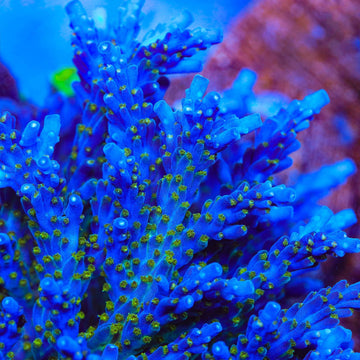
Pacman Dragon Acropora Coral
Overview
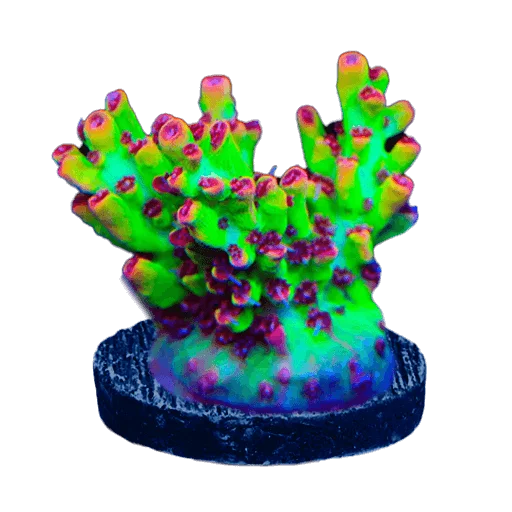
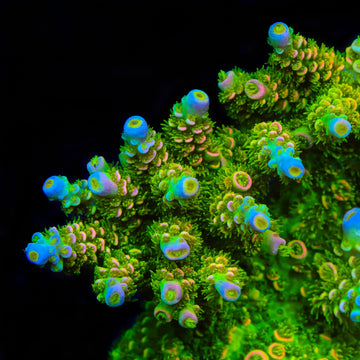
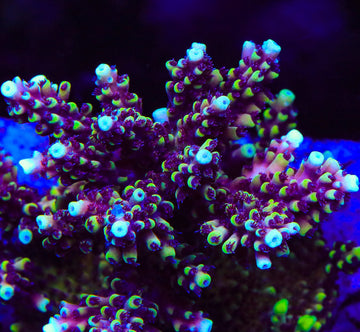
Pacman Dragon Acropora Coral shows yellow‑green branches with contrasting blue polyps and pointed axial tips. Acropora sp. is a small‑polyp stony branching coral that prefers high light and strong, turbulent water flow. It is photosynthetic via symbiotic algae but accepts occasional small‑particle foods to support growth and coloration. Place high on stable rockwork with space to grow, and keep distance from aggressive corals to prevent stings.
Quick Facts
Care
Difficult
Lighting
High
Flow
High
Placement
High
Temperament
Peaceful (moderate spacing recommended)
Recommended Parameters
Temp
76–80°F
pH
8.1–8.4
Salinity
1.025–1.026
Calcium
420–450 ppm
AlkAlkalinity
8–9 dKH
Magnesium
1250–1350 ppm
Feeding
photosynthetic (primary), microplankton, rotifers, copepod nauplii, baby brine shrimp (nauplii), oyster eggs, coral-specific powdered foods (e.g., Reef-Roids), marine snow, amino acid supplements
Care & Placement
FAQ
Frequently Asked Questions
About the Pacman Dragon Acropora Coral
-
How do I keep the signature yellow-green coloration on a Pacman Dragon Acropora?
Provide strong, turbulent flow and PAR around 250–350 with a balanced spectrum (blue-heavy but not exclusively). Maintain moderate nutrients (NO3 5–15 ppm, PO4 0.03–0.08 ppm); too lean turns it pastel, too rich browns it. Keep potassium 390–420 ppm and stable alkalinity 8–8.6 dKH. Small iron/iodine dosing can help, but go slow and test. Avoid rapid light changes; acclimate frags to higher PAR over 2–3 weeks. -
Why does my colony change shape from bushy to plate-like, and how can I guide growth?
Flow direction and intensity drive morphology. Strong, cross-current flow yields bushier, compact branches; laminar, single-direction flow can push a table-like form. Mount frags at a slight angle so new branches get light without self-shading. Periodically trim inner branches to prevent dead zones. Rotate the colony monthly to even out flow exposure and branch thickness. -
What early signs warn of AEFW or red bugs on this coral, and how should I respond?
Watch for daytime polyp retraction, pale bite marks on branch tips, sand-like eggs on undersides (AEFW), or tiny orange specks and reduced polyp extension (red bugs). Inspect under white light and a magnifier. Response: baster-blast, then sequential dips (e.g., Bayer/imidacloprid for AEFW; Interceptor for red bugs in-tank). Frag healthy margins if tissue loss accelerates; an iodine bath aids recovery. -
Why do my tips burn while bases look fine even though parameters test “good”?
Tip burn often follows alkalinity spikes under high PAR. This species pushes fast axial growth; sudden alk to >9 dKH can outpace calcification at the tips. Keep alk stable (±0.1–0.2 dKH/day), avoid rapid nutrient drops after heavy skimming or GFO changes, and raise light gradually. Check micro-hotspots from clean lenses or new reflectors; slight dimming or increased diffusion can stop the burn.