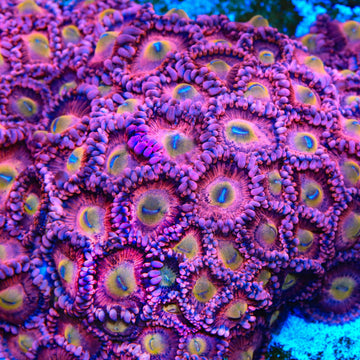
Nuclear Green Montipora Digitata Coral
Overview
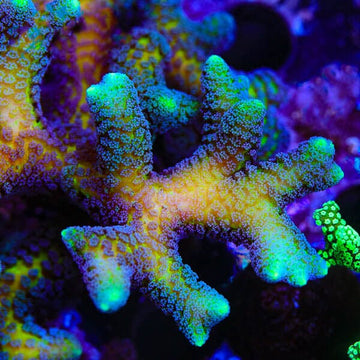
Nuclear Green Montipora Digitata Coral displays bright neon-green, finger-like branches with fine surface texture. Montipora digitata is a small-polyp stony branching coral that prefers moderate to strong light and moderate water flow for steady growth. It relies mainly on symbiotic algae for nutrition but can benefit from occasional small-particle foods, which may support color and polyp extension. Place high on stable rockwork with room for upward growth, and avoid direct contact with aggressive corals to prevent tissue damage.
Quick Facts
Care
Moderate
Lighting
Moderate–High
Flow
Moderate–High
Placement
Mid–High
Temperament
Peaceful (3–4 inches spacing)
Recommended Parameters
Temp
76–80°F
pH
8.1–8.4
Salinity
1.025–1.026
Calcium
400–450 ppm
AlkAlkalinity
7.5–9 dKH
Magnesium
1250–1350 ppm
Feeding
photosynthetic (primary), microplankton, phytoplankton, rotifers, copepod nauplii, bacterioplankton, marine snow, powdered SPS coral foods, amino acid supplements
Care & Placement
FAQ
Frequently Asked Questions
About the Nuclear Green Montipora Digitata Coral
-
Why does my Nuclear Green Montipora digitata grow thick, stubby branches in one tank and thin, fast branches in another?
Branch morphology tracks flow and nutrients. Strong, chaotic flow with moderate nutrients yields thicker, compact tips; laminar flow and lean nutrients push taller, slender growth. If branches are shading the base, prune selectively and rotate the colony to preserve tissue at the foot. Aim for pulsed, alternating flow to prevent dead spots and keep polyps active along the whole branch. -
My colony’s neon green is fading to dull olive despite stable alkalinity and calcium—what’s the likely cause?
Color loss often comes from spectral mismatch or nutrient imbalance. This morph responds well to strong blue-violet (420–450 nm) with moderate overall PAR rather than only white-heavy lighting. Keep phosphate detectable (around 0.03–0.08 ppm) to avoid pale tissue, and consider small, regular trace replenishment (especially iron) if you export aggressively. Stabilize salinity and temperature to keep pigments consistent. -
How can I propagate M. digitata to keep shape and color without stressing the colony?
Frag branches at junctions using bone cutters, not twisting, to avoid micro-fractures. Mount frags horizontally if you want multiple vertical shoots, or upright for single spires. Use fresh, thin cyanoacrylate and set frags in moderate, cross-flow to prevent tissue slime from settling. Start new pieces slightly lower in light, then raise over a week to prevent tip burn or sudden polyp retraction. -
What’s a subtle early sign of montipora-eating nudibranchs, and how do I respond without tearing down the system?
Look for tiny scalloped bite marks near branch undersides and unusually nocturnal polyp retraction at just a few tips. Remove affected branches for an iodine dip, brush egg spirals, and inspect nightly with a flashlight. A targeted wrasse can help patrol, but manual checks catch outbreaks earliest. Repeat dips on separated frags every 5–7 days until no new bites appear.