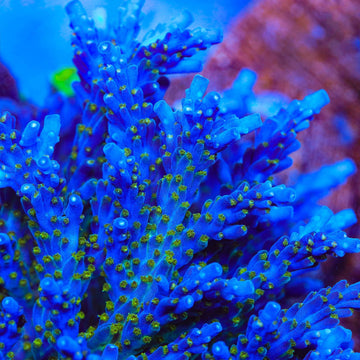
Lunar Lemonade Acropora Coral
Overview
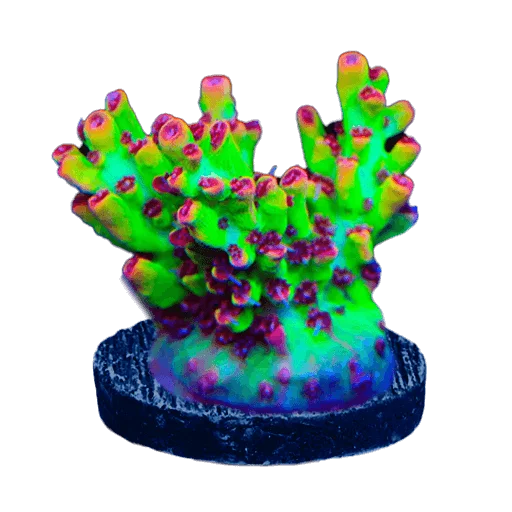
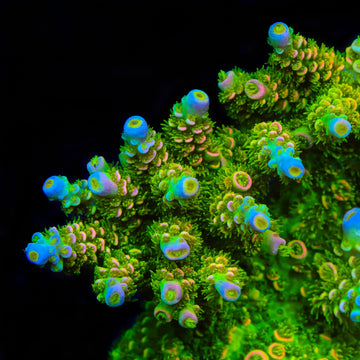
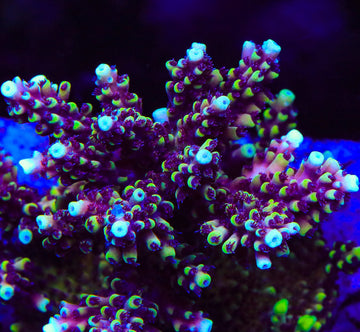
Lunar Lemonade Acropora Coral shows bright yellow-green branching with tight axial corallites and contrasting polyps. Acropora tenuis is a small-polyp stony branching coral that prefers strong light and high, turbulent water flow. It relies mainly on symbiotic algae for energy but benefits from occasional small, particulate foods, which can support growth and color. Place high on stable rockwork with space for vertical and lateral growth, and keep clear of aggressive corals with long sweepers.
Quick Facts
Care
Difficult
Lighting
High
Flow
High
Placement
High
Temperament
Peaceful (3–4 inches spacing)
Recommended Parameters
Temp
76–80°F
pH
8.1–8.4
Salinity
1.025–1.026
Calcium
420–450 ppm
AlkAlkalinity
7.5–9 dKH
Magnesium
1280–1350 ppm
Feeding
photosynthetic (primary), microplankton, rotifers, copepod nauplii, oyster eggs, powdered coral foods (e.g., Reef-Roids), amino acid supplements, dissolved organics
Care & Placement
FAQ
Frequently Asked Questions
About the Lunar Lemonade Acropora Coral
-
How do I keep the “Lunar Lemonade” yellow tones on Acropora tenuis without it turning green or brown?
Aim for PAR 300–450 with strong blue/UV, moderate white. Keep nutrients non-zero: NO3 ~5–15 ppm, PO4 0.03–0.08 ppm. Too lean drives pastel/washed tips; too rich deepens green/brown. Maintain alk 8–9 dKH with minimal swing. Trace balance matters—iron and potassium influence yellow/blue; test and dose cautiously to avoid color shifts. -
My tenuis is paling at the tips—burn, growth, or light shock?
If tips are evenly pale with good polyp extension, that’s normal new growth. Burn shows stark white, receded tissue and reduced extension; reduce PAR 10–20% and increase flow. Light shock follows a rapid light increase; use screen/acclimation mode over 2–3 weeks. Confirm alk stability and avoid rapid nutrients drops. -
Best way to mount and shape this coral for dense corymb growth?
Encourage a wide base first. Mount frags at a slight angle or horizontally so multiple axial corallites form, then raise light/flow once it encrusts. Space 3–4 inches from neighbors to avoid shading. Turbulent, alternating flow that sweeps all sides prevents dead zones and promotes tight, branching clusters rather than spindly vertical shoots. -
Are there pests this coral is especially sensitive to, and how can I catch them early?
Watch for AEFW (bite marks, oval eggs on undersides) and red bugs (tiny orange dots on polyps). Dip new frags (e.g., iodine, Bayer alternatives) and inspect with a jeweler’s loupe. AEFW eggs resist many dips—scrape or cut affected areas. Stable nutrients and strong flow support recovery after treatments; avoid stacking dips with major parameter changes.