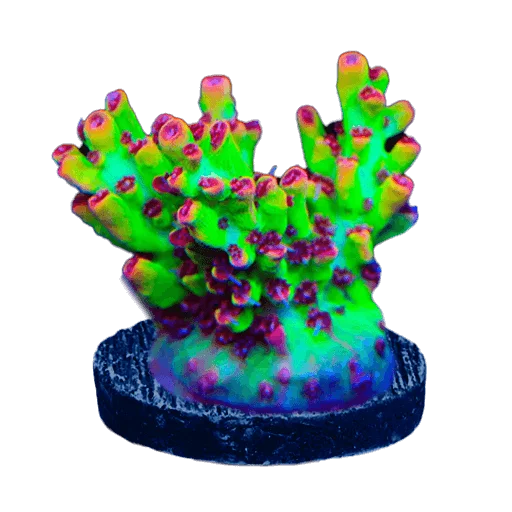
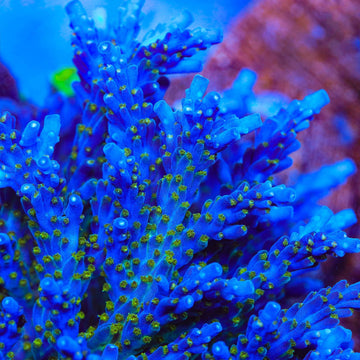
Little Red Ferrari Acropora Coral
Overview
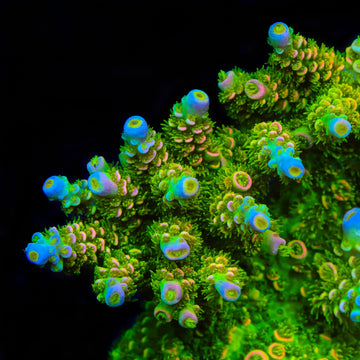
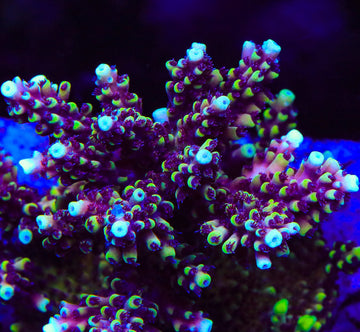
Little Red Ferrari Acropora Coral shows bright red branch tips with tight radial corallites on a branching skeleton. Acropora tenuis is a small-polyp stony coral that prefers strong light and high, turbulent flow. It relies mainly on symbiotic algae for energy, and occasional small-particle foods can support growth and color. Place high on stable rockwork with room for upward growth, and keep clear of aggressive neighbors.
Quick Facts
Care
Difficult
Lighting
High
Flow
High, turbulent
Placement
High
Temperament
Semi-aggressive (2–3 inches spacing)
Recommended Parameters
Temp
76–80°F
pH
8.1–8.4
Salinity
1.025–1.026
Calcium
420–450 ppm
AlkAlkalinity
7–9 dKH
Magnesium
1280–1350 ppm
Feeding
photosynthetic (primary), microplankton, rotifers, copepod nauplii, oyster eggs, reef roids, amino acids, phytoplankton
Care & Placement
FAQ
Frequently Asked Questions
About the Little Red Ferrari Acropora Coral
-
Why did my Little Red Ferrari Acropora fade from deep red to pink or brown?
Color shifts usually track light spectrum, nutrients, and key traces. Aim for PAR 250–400 with strong blue/violet (400–460 nm) and minimal warm white. Keep NO3 at 5–15 ppm, PO4 at 0.03–0.08 ppm, alkalinity 7.5–8.5 dKH, potassium 380–420 mg/L, and iodine 0.03–0.06 ppm. Avoid rapid changes; ramp lighting over 2–3 weeks after introduction or moves. -
How should I place it to prevent base shading and slow tissue loss?
A. tenuis encrusts before branching, then self-shadows. Mount slightly angled with 6–8 inches clearance, and provide cross-current, turbulent flow from multiple directions. Periodically prune inner or downward branches to open light paths. Consider side or back lighting to reach the base. Stable nutrients and alkalinity reduce basal STN risk when the colony becomes dense. -
My polyp extension stalled after great initial growth—what could be wrong?
Check for early pests (tiny bite marks, sand-like eggs) indicating AEFW or red bugs. Use a dip and magnification to confirm. If clean, review flow (increase random turbulence), nighttime feeding (amino acids or fine zooplankton 1–2x weekly), and micro-imbalances—especially potassium and iodine. Also rule out abrupt alkalinity or temperature shifts; even brief swings can suppress PE for days. -
How do I respond to sudden tissue loss on this coral?
First, stabilize parameters and increase aeration and flow. Start fresh carbon, halt major adjustments, and perform an iodine or antiseptic dip. Frag healthy tips above the recession line and remount. Inspect for pests and remove any detritus trapped within branches. Maintain moderate light for a few days, then return to target PAR once recession stops and polyps resume.