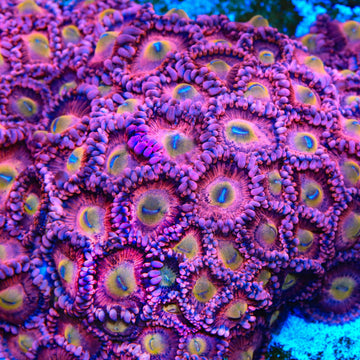
JF Yellow Submarine Favia Coral
Overview
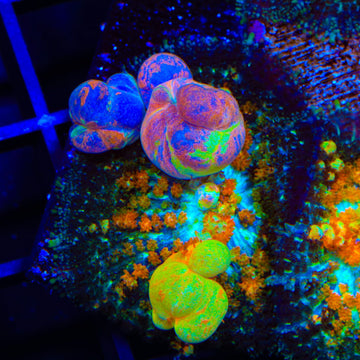
JF Yellow Submarine Favia Coral shows bright yellow polyps with contrasting ridges and a dome-shaped, multi-polyp surface. Favia favus is a stony brain coral forming encrusting to massive colonies; it does well under moderate lighting and low to moderate, steady water flow. It is photosynthetic via symbiotic algae but accepts small meaty foods at night, which can support faster growth and maintain color. Place with space from neighbors, as it extends nighttime sweeper tentacles that can sting nearby corals.
Quick Facts
Care
Easy
Lighting
Low–Moderate
Flow
Moderate indirect
Placement
Low–Mid
Temperament
Semi-aggressive (3–6 inches spacing)
Recommended Parameters
Temp
76–80°F
pH
8.1–8.4
Salinity
1.025–1.026
Calcium
400–450 ppm
AlkAlkalinity
8–9.5 dKH
Magnesium
1250–1350 ppm
Feeding
photosynthetic, mysis shrimp, enriched brine shrimp, copepods, rotifers, microplankton, marine snow, coral-specific powdered foods
Care & Placement
FAQ
Frequently Asked Questions
About the JF Yellow Submarine Favia Coral
-
How do I keep the yellow coloration on the JF Yellow Submarine Favia from fading or browning?
Maintain moderate PAR (120–180) with a blue-leaning spectrum; excessive white light can wash yellow. Keep nutrients non-zero but controlled (nitrate 5–15 ppm, phosphate 0.03–0.1 ppm). Strong, chaotic flow can stress tissue—aim for gentle, indirect movement. Stable alkalinity (8–9 dKH) and frequent small feedings at night help pigment retention. Avoid rapid light changes; acclimate over 2–3 weeks. -
Why does it sting neighbors at night even when daytime tentacles look short?
Favia favus deploys long nocturnal sweeper tentacles, often 2–5 cm, especially under higher flow or when defending territory. Give 3–4 inches of clearance all around, more down-current. Carbon and good skimming can reduce allelopathic stress, but spacing is the real fix. If space is tight, place less aggressive corals up-current and keep nutrients stable to reduce chemical warfare. -
What’s the safest way to frag this strain without causing recession between corallites?
Use a diamond band saw and cut through the skeleton precisely between corallites, avoiding shared walls. Dip fragments in iodine or chlorhexidine-based coral dips to limit infection. Mount on stable plugs with low-flow recovery for 5–7 days. Feed lightly at night to encourage healing. Avoid heavy handling during high-alk swings; plan frags after a week of parameter stability. -
My colony inflated then receded around the base—what’s the likely cause and fix?
Common triggers include alk swings, vermetid snail irritation, or bacterial insult after minor damage. Test alkalinity and correct slowly (no more than 0.5 dKH/day). Remove vermetids and trim their tubes. Siphon detritus from the base, increase gentle flow, and perform an iodine dip. If tissue lifts, stabilize on a flat, clean surface and reduce light 20% for a week, then gradually restore.